Showing posts with label Happy Jacks. Show all posts

Monday, April 19, 2021

Chapter 71: Ashes to Ashes (April - September 1982)

23 April 1982

The Yardbirds - Axe Ivy
Released: 23 April 1982
Recorded: September 1981 - January 1982
Producer: Robert Plant and Jimmy Page

Track listing[1]
Side A
Burning Down One Side
Moonlight in Samosa
Pledge Pin
Fool in the Rain
Mystery Title

Side B
Worse Than Detroit
Fat Lip
Sea of Love
Swan Song

The Yardbirds' first album of the 1980s, the long-awaited follow up to In Through the Out Door, brought back the return to their rock roots with some rhythm and blues influence. Among them was a cover version of Phil Philips' 1959 hit "Sea of Love", which was released as a single shortly before the release of Axe Ivy, peaking at #3 in the United States. However, it did not chart as well in the United Kingdom, at a comparatively lowly #56. But even that didn't stop the album from topping the charts there (it stalled out at #2 in the United States, kept out of the top spot by Fleetwood Mac's Mirage).

JOHN BONHAM: "The album title Axe Ivy was a play on words; it was the Yardbirds' fourteenth album, and in Roman numerals, it's X-I-V [pronounced "acks"-"eye"-"vee"]. Get it? I came up with it myself; no one else had a good enough idea for the title, so it stuck." (2007)

Axe Ivy received generally positive reception from critics and fans, being regarded as a return to form for the Yardbirds, and the tour that followed up ensured that they would stick around for a long time and still hold their place in the rock and roll world.

14 May 1982

The Clash - Rat Patrol from Fort Bragg
Released: 14 May 1982
Recorded: 1980, September 1981 and November 1981 - January 1982
Producer: The Clash

Track listing[2]
Side A
Straight to Hell
Know Your Rights
Rock the Casbah
Red Angel Dragnet

Side B
Should I Stay or Should I Go
Ghetto Defendant
Sean Flynn

Side C
Car Jamming
The Beautiful People Are Ugly Too
Atom Tan
First Night Back in London

Side D
Inoculated City
Death is a Star
Cool Confusion
Idle in Kangaroo Court

For the past few years, the Clash was one of Apple's most successful punk rock groups, and proved to critics and listeners that they were willing to put anything in their music. Even the most stupid-sounding shit, they turned to gold. But by the end of 1981, the cracks in their relationship were beginning to show.

JOE STRUMMER: "We were basically in two camps by that point; me and Paul [Simonon] on wanting to return to our more punk roots, and Mick [Jones] and Topper [Headon] wanting to continue evolving our sound. It didn't help that Topper was in the midst of a drug addiction." (1997)

MICK JONES: "I was unhappy; I felt estranged from the rest of the group and I was living with Ellen [Foley; his then-girlfriend] in New York. I thought, 'This must have been how Paul McCartney felt when he felt estranged from John, George and Ringo in the early 70s.' It felt like lightning was about to strike twice at Apple Records." (2009)

The Clash in Philadelphia, 1982.
Between January and March, the Clash embarked on their Far East Tour in Japan, Australia, New Zealand, Hong Kong and Thailand. Shortly afterward, they returned to London to listen to the music recorded in New York and decide what to do with the material. In the middle of arguing over how their next album should sound, they heard the news of a tragedy from the other side of the pond.

PAUL SOLOMON: "One of us caught a newspaper article saying that Ozzy Osbourne had choked on his own vomit. What really got to all of us was what Randy Rhoads said concerning his final words to Ozzy. 'You'll kill yourself, you know? One of these days.' It was very damning to read, and that made us realize that one of us could drop dead and we'd live the regret of never making up with him before then. We felt closer as a group, realizing that if we were to stay together, we'd have to cut the crap and make the album that all of us wanted to put out. And after that, we'd take a break for a while." (2007)

Rat Patrol from Fort Bragg came out that May, backed by singles "Know Your Rights" (#30 UK), "Rock the Casbah" (#14 UK, #5 US) and the double A-side, "Should I Stay or Should I Go"/"Straight to Hell" (#10 UK, #37 US), respectively released 23 April, 11 June and 17 September. The album topped the charts in the United Kingdom and peaked at #4 in the United States, becoming the Clash's best selling album to date. As the band was taking a hiatus to sort out their differences and drug problems, it would be a while before the world heard from them again.

Meanwhile, the original album art depicting the execution of Viet Cong member Nguyễn Văn Lém in 1968, photographed by Eddie Adams, sparked controversy due to insensitivity despite that it expressed the direct lyrical references to the Vietnam War and the notion of "urban warfare" that were prominent in the album. In wake of the controversy, the cover was replaced by a band photo.

25 June 1982

Fleetwood Mac - Mirage
Released: 25 June 1982
Recorded: November 1981 - March 1982
Producer: Fleetwood Mac, Richard Dashut and Ken Caillat

Track listing[3]
Side A
Love in Store
Dirty Creature
That's Alright
Log Cabin Fever
Gypsy
Only Over You

Side B
Take a Walk
Straight Back
Put a Candle in the Window
If You Were My Love
Hello Sandy Allen
Wish You Were Here

Fleetwood Mac's first album since 1977's Rumours had come out the week following Crosby, Stills & Nash's Daylight Again under Apple Records, and it was their first to feature Neil Finn as guitarist and vocalist. Mirage carried on with the band's soft rock sound from Rumours and topped the charts in the United States for five weeks, and topped out at #3 in the United Kingdom. Finn's "Dirty Creature", Stevie Nicks' "Gypsy" and Christine McVie's "Love in Store" were all Top 20 hits in the United States.

MICK FLEETWOOD: "It was just before Mirage came out when Lindsey reached out to me and John a few days after Ozzy Osbourne was declared dead from excessive drinking. I could see that he clearly regretted his behavior following the aborted Tusk sessions, and it seemed as if a few years away from us had given him a lot of time to work on his behavior." (1998)

STEVIE NICKS: "Christine and I were reluctant to let him back into the band - Neil didn't have an opinion on the matter, for he stayed to the sides to see what would unfold. Lindsey had hurt Christine the most, and she was afraid of being in the same recording studio as him, just in case he had another meltdown. But still, we gave Lindsey the benefit of the doubt and let him join us for our short American tour." (2014)
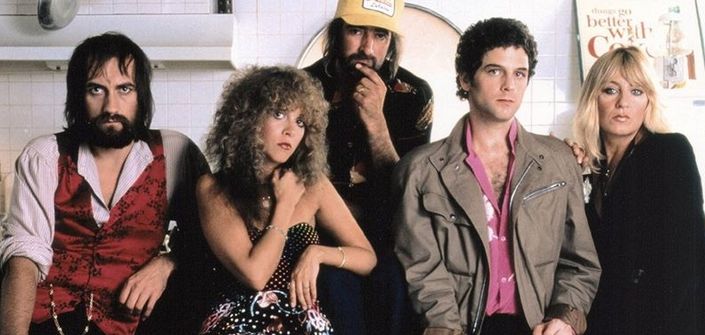
Fleetwood Mac, 1982. Not pictured: Neil Finn.
Lindsey Buckingham's return to Fleetwood Mac for their Mirage Tour (September 1 - October 31) also coincided with the band headlining the first US Festival in San Bernardino on September 5, for which they were paid half a million dollars. Among other artists during September 3-5 included the Ramones, Talking Heads, Dave Edmunds, the Cars, Pat Benatar and Tom Petty & Mudcrutch, some of whom were under Apple Records or its two subsidiaries, Highway 61 or Swan Song.[4]

The tour was met with a few hiccups, but fortunately, none were connected to band relations. On October 5, Stevie Nicks' best friend, Robin Anderson, had died from leukemia at the age of 34, following a pregnancy leading to a premature birth to a baby boy, Matthew - thankfully, he survived. After the death of Robin, Nicks would give off some of her most electrifying, heartfelt performances as a tribute to her fallen friend, later impulsively marrying her widower Kim Anderson in 1983, thinking that it would be best for Matthew. Sadly, Stevie and Kim would separate after only three months, and divorce by 1984.

Around the time of Robin's death, two shows were postponed when Nicks suffered from walking pneumonia, but soon recovered. The October 22 show at The Forum in Inglewood was filmed and later released under the title Fleetwood Mac In Concert - Mirage Tour '82 under Apple Films. Lindsey Buckingham would remember that for just about every show, it felt as though he had never left to begin with, finally being integrated back into the band. When asked what Fleetwood Mac's plans for the future were, he said, "Who knows? We might do another album. Hopefully it won't take five years to put out!"

Summary of Fleetwood Mac releases, 1982
  • "Dirty Creature"  / "That's Alright" - 11 June 1982 (#85 UK, #14 US)
  • Mirage - 25 June 1982 (#3 UK, #1 US)
  • "Gypsy" / "Cool Water" - 4 September 1982 (#34 UK, #7 US)
  • "Love in Store" / "Take a Walk" - 18 October 1982 (#10 US)
  • "Hello Sandy Allen" / "Only Over You" - 12 December 1982 (#71 UK)

4 September 1982
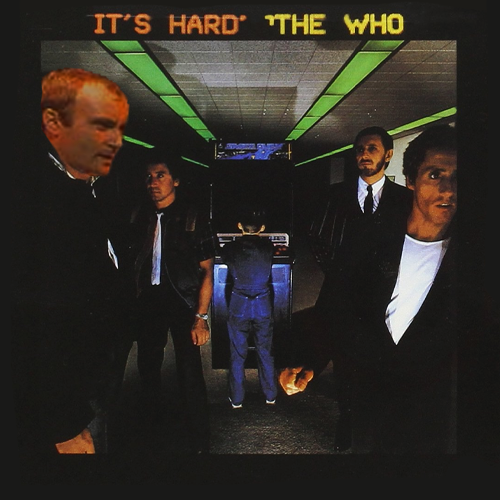
The Who - It's Hard
Released: 4 September 1982
Recorded: June 1982
Producer: Glyn Johns

Track listing[5]
Side A
Athena
It's Your Turn
Cooks County
It's Hard
Dangerous
Eminence Front

Side B
I've Known No War
One Life's Enough
One at a Time
Why Did I Fall for That
Man on the Corner
Cry If You Want

The Who's second post-Keith Moon album, It's Hard (#11 UK, #8 US), received polarizing reviews from critics. Some praised it and even considered it a spiritual sequel to Lifehouse from a decade prior, while others condemned the album, some even going so far as to say Phil Collins had "ruined" the Who. Having a solo career alongside his position as their drummer likely didn't help the hostility towards Collins either. "Athena" backed with the non-album B-side "A Man is a Man" was released as a single at the same time as It's Hard, reaching #40 in the United Kingdom and #28 in the United States. Neither of the follow up singles - "Eminence Front" (25 December 1982) and "It's Hard" (February 1983) - reached the Top 40 in either country.

PHIL COLLINS: "It was a pretty miserable time to be a part of the Who; Pete [Townshend] was depressed, often under heroin and constantly fighting with Roger [Daltrey] and John [Entwistle] over what to play on stage. I just sat there and let everything unfold. I almost regretted leaving Genesis in the first place, wondering what might have happened had I decided to stay with them." (2002)

The Who would embark on a farewell tour in North America with the Yardbirds as support, with the final show taking place on December 17 in Toronto, Canada.[6] Pete Townshend would spend part of 1983 writing new material for a potential follow-up to It's Hard, but was unable to come up with music that would be good enough for the Who to record, and so on 16 December 1983, he announced his departure from the Who, which ended the band for good. This left Phil Collins free to focus on his solo career for the remainder of the 1980s, although he would still play with them for live performances up until 1989.[7]

Footnotes
  1. "Fool in the Right" is sourced from In Through the Out Door, "Sea of Love" from The Honeydrippers: Volume One, and "Swan Song" is "Midnight Moonlight" from The Firm. The remaining tracks all come from Robert Plant's solo album Pictures at Eleven.
  2. Track listing is based upon what Mick Jones proposed for Rat Patrol from Fort Bragg before it was pruned down to become Combat Rock. The four outtakes ("The Beautiful People Are Ugly Too", "First Night Back in London", "Cool Confusion", "Idle in Kangaroo Court") can be found on the 2013 box set Sound System.
  3. Neil Finn's tracks ("Dirty Creature", "Log Cabin Fever", "Take a Walk", "Hello Sandy Allen") are all taken from Time and Tide, due to Split Enz breaking up earlier than in OTL. The remaining tracks are sourced from OTL's Mirage, with "Put a Candle in the Window" and "If You Were My Love" being outtakes from the same sessions, found on the 2016 deluxe edition. The latter track was eventually re-recorded for Stevie Nicks' 24 Karat Gold: Songs from the Vault in 2014.
  4. This actually happened in OTL, except it was during Lindsey Buckingham's final tour with Fleetwood Mac until 1997.
  5. "Man on the Corner" is sourced from Genesis' Abacab, taking the place of "A Man is a Man". Otherwise, It's Hard follows the exact same track listing as OTL. In addition, Roger Daltrey takes lead vocals on "Man on the Corner" while Phil Collins sings co-lead on "Cooks County" instead of Pete Townshend.
  6. In OTL, the Clash went on tour with the Who; because of the former taking a hiatus by that point, the Yardbirds take their place instead.
  7. In OTL, Kenney Jones played with the Who for one-off performances at Live Aid in 1985 and at the BPI Awards Ceremony in 1988, as well as their 25th anniversary tour in 1989. He was not, however, invited for their performance at the Rock and Roll Hall of Fame Induction Ceremony in 1990, and in 1996, Zak Starkey became the Who's new touring drummer starting with their Quadrophenia Tour. With Phil Collins on board, all of this will happen.
Author's Comments

Not much to comment on here; a fair number of storylines are coming to close. The Yardbirds' 1980s discography will draw parallels to Robert Plant's (I mean, he is the lead singer of Led Zeppelin, after all), and those of the Clash and Fleetwood Mac will be revisited once more in 1985 in universe. The Who's storyline is just about finished barring their appearance at Live Aid, which I'm sure most of you can predict, but we will hear from Phil Collins once more in 1985.

Monday, February 8, 2021

Chapter 68: In the Air Tonight (February - September 1981)

13 February 1981

Phil Collins - Face Value
Released: 13 February 1981
Recorded: June 1980 - January 1981
Producer: Phil Collins and Hugh Padgham

Track listing[1]
Side A
In the Air Tonight
This Must Be Love
Misunderstanding
The Roof is Leaking
Droned
Hand in Hand

Side B
I Missed Again
You Know What I Mean
Thunder and Lightning
I'm Not Moving
If Leaving Me is Easy
Me and Virgil

Phil Collins' post-Genesis career had started when he became the new drummer for the Who following the death of Keith Moon in 1978. Afterward, he had been hoping to fix up his marriage with his wife Andrea Bertorelli who complained that he was rarely at home enough, and the cracks further widened between them during Genesis' And Then There Were Four Tour. Collins had been hoping that, with Genesis on the cusp of international breakthrough, the tour would help to pay dividends for the future. But then he left Genesis for the Who, with Kim Beacon taking over on drums for the former. Collins, meanwhile, had moved his family to Vancouver, Canada to save his marriage with Bertorelli, but they ended up returning to England instead.

PHIL COLLINS: "My life seemed to be in a never-ending hell by that point. I played on stage with the Who, but then... Cincinnati happened. Everyone was in low spirits by that point, but I seemed to get the brunt of it. Pete [Townshend], John [Entwistle] and Roger [Daltrey] were going for solo projects at that point, so I figured, what the heck." (1996)[2]

Hugh Padgham (center) at the mixing console, date unknown.
Collins teamed up with Hugh Padgham, with whom he was familiar with having worked on Peter Gabriel's third solo album, Melt, for his first solo album, Face Value. Much of the writing was inspired from his divorce from Bertorelli, and the album served as an outlet for his feelings. Among the songs recorded was his own solo version of "Misunderstanding", having previously featured on Genesis' Duke the year prior. Another song from the sessions, "Please Don't Ask" would later end up on the Who's first post-Moon album.

Upon release, Face Value became an immediate success, quickly reaching #1 in the United Kingdom (and #7 in the United States) before being knocked off of the top spot by the Beatles' Quadruple Fantasy. Likewise, the lead single from January, "In the Air Tonight"/"The Roof is Leaking" (#2 UK, #19 US), was kept off of the top spot by "Blow Away". The next two singles, "I Missed Again" (#14 UK, #19 US) and "If Leaving Me is Easy" (#17 UK), were also Top 20 hits in the United Kingdom, showing promise for a solo career by the former drummer for Genesis and current drummer for the Who.

The follow-up album, Hello, I Must Be Going! (#2 UK, #8 US), would be released 5 November 1982, featuring popular tracks such as "Thru These Walls", "You Can't Hurry Love", "I Don't Care Anymore" and "Don't Let Him Steal Your Heart Away".

16 March 1981

The Who - Face Dances
Released: 16 March 1981
Recorded: July - December 1980
Producer: Bill Szymczyk

Track listing[3]
Side A
You Better You Bet
Don't Let Go the Coat
Cache Cache
The Quiet One
Did You Steal My Money

Side B
Please Don't Ask
I Like Nightmares
Daily Records
You
Another Tricky Day

PETE TOWNSHEND: "So, we had just come out with our first album with Phil, and then we get kicked off of the top of the charts in our home country by his own solo project, and he's now our drummer! And then the Beatles reunite and further deny us the top spot. Fucking hell..." (1981)

At the time, Pete Townshend's reaction was that of frustration when the Who's Face Dances (#2 UK, #4 US) was first released. However, in retrospective years, he would admit that Collins' Face Value was actually quite good and even claimed to have liked a few songs off of the Beatles' Quadruple Fantasy. Still, "You Better You Bet"/"The Quiet One", when released that March, was a successful hit on both sides of the Atlantic (#9 UK, #18 US), and was even one of the first music videos shown on the newly-launched MTV. The second single, "Don't Let Go the Coat"/"How Do You Do It Alone" (#47 UK, #84 US), released that May, did not chart as highly.

May 5, 1981

Tom Petty & Mudcrutch - Hard Promises
Released: May 5, 1981
Recorded: 1980 - 1981
Producer: Jimmy Iovine and Tom Petty

Track listing[4]
Side A
The Waiting
A Woman in Love (It's Not Me)
Nightwatchman
Something Big
Gator on the Lawn
Kings Road

Side B
Letting You Go
Worried Guy (Insomnia)
A Thing About You
Insider
The Criminal Kind
You Can Still Change Your Mind

The working title for Tom Petty and Mudcrutch's fifth album was going to be Benmont's Revenge, referring to keyboardist Benmont Tench, but it was changed up to a more marketable title, Hard Promises. The album hit #2 in the United States, kept out of the top spot by Quadruple Fantasy, while hitting #23 in the United Kingdom. The first single released in April, "The Waiting"/"Nightwatchman" (#8), was a Top 10 hit, while the second single from June, "A Woman in Love (It's Not Me)"/"Stop Draggin My Heart Around (demo)" (#54 US) barely made the Top 60.

During the recording sessions, John Lennon made a visit to the studio and Tom Petty recalled the meeting very fondly, even giving him a shout-out on the back cover of Hard Promises.[5] Two months following the release of Hard Promises, Stevie Nicks' debut single from Bella Donna, "Stop Draggin' My Heart Around" (#31 UK, #2 US) featuring Petty and Mudcrutch, was released, kicking off a strong solo career from one of Fleetwood Mac's vocalists.

18 September 1981

Genesis - Abacab
Released: 18 September 1981
Recorded: March - June 1981
Producer: Genesis

Track listing[6]
Side A
Abacab
No Reply At All
Me and Sarah Jane
Naminanu

Side B
Dodo/Lurker
You Might Recall
Don't Tell Me
Like It or Not
Paperlate

In November 1980, Genesis had bought a new recording studio in Chiddingfold, Surrey that they named The Farm. They convened there in March the following year to record their follow-up to last year's Duke. With that album being successful commercially, how were they possibly going to top it?

KIM BEACON: "Working in a different environment was pretty relaxing for us; recording material at The Farm ensured that we wouldn't get distracted that much and we could do our jobs in peace. We had recorded more than enough material for a double album, but we ended up whittling it down to a single album instead." (1997)

TONY BANKS: "We wanted to avoid going for the musical clichés associated with Genesis by that point; tambourines during a chorus, reprises, extended solos, lengthy instrumental passages. Just keep the melody simple. Abacab was our least technical album at the time." (2006)

For the first time since 1974's The Lamb Lies Down on Broadway, Genesis did not bring forth longtime producer David Hentschel. In fact, they didn't bring forth an outside producer at all. For the first time, they would be self-producing, although they would bring in Glyn Johns as engineer.[7]

Tony Banks performing live with Genesis, 1981.
Upon initial release, Abacab topped the charts in the United Kingdom and reached #3 in the United States. Reception from critics and fans was generally positive, with many noting that the tracks simultaneously called back to their past and looked forward to the future. Three of the leftover tracks - "Keep It Dark", "Who Dunnit" and "Another Record" - would eventually be released on 21 May 1982 as part of an extended play, 3x3, focusing on the more experimental tracks from the sessions. The Abacab Tour ran from September to December 1981, later leading to Three Sides Live the following year.

Summary of Abacab single releases, 1981-1982:
  • "Abacab" / "Like It or Not" - 14 August 1981 (#5 UK, #15 US)
  • "No Reply at All" / "Me and Sarah Jane" - 9 September 1981 (#20 US)
  • "Paperlate" / "You Might Recall" - 23 October 1981 (#15 UK)
  • "Don't Tell Me" / "Submarine" - 5 March 1982 (#41 UK, #40 US)

Footnotes
  1. All tracks are sourced from OTL's Face Value, excluding "Me and Virgil", sourced from Genesis' 3x3 extended play. "Misunderstanding" is the live version found on the deluxe version of Face Value. ("Misunderstanding" also had origins from the sessions, later included on Duke.) In OTL, Phil Collins recorded a cover of "Tomorrow Never Knows" as a tribute to John Lennon following his murder; Collins even sings a snippet of "Over the Rainbow" referencing the murder as a hidden track. If Lennon was still alive by February 1981, then Collins would've had no reason to record a Beatles cover.
  2. Pete Townshend put out Empty Glass, which dealt with issues he was struggling with following Keith Moon's death, with much of the album sounding like the Who. John Entwistle's Too Late the Hero was being recorded alongside Face Dances, and Roger Daltrey starred in the drama film McVicar and released a solo album of the same name, featuring Townshend and Entwistle on same tracks.
  3. The track listing for Face Dances is mostly unchanged, but with "How Can You Do It Alone" replaced with "Please Don't Ask" from Genesis' Duke and "I Like Nightmares", a bonus track from the 1997 reissue of Face Dances. Phil Collins sings lead vocals on "Please Don't Ask" much like OTL.
  4. All tracks from Hard Promises are included. "Gator on the Lawn" is sourced from the box set Playback, and "Worried Guy (Insomnia)" remains officially unreleased.
  5. This almost happened in OTL; John Lennon was scheduled to be in the same studio at the same time as Tom Petty and the Heartbreakers during the recording of Hard Promises, but the meeting never took place due to Lennon being murdered before the planned visit. Petty and the band would then pay tribute to him by etching "WE LOVE YOU J.L." in the runout deadwax on early North American pressings.
  6. All tracks are sourced from OTL's Abacab, excluding "Naminanu", the B-side to "Keep It Dark" and originally the opener to the four-part "Dodo/Lurker" suite, "You Might Recall" and "Paperlate", both from 3x3, and "Don't Tell Me" from Kim Beacon's Talking to Myself. All lead vocals are by Beacon. From this album on, without Collins' (and by extension, Hugh Padgham's) influence, it becomes easier to separate a Genesis album from a Phil Collins solo album.
  7. For Abacab, as well as Genesis (1983) and Invisible Touch (1986), Hugh Padgham was co-producer. As mentioned, without Padgham's influence, the public is more likely to separate Phil Collins' solo career from Genesis' 1980s onward output.
Author's Comments

Yeah, I know; it's been a few weeks since the previous chapter. I've been very busy with a lot of other things at the moment, and this kind of got sidelined, so sorry about the delay, folks. I'm just glad that I got a chapter out at all.

Regarding Genesis, and speaking with Dan Martin about it, looking back, we probably should've gone for John Wetton (King Crimson, Roxy Music, U.K., Asia, etc.) from the get-go. Bringing in an obscure figure like Kim Beacon seemed like a good idea in theory, especially with how successful John Wetton's career was, but given how Kim had very little solo output in his entire career, and not to mention troubling behavior when it came to drugs and alcohol (according to Graham Forbes' Rock and Roll Busker), that turned out to be incredibly problematic. Fortunately, I've always intended to end the first draft at 1985, so this won't be as big a problem. That's going to be one of the major retcons I'll be making for The Second Coming. At the moment, we've got an extended play (3x3) and album (Genesis) to cover, as well as seven solo albums (two each from Mike, Tony and Kim, and one from Phil).

Monday, September 21, 2020

Chapter 58: Hotel California (February - September 1978)

February 10, 1978

Neil Young - Comes a Time
Released: February 10, 1978
Recorded: November 28, 1975 - November 21, 1977
Producer: Neil Young, David Briggs, Ben Keith and Tim Mulligan

Track listing[1]
Side A
Goin' Back
Comes a Time
Bite the Bullet
Lotta Love
Peace of Mind

Side B
Saddle Up the Palomino
Already One
Field of Opportunity
Motorcycle Mama
Four Strong Winds

Neil Young's latest album, Comes a Time (#42 UK, #7 US), was perhaps his most commercially accessible album in quite some time, marking a return to his folksy roots, including a cover of Ian Tyson's "Four Strong Winds" (#57 UK, #61 US) that was released as a single. Comes a Time received mostly positive reviews upon release. Young's last album of the 1970s, Rust Never Sleeps, would come out later in the year, for he would soon go on a lengthy tour with Crazy Horse of the same name.

Meanwhile, under the pseudonym Bernard Shakey, Young would co-direct a comedy film with Dean Stockwell called Human Highway, named for Crosby, Stills, Nash & Young's 1975 masterpiece, spending $3 million of his own money on production, but it would not be released until 1982 to negative critical reaction. Also starring in the film were Stockwell, co-writer Russ Tamblyn, famed actor Dennis Hopper, and newly-signed Swan Song Records band Devo, who would put out their debut album on August 28.

31 March 1978

Genesis - And Then There Were Four
Released: 31 March 1978
Recorded: September - October 1977
Producer: David Hentschel and Genesis

Track listing[2]
Side A
Down and Out
Undertow
Minute By Minute
Snowbound
Burning Rope

Side B
Deep in the Motherlode
Many Too Many
Scenes from a Night's Dream
Say It's Alright Joe
The Lady Lies
Follow You Follow Me

The following is excerpted from Kim Beacon's 2006 autobiography, Spotting a Night Bird, published under Apple Books:

"It was about a few hours before an official recording session for And Then There Were Four, that Phil and I were in the studio, and I was messing around a bit on a drum kit. I had played drums in the past, but I never really thought I was that great a drummer. Heck, I'd even told Phil that he was better at it than I was, even though we had dual drum kits when we toured as Genesis during 1976 and 1977. Mainly, I did percussion work like bongos, timbales, tambourine, cymbals, that sort of thing.

'How about a drum duet?' he suggested. 'Nothing all that serious, you understand; just something for a little bit of fun in the studio.'

'Alright, Phil,' I said. 'I'm game.' It would be a while yet before Mike, Tony and David [Hentschel] would arrive, so I thought that a drum duet between me and Phil would be a nice time killer. Sadly, we never thought about recording it, because if we had, then I bet people would really understand the fun we had behind the scenes.

Mine and Phil's drum duet, what we humorously dubbed as 'Collin for a Beacon' (get it?), was kind of akin to what Ralph Humphrey and Chester Thompson did with Frank Zappa and the Mothers of Invention for the live album Roxy and Elsewhere a few years prior. By the time the recording session began proper, Phil and I thought of switching things up a bit like myself playing drums on occasion - usually for one song at most - while Phil played on my set of percussion.

Phil Collins behind the drums, 1978.
The tour for And Then There Were Four, our first album as a quartet and with Daryl Stuermer as touring guitarist, began shortly before the album was released, lasting about eight months, and to say it was grueling would be a bit of an understatement. Especially for Phil. Of course, we did have breaks between legs, but I think he suffered more than the rest of us. His marriage with Andrea [Bertorelli] seemed to be faltering at the time, and he wasn't spending as much time as he wanted to with her or their baby son Simon.

It wasn't until after the final show of the tour in Osaka, Japan [3 December 1978] that Phil finally opened up to the rest of us.

'I'm sorry, guys,' he said, 'but my heart's just not into being part of Genesis anymore. I feel like I'm an absent father and I've recently offered my services as drummer to another band.'

Tony, Mike and I didn't know what to say at first, but after what felt like eternity, I walked over to Phil, my closest friend in the band, and hugged him. I'd noticed he'd been feeling distant for the past few weeks ago, especially when we began the North American leg at the end of September. It was a bit of a red flag in hindsight and we probably should've seen this coming. I was upset, mostly with myself for not noticing it sooner, but whatever Phil wanted to do, I was behind him all the way.

Eventually, Mike and Tony joined in the group hug as well. I can't remember how long it lasted, though there were tears in my eyes by the end of it. Some time afterward, Phil went to Vancouver to try and fix his marriage, though we still kept in close contact and even co-wrote a few songs that would later up either on Genesis albums or on solo projects either by me or by Phil. By the start of the new year, 1979, we soon discovered 'who' Phil was now the drummer for..."

Summary of Genesis releases, 1978
  • "Follow You Follow Me" / "Minute By Minute" - 25 February 1978 (#2 UK, #10 US)
  • And Then There Were Four - 31 March 1978 (#1 UK, #3 US)
  • "Many Too Many" / "The Day the Light Went Out" - 30 June 1978 (#14 UK, #26 US)

May 2, 1978

Tom Petty & Mudcrutch - Terminal Romance
Released: May 2, 1978
Recorded: 1977-1978
Producer: Pete Ham and Tom Petty

Track listing[3]
Side A
When the Time Comes
You're Gonna Get It
Hurt
You Don't Care
Magnolia
I Don't Know What to Say to You
Too Much Ain't Enough

Side B
I Need to Know
Listen to Her Heart
Save Me
No Second Thoughts
Restless
Long Way from Home
Baby's a Rock 'n' Roller

The third album under Tom Petty & Mudcrutch, Terminal Romance, did better than their previous album, American Girl, commercially (#28 UK, #16 US), even reaching gold status (half a million units sold), although it was ranked a notch lower than the latter album. The album's two singles, "I Need to Know"/"No Second Thoughts" (#26 US) and "Listen to Her Heart"/"I Don't Know What to Say to You" (#33 US), were also Top 40 hits after being released in June and August, respectively.

18 August 1978

The Who - Who Are You
Released: 18 August 1978
Recorded: September 1977 - April 1978
Producer: Glyn Johns and Jon Astley

Track listing[4]
Side A
New Song
Had Enough
905
No Road Romance
Sister Disco
Music Must Change

Side B
Trick of the Light
Guitar and Pen
Say It Ain't So, Joe
Love is Coming Down
Who Are You

PETE TOWNSHEND: "Ever since this little battle of the bands with the Rolling Stones ended back in 1972, we were feeling kind of burned out, if Who by Numbers was any indication. The Tommy film did really well, as did the 1976 tour, but we needed a break." (1996)

The last few years were generally a mixed bag for the members of the Who. Pete Townshend stayed at home with his family, Roger Daltrey put out a solo album called One of the Boys, and John Entwistle was planning a science-fiction rock opera of his own; it would concern a man given the identity number 905 and living with another man named 503, and both were absolutely identical. No women existed in the future because that was what they were eating, but Entwistle eventually scrapped the project, deciding that the story seemed too similar to the 1973 dystopian thriller Soylent Green.

But what about the Who's very own Jekyll and Hyde, Keith Moon? To him, going on tour meant that he would be very physically active, but having not done so since 21 October 1976 at Maple Leaf Gardens in Toronto, Moon was in a very unhealthy state, not helping that he had become obese. His drumming for a gig filmed on 15 December 1977 for a documentary was so lackluster that the footage remained in the vaults. To be fair to Moon, however, having not played as a group for over a year meant that the performance itself was weak overall.

The Who, 1978.
ROGER DALTREY: "Because of Keith's state, we agreed not to make any live performances for the immediate future. Pete had this idea for a sequel to Lifehouse and John had his Soylent Green-esque sci-fi story, but it was decided instead to make a standard album instead. The sessions were pretty hellish, not helping by the fact I had throat surgery. I think our personal lives may have affected our performance." (2006)

Tensions between the band and production grew had grown so intense that Townshend had planned to fire Moon unless he cleaned up his act. Taking this threat seriously, Moon attempted to kick his alcohol addiction and take his drumming skills with greater enthusiasm. Once recording for Who Are You had finally finished in April, the Who filmed another performance that May for the documentary, The Kids Are Alright. It was a much stronger performance overall than the one in December, and what made this performance stand out was that it was the last gig Keith Moon would perform with the Who.

Who Are You was a fast seller in both the United States (#2) and the United Kingdom (#6), although in the former country, it was left out of the top spot by the soundtrack to the movie Grease, starring John Travolta and Olivia Newton-John. The sole lead single, "Who Are You"/"Had Enough" (#18 UK, #14 US), was released on 14 July prior to the album.

7 September 1978
9 Curzon Square, formerly Curzon Place, 2012. Cass Elliot and Keith Moon died in apartment 12, a two-bedroom apartment, within four years of each other, both aged 32. Harry Nilsson also lived there before renting it out to Moon in 1978, thinking that the apartment was cursed.
KEITH MOON: "If you don't like it, you can fuck off!" (1978, his last words to girlfriend Annette Walter-Lax)

In mid-1978, Keith Moon had moved into Flat 12 at 9 Curzon Place, Shepherd Market, Mayfair, London, renting from Harry Nilsson. Cass Elliot of the Mamas and the Papas had died there four years ago at the age of 32 from heart failure. Nilsson was concerned about letting Moon live there, believing it was cursed. Townshend dismissed Nilsson's concerns by saying "lightning wouldn't strike the same place twice."

How wrong he would be...

On 6 September, Moon and his girlfriend Annette Walter-Lax, a Swedish model, were at a preview of The Buddy Holly Story, and afterward dined with Paul and Linda McCartney, who had also seen the film, at Peppermint Park in Covent Garden. Upon heading home, Moon watched The Abominable Dr. Phibes and asked Walter-Lax to cook him steak and eggs, to which she objected too. He then took thrity-two clomethiazole tablets and when Walter-Lax checked on him the following afternoon, Moon was dead.

Keith Moon during his last tour as drummer for the Who, 1976.
Moon had been given a prescription of Heminevrin (clomethiazole, a sedative) to try and overcome his alcohol withdrawal symptoms, and because of his fear of psychiatric hospitals, Moon insisted on doing it at home. Physician Geoffrey Dymond, who was unaware of Moon's lifestyle, had prescribed a bottle of a hundred pills, instructing him to take only one pill when he felt a craving for alcohol, but no more than three pills per day. Six of the thirty-two pills Moon had taken were digested, and that was enough to end his life.

Pete Townshend was the first to be informed about Moon's death, and he soon let Roger Daltrey and John Entwistle (the latter of whom was being interviewed in France at the time) know about what had happened. Now that Keith Moon had died before he could get old, the three remaining members of the Who were left wondering, what next? Would they carry on despite losing their friend, or would they break up out of respect for his legacy?

PHIL COLLINS: "Shortly after Moonie's demise, I was working with Pete Townshend at Oceanic in Twickenham, helping on tracks for an artist from New York he was producing, Raphael Rudd, a brilliant pianist and harpist. At the time Pete was running around London clubs with New Romantic gadabout Steve Strange. He wasn't in great shape, partying all night and recovering all day. Pete was still sleeping when I arrived at the studio for the session. But once he was up I grabbed him: "Who's gonna play drums for The Who now? 'Cause I'd love to do it.' 'Oh damn, we haven't thought of that.' It was a serious offer, and I was a little surprised but also happy and nervous. This meant that I had to leave Genesis to join Pete, Roger Daltrey and John Entwistle. This is The Who we're talking about, man! I grew up with that band. I just loved the energy and I know I could have done it and made it work. After Genesis finished the And Then There Were Four tour, I got to play with a set of childhood heroes full time. Meanwhile with Genesis, and now there were three." (A Stranger Like Me, 2011)[5]

Now that Genesis had been reduced to just Tony Banks, Mike Rutherford and Kim Beacon, the trio had planned on continuing despite Phil Collins' departure, with Beacon now taking the position as the band's drummer (as well as keyboards here and there). Beacon was initially nervous about becoming the new drummer for Genesis, but with encouragement from Banks and Rutherford as well as Collins' blessing, he gradually grew more comfortable with the position. Whenever the band would go on tour, Chester Thompson would be brought in to play the drums live. The now classic Genesis lineup was born.

Footnotes
  1. All tracks are sourced from Comes a Time, excluding "Bite the Bullet" and "Saddle Up the Palomino", both from American Stars 'n Bars.
  2. All tracks are sourced from ...And Then There Were Three..., excluding "Minute By Minute" which comes from Kim Beacon's Ravenna. In addition, Kim Beacon sings lead vocals on all of the tracks
  3. Terminal Romance was the original title for You're Gonna Get It!. All tracks from said album are included. "I Don't Know What to Say to You" is sourced from Playback and "You Don't Care", "Save Me" and the 1977 re-recording of "Long Way from Home" are all from the bootleg Mudcrutch and Solo Petty Outtakes, being recorded during the sessions for You're Gonna Get It!.
  4. All tracks are sourced from the 1996 remaster of Who Are You, excluding "Say It Ain't So, Joe", taken from Roger Daltrey's One of the Boys, which features Keith Moon on drums and John Entwistle on bass guitar. "Guitar and Pen" is the Olympic 1978 Mix and "Who Are You" is the Lost Verse Mix.
  5. The first half is verbatim from Phil Collins' 2016 autobiography, Not Dead Yet: The Memoir. The second half was re-written to reflect the events of TTL. In addition, Collins and Pete Townshend had played together on other people's records prior to Keith Moon's death, so they knew each other prior to that event. The autobiography also mentions the death of John Bonham and the break-up of Led Zeppelin in OTL.
Author's Comments

Quite a bit to unpack on the Genesis side of things, isn't there? This time around, Phil Collins has left the group to play with the Who following Keith Moon's demise, and this time, he gets the gig. How will this change things up for the Who? Probably not much; Face Dances and It's Hard would likely be unchanged bar the covers with Phil in Kenney Jones' place, and their trajectory continues more or less like in OTL, barring John Entwistle surviving. I don't think any Genesis songs Phil wrote during 1979-1982 would've ended up on either of the 80s Who albums.

And for those who are curious, here's the rest of the actual Phil Collins quote from Not Dead Yet:
"Oh damn, we just asked Kenney Jones to do it". It was a serious offer, and I was a little disappointed. I'd have left Genesis to join Pete, Roger Daltrey and John Entwistle. It's The Who, man! I grew up with that band. I just loved the energy and I know I could have done it and made it work. Denied the chance to play with one set of childhood heroes, here's Robert Plant offering me another".
You'll find out soon enough why I chose to leave off the bit regarding John Bonham's death.

Not much to say about Neil Young or Tom Petty; the former will have his personal life affected when Ben is born this November, while the latter carries on like normal, except he and his band don't go into the legal dispute with MCA Records like they did in OTL.

Thanks to danielmartin273 for helping in writing the Genesis/Who portion of this chapter out, mainly suggesting ideas on what should happen.

Monday, December 23, 2019

Chapter 40: You're So Vain (August - October 1974)

23 August 1974

The Yardbirds - Kashmir
Released: 23 August 1974
Recorded: January - February 1974
Producer: Jimmy Page

Track listing[1]
Side A
In the Light
Custard Pie
Trampled Under Foot
Kashmir

Side B
Ten Years Gone
The Wanton Song
Sick Again
In My Time of Dying

By the end of 1973, following a rough start in the mid-1960s before a revival by the end of the decade, the Yardbirds had overtaken the Beatles as the most popular rock band in England. However, by the start of 1974, they had decided to take a break from touring and launched their own record label, Swan Song, after an unreleased song from the early 1970s. Some critics dismissed this as the Yardbirds trying to copy the formula the Beatles had achieved with Apple Records, now in its seventh year, in attempt to maintain their spot as England's most popular rock band.

ROBERT PLANT: "Those claims that we were copying the Beatles when we started Swan Song Records were nothing but pure bullshit. Yes, the albums sold well, but the singles weren't quite as huge. The Beatles did their own thing, as did the Yardbirds." (1994)

JIMMY PAGE: "We left Peter Grant [the Yardbirds' manager] in charge of Swan Song while we did our own thing, mostly recording and touring. When we started, we got the Pretty Things, Margaret Bell and Paul Rodgers' band Bad Company as part of the roster." (1988)

The Yardbirds with Peter Grant at the Swan Song label party in New York City, 1974.
For the band's eleventh album, their first under Swan Song, eight new songs were written and recorded, the combined length lasting longer than fifty minutes. Although initially considered for a double album, the only outtakes available were "Bron-Y-Aur Stomp" and "St. Tristan's Sword", both outtakes from Fight the Horde, and "Boogie with Stu", an outtake from Stairway to Heaven. Seeing as that wasn't enough to fill four sides, it was decided that the next album should only include the sessions from January and February 1974, although "Boogie with Stu" ended up being a B-side.

The resultant album, Kashmir, was the second to be released on Swan Song Records, following Bad Company's eponymous debut album from June. It was the Yardbirds' fifth consecutive album to hit #1 in the United Kingdom, and the fourth to do so in the United States (Stairway to Heaven having stalled at #2). The sole single, "Trampled Under Foot"/"Boogie with Stu", reached #38 in America but did not chart in the United Kingdom. Kashmir was met with positive reviews from critics, with some even calling it their greatest album; Robert Plant tended to share that opinion in later years, saying he preferred it to Stairway to Heaven. The album was even nominated for a Grammy for the best album of 1974.

6 September 1974

Electric Light Orchestra - The Falcons of El Dorado
Released: 6 September 1974
Recorded: February - August 1974
Producer: Jeff Lynne and Roy Wood

Track listing[2]
Side A
Intro/Eddy's Rock
Boy Blue
You Got Me Runnin'
Laredo Tornado
This is the Story of My Love (Baby)

Side B
Mister Kingdom
Crazy Jeans
Nobody's Child
Come Back Karen
Eldorado (Finale)

The Electric Light Orchestra's fourth album was a combination of two ideas by their two frontmen - Roy Wood's concept of a fictional band called Eddy and the Falcons and Jeff Lynne's concept about a daydreamer. For the first time, Lynne and Wood had hired an orchestra and choir arranged by Louis Clark to record alongside the band as opposed to overdubbing strings. During the recording, Mike de Albuquerque had departed the band to spend more time with his family. He was later replaced by Kelly Groucutt. Similarly, Mike Edwards was replaced by Melvyn Gale on cello. Bill Hunt also departed, but he was not replaced; Richard Tandy took over on piano duties full time.

With two different ideas taking place at once, The Falcons of El Dorado ended being an album in which every song was its own thing. The album reached #16 and #19 in both the United States and the United Kingdom, respectively. The preceding non-album single released August 12, "Rock and Roll Winter"/"Illusions in G Major", hit #6 in the United Kingdom, whilst the November 18 single, "Can't Get It Out of My Head"/"Are You Ready to Rock" also hit #6, but in the United States. It did, however, hit #8 in the United Kingdom. By now, the Electric Light Orchestra was gaining a greater following in the United States, but not all was well in the band, as Roy Wood was beginning to show signs of weariness with being part of the band...

4 October 1974

The Who - Who's Next
Released: 4 October 1974
Recorded: May - September 1973
Producer: The Who and Kit Lambert

Track listing[3]
Side A
I Am the Sea
Sea and Sand
Quadrophenia
We Close Tonight
Bell Boy

Side B
The Punk and the Godfather
Helpless Dancer
The Rock
I've Had Enough

The Who's follow-up album to Rock Is Dead - Long Live Rock featured nothing but outtakes from said album, and at one point, a working title was Odds and Sods. Who's Next reached #15 in the United States and #10 in the United Kingdom. John Entwistle had been in charge of the Who's Next project whilst Roger Daltrey, Pete Townshend and Keith Moon were making plans for a film adaptation of their 1969 rock opera Tommy, with the intentions of having Ken Russell as the director, per Townshend's suggestion. Among the castings for the film included actors Ann-Margret, Oliver Reed and Jack Nicholson, as well as musicians Eric Clapton, Tina Turner and Elton John, plus Daltrey as Tommy himself and Moon as Uncle Ernie. The film would not be released until next year, but by then, Moon's health was beginning to decline...

18 October 1974

Hunky Dory - The Gouster
Released: 18 October 1974
Recorded: February - May 1974
Producer: Hunky Dory and Nick Mason

Track listing[4]
Side A
Day By Day
I Need Somebody
Drive-In Saturday
Maisie
A Last Straw
Hangin' Around

Side B
Terrapin
Everybody's Sometime and Some People's All the Time Blues
Panic in Detroit
Make Up
Search and Destroy
Little Red Robin Hood Hit the Road

Between the release of Hunky Dory's Melting Pottery duology and the recording of the second (or third, depending on how one viewed Melting Pottery I and II) album, drummer Robert Wyatt had been involved in accident on 1 June during Gilli Smyth's and Lady June's shared birthday party in which he fell from a window, causing him to become paraplegic from waist down. Later in November, Pink Floyd performed two benefit concerts at the Rainbow Theatre alongside Wyatt's and Kevin Ayers' former band Soft Machine, raising ten thousand pounds for Wyatt.

ROBERT WYATT: "By the time we had reunited to record The Gouster, I was in a much happier state than I was in the late 60s. Before then, I did not drink alcohol, but I became an addict when drinking with Keith Moon. In a way, I'm actually glad I had the accident; if I hadn't, my lifestyle wouldn't have changed and I'd have kicked the bucket before or by 1980." (2012)

LOU REED: "Rob's accident meant that he couldn't play the drums rock and roll style anymore; he started to play the drums in more of a jazz fashion without his feet, and that made Hunky Dory more wild and varied than it already was." (1995)

Robert Wyatt and Nick Mason, 1974.
Wyatt, Ayers, Syd Barrett, David Bowie, Lou Reed and Iggy Pop reunited in Los Angeles in February 1974 to record the next Hunky Dory album, shortly after the final sessions for the Rolling Stones' The Diamond Dogs of Rock 'n' Roll. Barrett's former Pink Floyd bandmate Nick Mason was in the producer's chair; in between the sessions, the pair would catch up on what activities the other was going through. "I was happy that Syd was finally making a name for himself," Mason recalled years later. "Being surrounded by Robert and the others really helped."

During the sessions for The Gouster, Kevin Ayers had put out his fourth solo album, The Confessions of Dr. Dream and Other Stories, in May, his first since 1971's Whatevershebringswesing. Similarly, Lou Reed had already put out his solo debut, Berlin, in July 1973, and was recording his follow-up, Sally Can't Dance, for an August 1974 release.

The Gouster was finally released on 18 October 1974, charting at #28 in the United States and #10 in the United Kingdom. Like Melting Pottery, no singles were released from the album, as Iggy Pop and Lou Reed both said in interviews that Hunky Dory did not do single releases. "You get the full experience of the group by listening to the album as a whole," Syd Barrett added. Still, reviews for The Gouster were generally positive, with some critics seeing it as an improvement over Melting Pottery by having a more refined sound as a supergroup.

Footnotes
  1. All tracks are sourced from Physical Graffiti.
  2. Tracks are sourced from Introducing Eddy and the Falcons and Eldorado. "Intro" and "Eddy's Rock" are merged to form a single track, as are "Eldorado" and "Eldorado Finale".
  3. All tracks are sourced from Quadrophenia with the exception of "We Close Tonight" from Odds & Sods. "I Am the Sea", "Quadrophenia" and "Helpless Dancer" all had their transitions at the end removed ("I Am the Sea" now runs at 1:09), and "The Rock" fades out earlier.
  4. Tracks are sourced from Kevin Ayers' The Confessions of Dr. Dream and Other Stories, the Stooges' Raw Power, David Bowie's Aladdin Sane, Syd Barrett's Barrett and The Madcap Laughs, Robert Wyatt's Rock Bottom, and Lou Reed's Transformer.
Author's Comments

As an early Christmas gift to you all, here's four new albums from Strawberry Peppers! The Yardbirds' Kashmir is one of my personal favorite albums to make, especially since it tackles the challenge of whether or not you can make Physical Graffiti a single album instead of a double album mixing outtakes and new material. Despite the 1974 material exceeding fifty minutes, yes you can. I mean, the Rolling Stones' Aftermath (the UK version, at least) was over fifty minutes in length, and that was released in 1966. After that, we had Bob Dylan's Desire from 1976 that was fifty-six minutes long. So I don't see why Led Zeppelin (or the Yardbirds, in this instance) couldn't put out a fifty-three minute album in 1974/5. After all, they have already done so in Strawberry Peppers by including the outtakes from Physical Graffiti on the pre-1974 albums.

I don't have much to say about the other three albums, really. Roy Wood's not gonna last much longer in ELO, Who's Next kinda feels like a filler album, and The Gouster's finally given Robert Wyatt some vocal spots alongside his bandmates. Don't worry, I'll get to the solo albums of the Hunky Dory members soon enough; most likely as an Extra Scene focusing on the 1973-1976. And I might do one focusing on the Velvet Underground leading up to Lou Reed's joining of the supergroup. I'm wondering what other Extra Scenes I could do that focus on what I haven't throughout 1966-1976; maybe one focusing on the Tommy movie with a different director (maybe George Lucas)? So many ideas, so little time...

And on that note, I'd like to wish you all a Merry Christmas, a Happy New Year, and well, Happy Holidays in general. We'll see you all on January 13, 2020 with chapter 41 to Strawberry Peppers!

Monday, November 11, 2019

Chapter 34: Smoke on the Water (November 1972 - October 1973)

November 1972 - January 1973
David Bowie as Aladdin Sane, 1973.
After completing the work for Hunky Dory's Melting Pottery duology, David Bowie could now turn his attention to his next project with the Rolling Stones. Their recording location was at Dynamic Sound Studios in Kingston, Jamaica. Bowie's initial idea for the title was Love Aladdin Vein, which he later revised to Aladdin Sane, a pun on the term "A Lad Insane". The character of Aladdin Sane was to be a development of the Ziggy Stardust character Bowie had created last year, and the next album would essentially be "Ziggy goes to America".

DAVID BOWIE: "By that time, the Stones had practically won this little battle of the bands against the Who. They didn't put out an album in '72, but we did. I was practically the Stones' secret weapon in their victory. *laughs*" (2003)

MICK JAGGER: "Unlike Ziggy, there was no story going on with Aladdin. I think there was beneath the music, expressing how simultaneously disgusted and fascinated David was with America at the time." (1994)

KEITH RICHARDS: "David seemed to be going through a sort of identity crisis when it came to his characters. I mean, in '69, he had Major Tom, and then in '71, there was Ziggy. Now, come '73, he introduced Aladdin Sane. It was hard to tell at times, especially when performing, if the characters were a part of David, or if he were a part of them." (2017)

Keith Richards and Mick Jagger, 1973.
With the exception of Keith Richards, all members of the Rolling Stones found themselves back in France to deal with an investigation there regarding drug suspicions. Fortunately, they were cleared of charges and were soon back in the Jamaican studio. Unfortunately, however, heroin and drug possession charges were laid upon Richards and his girlfriend Anita Pallenberg, and both found themselves undergoing heroin withdrawal when their supplies ran out. Another recording interruption had taken place two days before Christmas when Mick and Bianca Jagger flew to Mangua, Nicaragua following an earthquake there; to their relief, the latter's mother had survived the event.

Shortly after the recording sessions had ended, the Rolling Stones performed a benefit concert for the earthquake victims at the Los Angeles Forum with local band Santana and and comedy duo Cheech & Chong as the opening acts. Afterwards, they flew to Hawaii to begin their tour in Australia and Asia.

30 March 1973

The Yardbirds - Houses of the Holy
Released: 30 March 1973
Recorded: December 1971 - August 1972
Producer: Jimmy Page

Track listing[1]
Side A
The Song Remains the Same
Black Country Woman
Over the Hills and Far Away

Side B
Houses of the Holy
The Rain Song
The Crunge

Side C
Dancing Days
Walter's Walk
No Quarter

Side D
D'yer Mak'er
The Rover
The Ocean

By the end of 1972, the Yardbirds were enjoying their revived commercial success from their studio albums and live performances. However, there were the inevitable debates as to whether or not the pre-1969 albums could still hold up compared to the releases from Going Down Like a Lead Zeppelin onwards. Indeed, the albums prior to Dazed and Confused ran at less than forty minutes overall, and their most recent album, Stairway to Heaven, had breached the 50 minute limit that vinyl records would allow, with the first side running at less than a minute longer than the second side.

JIMMY PAGE: "I wanted to see how far we could push vinyl records at the time. We'd managed to put out Stairway which ran at 51 minutes total. But could we squeeze an hour's worth of material onto a single record? I believed we could, but I had severely overestimated their capabilities. If compact discs had existed back then, this wouldn't have been a problem." (1997)[2]

The sessions for the Yardbirds' tenth album had begun back in December 1971 and stretched all the way to August 1972. The recording had taken place using the Rolling Stones Mobile Studio, the same studio used to record Fight the Horde and Stairway to Heaven, as well as the Rolling Stones' Life on Mars, the Who's Lifehouse, and Deep Purple's Machine Head. Twelve songs were recorded during that time, including potential hit singles "Over the Hills and Far Away" and "D'yer Mak'er".

The Yardbirds performing live, 1972. On John Bonham's drumkit, instead of the Yardbirds' name, three intersecting circles are used on the front of the bass drum as the new symbol for the band.
Instead of the blues rock distortion found on Going Down Like a Lead Zeppelin, Whole Lotta Love, Fight the Horde, and Stairway to Heaven, Houses of the Holy went for a clean, expansive rock sound, becoming the Yardbirds' most eclectic album musically. Despite the intention to put up to thirty minutes' worth of music per side, Houses ended up becoming a double album with each side running close to fifteen minutes each. However, some single album copies were still released and have since become collectors' items among the Yardbirds fanbase.

ROBERT PLANT: "We recorded way more than we really should've at the time; with hindsight, we probably could've cut one or two songs and still have a single album." (2004)

But becoming a double album did not keep Houses of the Holy from reaching #1 in both the United States and the United Kingdom. It was one of the greatest musical left turns of the 1970s, with critics complaining about the off-beat nature of the tracks "The Crunge" and "D'yer Mak'er" and saying that they had digressed into a watered down heavy metal act. Because of this, neither of the singles ("D'yer Mak'er", "Over the Hills and Far Away") reached the Top 10. Later reception proved kinder towards the album, with Rolling Stone ranking it #148 on "The 500 Greatest Albums of All Time" in 2003.

29 June 1973

The Rolling Stones - Aladdin Sane
Released: 29 June 1973
Recorded: November 1972 - January 1973
Producer: The Rolling Stones and Jimmy Miller

Track listing[3]
Side A
Watch That Man
100 Years Ago
Aladdin Sane (1913-1938-197?)
Doo Doo Doo Doo Doo (Heartbreaker)
Angie
Cracked Actor

Side B
The Prettiest Star
Winter
The Jean Genie
Lady Grinning Soul
Waiting on a Friend

CHARLIE WATTS: "Aladdin Sane was the last album we did with Jimmy Miller. Keith describes Jim as going in a lion and coming out a lamb. After David came into the picture, we practically wore Jimmy down to the ground. He was a great producer, but the more successful he became, the more he started to act like Brian, such as carving swastikas into the wooden console at Island Studios in London, where we did the final mixing for Aladdin. Meanwhile, it was up to Mick, Keith and David to finish up the album." (1985)

Despite it being the Rolling Stones' final collaboration with Jimmy Miller, Aladdin Sane managed to reach #1 in both the United States and the United Kingdom, as did the lead single released in July, "Angie"/"The Jean Genie", although it stalled at #2 in the latter country. Critical reception for Aladdin Sane was largely positive, although more so in the United States.

Shortly after the release of the album, David Bowie recorded his third solo album, which was to be a collection of covers he called Pin Ups. Among the tracks he recorded for said album were Pink Floyd's "See Emily Play", the Kinks' "Where Have All the Good Times Gone", and the Who's "I Can't Explain". Hunky Dory members Syd Barrett and Lou Reed served as guest musicians for Pin Ups, released 19 October and reaching #1 in the United Kingdom.

19 October 1973

The Who - Rock Is Dead - Long Live Rock
Released: 19 October 1973
Recorded: May - June 1972, May - September 1973
Producer: The Who

Track listing[4]
Side A
Relay
5:15
Is It In My Head?
Long Live Rock
Drowned
Join Together

Side B
The Real Me
Dirty Jobs
Cut My Hair
I'm One
Doctor Jimmy
Love, Reign O'er Me

After being mostly inactive throughout 1972, with the members pursuing solo projects, the Who were now in their new recording studio, Ramport Studios, which they had modeled out of an old church. Pete Townshend still held onto the concept for Rock is Dead - Long Live Rock, and he had also written up new material such as "Quadrophenia" (a play on schizophrenia), "5:15", and "Helpless Dancer". However, not all the material could be put out on a single album.

PETE TOWNSHEND: "We'd put out Lifehouse a couple of years before, and it was a complete monster of an album running at over seventy minutes. We had to put out something that was a bit more small scale in comparison." (1998)

ROGER DALTREY: "It was a very simple agreement we came up with; put out Rock is Dead this year [1973], and anything that wasn't on the album could come out next year." (1975)

The Who performing live, 1973.
The final Rock is Dead - Long Live Rock was a middle ground between the Who's goofier, looser albums (A Quick One, Magic Bus, 7ft. Wide Car, 6ft. Wide Garage) and their more serious, ambitious projects (Who's Lily, Tommy, Lifehouse) - an ideal showcase as to what made the six albums before it great. The album was preceded in September by the single "5:15"/"Long Live Rock", which reached #20 in the United Kingdom. The United States single, "Love, Reign O'er Me"/"The Punk and the Godfather", only managed to reach #76 there.

Rock is Dead - Long Live Rock hit #2 in the United Kingdom and the United States, being kept off of the top spot by David Bowie's Pin Ups and Elton John's Goodbye Yellow Brick Road in the respective countries. Finding a copy for the Who's eighth album was difficult due to the shortage of vinyl caused by the OPEC oil embargo at the time despite the high charting position, but even then, the album was met with positive reception, being labeled as the Who's greatest masterwork.

On the second side - the rock opera half - the six songs formed a story about adolescence. The mini opera concerns a teenager by the name of Jimmy working a dead-end job and he gets mocked by his elders for his appearance regarding his hair and clothing. He later laments his self-destructive nature but soon comes to an epiphany that only love can reign over his problems. Along with some of the then-unreleased material from the sessions of Rock is Dead - Long Live Rock, the story would serve as the basis for a film in 1979 called Quadrophenia.

Footnotes
  1. All tracks from Houses of the Holy are included. "Black Country Woman", "Houses of the Holy" and "The Rover" are all sourced from Physical Graffiti, and "Walter's Walk" is from Coda.
  2. It is technically possible to include up to thirty minutes of music per side, but the sound quality isn't expected to be the greatest compared to compact discs.
  3. Tracks are sourced from Aladdin Sane and Goats Head Soup, except for "Waiting on a Friend", sourced from Tattoo You.
  4. Tracks are sourced from The Who Hits 50! ("Relay", the single edit of "5:15", "Join Together"), Odds & Sods ("Long Live Rock") and Quadrophenia. For the latter, "Is It In My Head" and "Drowned" are edited to fade out earlier on Side A, and for Side B, all tracks were initially re-edited to form a single track before be re-edited into individual tracks with new transitions.
Author's Comments

Has it really been eight chapters since we last saw the Yardbirds? Wow! It seems like yesterday when I put out Stairway to Heaven. Of course, there's not much I can really change with the Yardbirds/Led Zeppelin in the 1970s, save for the shifting in the tracklistings, but what can I do with them after I post the equivalent to In Through the Out Door (1979, during Phase Three)? 1980 was a crucial moment in their history as it's the year John Bonham died choking on his vomit and they broke up because of it. Either they still break up or they replace Bonzo; that I've yet to fully decide, especially if I can find good enough material from Robert Plant and/or Jimmy Page in the 80s.

Also, while the Rolling Stones' story will continue through Phases Two and Three, this is the second to last time in a while we will hear from the Who in Strawberry Peppers. There will be an album featuring the remaining material from Quadrophenia for 1974, but after that, I don't think I can do much justice to The Who by Numbers (1975) or Who Are You (1978) - though for the former, I'd swap "However Much I Booze" and "They Are All in Love" around so both sides are of roughly equal length. But as for the latter, I wonder if I can rearrange the tracks to serve as a sequel to Lifehouse.

Album cover for Rock is Dead - Long Live Rock was made by IdesignAlbumCovers on Tumblr.