Showing posts with label 1960s. Show all posts

Wednesday, July 17, 2019

Extra Scenes: The Byrds' "20 c." (September 1967 - May 1968)

September - October 1967
The Byrds, 1967.
The recording sessions for the Byrds' next album were fraught with tension. For the past three months, the band, led by Roger McGuinn, had only managed to record seven songs, the most recent one being a cover of Gerry Goffin and Carole King's "Goin' Back", made popular the previous year by pop singer Dusty Springfield.

ROGER McGUINN: "There was a lot of pressure from Columbia to have an album out before the Christmas rush. We were having a bit of writer's block, and we hadn't enough material for a ten-track album." (1989)

If it wasn't writer's block that put pressure on the Byrds, it was arguments among the members, especially with Michael Clarke and David Crosby. The former resigned from his position as the band's drummer following disputes with the other band members over his playing ability as well as his feelings toward the material that Crosby, McGuinn and Chris Hillman had gathered. Crosby was soon kicked out of the band over the recording of "Goin' Back", arguing that his controversial song "Triad" should be on the album instead.

CHRIS HILLMAN: "After Roger and I fired David, we considered bringing back Gene Clark to replace him, but Columbia reminded us that we had to put out an album by November. There was no time to bring in replacement members, so we had to release what we had already managed to finish as well as bring back a few older songs onto the track listing. It's a miracle we managed to get The Notorious Byrd Brothers out at all, given all the shit we were going through." (2004)

DAVID CROSBY: "If Roger and Chris hadn't fired me, I'd have never formed a group with Stephen [Stills] and Graham [Nash]. Oh, and Neil [Young] too. Sometimes bad things have good outcomes." (1977)

November 17, 1967

The Byrds - The Notorious Byrd Brothers
Released: November 17, 1967
Recorded: December 5, 1966 - September 9, 1967
Producer: Gary Usher

Track listing[1]
Side A
Lady Friend
Goin' Back
Tribal Gathering
Draft Morning
Don't Make Waves

Side B
Change is Now
Old John Robertson
Triad
Dolphin's Smile
It Happens Each Day

The songs included with the seven planned album tracks were the "Lady Friend"/"Don't Make Waves" single from July, as well as an outtake from Younger Than Yesterday, "It Happens Each Day". The Notorious Byrd Brothers received good reviews from critics, but it only managed to peak at #47 in the United States. It fared far better, however, in the United Kingdom by topping out at #12. The album's sole single, "Goin' Back", was released ahead of the album on October 20 and reached a rather dismal #89 on the Billboard Hot 100. It failed to chart at all in the United Kingdom.

Whilst the various incidents surrounding the album's production were noted at the time, they were eventually forgotten about over time in favor of the quality of the music, being regarded as some of the best music the Byrds had ever recorded, despite running at less than a half hour. Their next album, however, would be bigger not only in length, but in terms of innovation...

March - April 1968
Gram Parsons, 1968.
By the time the Byrds were back in the studio, their new lineup included drummer Kevin Kelley (Hillman's cousin) and folk guitarist Gram Parsons alongside the McGuinn/Hillman duo. The next album was set to be a musical history of American popular music during the 20th century, ranging from traditional folk music all the way up to psychedelic music. McGuinn and Hillman had already recorded five new songs during the mixing of The Notorious Byrd Brothers which already covered psychedelic music, and they were recorded with Michael Clarke who only agreed to return to play the drums.

GRAM PARSONS: "I was ambivalent when it came to the psychedelic noodlings Roger and Chris did with Michael. I wanted a full country record, but we soon reached a middle ground that the entirety of the first half of what became 20 c. focused a lot on traditional tunes and country and folk music. The second half would include more modern country and folk before delving into psychedelic territory." (1970)

The first songs recorded were a rendition of Bob Dylan's "You Ain't Going Nowhere" and a Parsons original, "Hickory Wind". Over a week, the Byrds had managed to record eight new songs, far more efficient than the seven new songs recorded over a three-month period. The last three songs, Merle Haggard and Jelly Sanders' "Life in Prison", Luke McDaniel's "You're Still on My Mind" and the Louvin Brothers' "The Christian Life" were all recorded the following month, along with two other outtakes, William Bell's "You Don't Miss Your Water" and Cindy Walker's "Blue Canadian Rockies".

May 31, 1968

The Byrds - 20 c.
Released: May 31, 1968
Recorded: October 23, 1967 - April 15, 1968
Producer: Gary Usher

Track listing[2]
Side A
Pretty Polly
I am a Pilgrim
The Christian Life
Hickory Wind
Nothing was Delivered
Life in Prison
You're Still on My Mind
Pretty Boy Floyd

Side B
You Ain't Goin' Nowhere
Lazy Days
You Got a Reputation
Get to You
Natural Harmony
Artificial Energy
Space Odyssey
Moog Raga

Originally dubbed Cosmic American Music, a term Parsons used to describe McGuinn's concept, 20 c. was met with some confusion among fans and critics; was this really an album made by the same band that recorded "So You Want to Be a Rock 'n' Roll Star"? This sounded like a step backwards... at least until you get to the second half of the second side. At the time, people didn't really see the concept behind the album and saw it as simply another country album. Despite that common criticism, 20 c. managed to hit #77 on the Billboard charts, the Byrds' lowest album chart position thus far. The lead single from April, "You Ain't Goin' Nowhere", was a modest hit, reaching #75 and #45 in America and the United Kingdom, respectively.

Like The Notorious Byrd Brothers before it, time eventually proved kinder to 20 c., being regarded as the Byrds' most ambitious effort as well as their last influential album. Of course, fans and listeners are still divided regarding the album's merits as until the three-quarters mark, the Byrds' trademark experimentation is nowhere to be heard.

Footnotes
  1. All tracks are sourced from The Notorious Byrd Brothers excluding "Lady Friend", "Don't Make Waves" and "It Happens Each Day", sourced from Younger Than Yesterday.
  2. Tracks are sourced from Sweetheart of the Rodeo and The Notorious Byrd Brothers.
Author's Comments

Another band getting some focus that they didn't get in the initial Phase One; it's the Byrds, David Crosby's band before he became a member of Crosby, Stills, & Nash... and sometimes Young. The inspiration for my take on 20 c. came from AEC on Albums Back from the Dead, only my version includes tracks from The Notorious Byrd Brothers and is a single album instead of a double. I did use AEC's tracklisting as a basis and rearranged some songs around so my version could stick out a little more, also using Sweetheart of the Rodeo as a basis. After that, their discography continues as it did with Dr. Byrds & Mr. Hyde. Unless something else changes courtesy of yours truly.

Album cover for 20 c. was made by IdesignAlbumCovers on Tumblr.

Tuesday, July 9, 2019

Extra Scenes: Badfinger's "Magic Christian Music" (July 1969 - January 1970)

4 July 1969
The cover for the Iveys' (later Badfinger) Maybe Tomorrow album, released July 1969.
Badfinger had originally began in 1961 as The Iveys, fronted by lead guitarist Pete Ham. It had taken them seven years before they finally found themselves signed up onto the Beatles' Apple Records and released their first single, "Maybe Tomorrow", which was a Top 40 hit in both the United States and the United Kingdom. Eight months later, they put out their first album, Maybe Tomorrow, named for the November single. It topped out at #30 in the United Kingdom and reached a slightly higher #23 in the United States.

PETE HAM: "Maybe Tomorrow - both the album and the single - weren't quie the huge success we were aiming for, but it was still a good start for us when we signed up for Apple. The company was barely a year old, but hits were coming in like Mary Hopkin and Jackie Lomax, and many were being produced by the Beatles; we got their roadie, Mal Evans. Sweet guy, he is. By the end of '68, Ron [Griffiths] had become a father, but he stuck around for Magic Christian Music despite falling ill during the sessions. That was before Joey [Molland] came onto the scene and we re-branded ourselves as Badfinger." (1977)

The Magic Christian, based on the novel by Terry Southern and directed by Joseph McGrath, was due for a theatrical release by the end of 1969, and so Badfinger were commissioned to record three songs for the film. Paul McCartney was their producer, and he also wrote up the hit single "Come and Get It" for them to record. The other two tracks, both written by Pete Ham and Tom Evans (with Mike Gibbins co-writing "Rock of All Ages"), were also produced by McCartney.

9 January 1970

Badfinger - Magic Christian Music
Released: 9 January 1970
Recorded: 1968-1969
Producer: Paul McCartney, Mal Evans, Tony Visconti and Pete Ham

Track listing[1]
Side A
Come and Get It
Crimson Ship
No Escaping Your Love
Mrs. Jones
Midnight Sun
Storm in a Teacup
Rock of All Ages

Side B
Carry on Till Tomorrow
And Her Daddy's a Millionaire
Walk Out in the Rain
Arthur
Give It a Try
Looking for My Baby

"Come and Get It" had been issued as a single the week before The Magic Christian was released in theaters in the United Kingdom, and it marked Badfinger's first #1 single in said country. When it was later released in the United States the following month, it topped out at #5. Critics praised the Beatle-esque sound of the single, part of it due to McCartney's involvement in writing the single as well as producing it.

The film had been hit with a mixed to negative reception among critics, especially due to the extensive use of black comedy. However, there was plenty of praise given to the performances of Peter Sellers and Ringo Starr, and although it was not produced by Apple Films, The Magic Christian was adopted as part of the canon due to the involvement of the people associated with Apple at the time, and the film has since then become a cult hit among audiences.

As for the Badfinger album, along with the three songs recorded for the movie, ten previously unreleased tracks produced either by Tony Visconti or Mal Evans (with "Looking for My Baby" produced by Ham himself) were packaged with the movie songs for an album release. It was given a more positive reception than Maybe Tomorrow, topping the charts in the United Kingdom but only hitting #8 in the United States.

Footnotes
  1. The replacement tracks are sourced from the CD editions of Maybe Tomorrow (1992) and Magic Christian Music (1991). The track listing in general follows the latter.
Author's Comments

Ah, Badfinger; probably one of the most unlucky bands in rock music history. Despite being a part of the Beatles' Apple label, misfortune seemed to follow Pete Ham and co. wherever they went, eventually leading to Ham's suicide in 1975, followed by Tom Evans' in 1983. It's too bad that it's only now we realize how great they were musically.

With 20/20 retrospect, I can hopefully salvage their good name and give Pete Ham a better fate than he got in OTL, starting with a redo of Magic Christian Music. I couldn't believe I overlooked that when I wrote up Phase One. Hopefully this will fill up that gap; I wonder what other gaps I'll fill in during the 1966-1970 period that I can give a proper resolution to.

Wednesday, May 29, 2019

Chapter 16: Ain't No Mountain High Enough (November 1969 - August 1970)

3 November 1969 - 4 January 1970
The Beatles, September 1969.
After a month off to spend time with their loved ones, the Beatles returned to the basement studio of Savile Row to work on their next album. Following the blowout between Paul McCartney and George Harrison at the end of the Get Back sessions, it was agreed that the latter would have more say in what songs the Beatles would include on their albums.

This would ultimately prove to be a good decision in retrospect, especially when Paul had brought forth the murder ballad "Maxwell's Silver Hammer", set to a jaunty tune. The other three Beatles reacted negatively to the tune, John Lennon especially.

JOHN LENNON: "Listen here, Macca; you already had your granny shit included on [Beatles] '68 when we did 'Ob-La-Di, Ob-La-bloody-Da', and we're not going through that bollocks again with 'Maxwell'! Even if we wanted to, it would never be made as a single anywhere." (to Paul McCartney, 1969)

Instead, the Beatles opted for "Come and Get It", a tune McCartney had written and produced for Badfinger for their next album, due for a single release next week. Seeing as the others were unwilling to play on "Maxwell's Silver Hammer" - "It was too complicated to work with," said Harrison (1995) - he withdrew the song from the potential track list and worked on a new version of "Comet and Get It". However, for the final track listing, it would be credited to McCartney alone as opposed to Lennon/McCartney, to which Lennon admitted to feeling hurt by being left out of the writing process.

Paul McCartney, December 1969.
Another controversial contender for the next album was Lennon's "Cold Turkey", inspired by his experiences recovering from a brief heroin addiction alongside Yoko Ono. Well, that was what he claimed at first, but in later years, he revealed that it was about a severe case of food poisoning he and Yoko suffered after eating leftover Christmas turkey that was cold. McCartney was concerned about the content of the song, but Harrison was supportive, even providing an impromptu guitar solo that gave the track its own sound. The track was included anyway, citing Lennon as going through writer's block at the time.[1]

PAUL McCARTNEY: "It just seemed strange, really. They wouldn't include 'Maxwell' for being granny music - as John put it - and yet they were okay with 'Cold Turkey' despite the drug implications. That was, in hindsight, another sign that the others were getting fed up with me." (1984)

When it came to deciding how the new album would be structured, Lennon preferred the more traditional release with self-contained songs whilst McCartney and George Martin wanted another album with a thematic approach akin to Merseyside by including a medley. Side A would fulfill Lennon's wish whilst side B fulfilled McCartney's and Martin's collective wish.

Ringo Starr and George Harrison during the recording sessions for Everest, 1969. George Martin can be seen behind Harrison.
Out of the four Beatles, Harrison finally received a chance for his songwriting to shine with the love song "Something" for his wife Pattie and "Here Comes the Sun". The former was considered by both Lennon and McCartney as the best song of the album, as well as the best song Harrison had ever written. So much so that it was planned to be the first single released ahead of the album with McCartney's "Let It Be" as a double A-side. Harrison's third and final contribution to the album was "I Me Mine", a commentary on his fractious relationship with McCartney at the time; it became part of a medley with Lennon's "Polythene Pam", and would also be the last song for several years that all four Beatles would record together on the same track.

9 January 1970
GEORGE MARTIN: "Brian Epstein came to me after the boys had put out Get Back, and he noted to me that there were a lot of songs that Capitol had not put out on an album. It was a similar case for the United Kingdom, so I went over all of their albums from the days beginning with Please Please Me all the way up to Abracadabra. The United Kingdom compilation, which ultimately became known as Past Masters, was easy to assemble. The American compilation was a lot more difficult to put together, because there were only ten tracks that hadn't been on an American album. I discussed this issue with the boys, and they agreed to put out some tracks that weren't put on an album at all. It really gave Sessions some exclusivity when it came out." (2003)

The original Past Masters 1963-1966 cover; it was later replaced with a plain black cover with white text in 1988.
The Beatles - Past Masters 1963-1966
Released: 9 January 1970
Recorded: 5 March 1963 - 16 April 1966
Producer: George Martin
Compiler: George Martin

Track listing[2]
Side A
From Me to You
Thank You Girl
She Loves You
I'll Get You
I Want to Hold Your Hand
This Boy
Long Tall Sally
I Call Your Name
Slow Down
Matchbox

Side B
I Feel Fine
She's a Woman
Bad Boy
Yes It Is
I'm Down
Day Tripper
We Can Work It Out
Paperback Writer
Rain

The Beatles - Sessions
Released: January 9, 1970
Recorded: 6 June 1962 - 5 August 1969
Producer: George Martin
Compiler: George Martin

Track listing[3]
Side A
Besame Mucho
How Do You Do It
Misery
There's a Place
From Me to You
One After 909 [original version]
Sie liebt dich
Can't Buy Me Love
A Hard Day's Night

Side B
I Should Have Known Better
Leave My Kitten Alone
If You've Got Trouble
That Means a Lot
I'm Down
Paperback Writer
Rain
Mailman, Bring Me No More Blues

Past Masters and Sessions were released on the same day in the United Kingdom and the United States, respectively. Past Masters compiled every track that was not included on an album in the United Kingdom, excluding the single version of "Love Me Do" and the Germany-released single "Komm, gib mir diene Hand"/"Sie liebt dich". The latter two tracks were included on the German release closing out sides A and B, respectively. Later CD releases would place the two tracks in between "This Boy" and "Long Tall Sally".

Sessions, meanwhile, included not only the ten tracks that had not received an album release in America, but it also included seven outtakes - including the original version of "One After 909" - ranging from before they had even released their first album ("Besame Mucho", "How Do You Do It") to the most recent Get Back sessions ("Mailman, Bring Me No More Blues"). The outtakes were included to flesh out the compilation a little more, and at the time, it was considered an exclusivity before the seven outtakes were later included for the Savile Row compilation album in 1995.[4]

17 April 1970

The Beatles - Everest
Released: 17 April 1970
Recorded: 3 November 1969 - 4 January 1970
Producer: George Martin

Track listing[5]
Side A
Because
Something
Come and Get It
Cold Turkey
Octopus's Garden
Her Majesty
I Want You (She's So Heavy)

Side B
The Long and Winding Road
Here Comes the Sun
Cosmically Conscious
Sun King/Mean Mr. Mustard
Polythene Pam/I Me Mine
Let It Be
Golden Slumbers/Carry That Weight/The End

The Beatles' fifteenth album, Everest, was released to near universal acclaim. The album received its title after Geoff Emerick's favorite brand of cigarettes, but also after the gigantic mountain in the Himalayas. An initial idea was to travel there for a photo session, but the idea was shot down and instead, an image of the band was placed overseeing Mount Everest, designed by Klaus Voormann, who also designed the cover for Abracadabra.

Everest reached #1 on both sides of the Atlantic, backed by the success of the double A-side "Something"/"Let It Be" released that February. Both tracks reached #1 in America, but stalled at #2 in the United Kingdom. A second single was released exclusively in the United States, McCartney's "The Long and Winding Road" with Ringo Starr's "Octopus's Garden" as the B-side. This was not dissimilar to the "Yellow Submarine"/"Eleanor Rigby" single from four years previous with a children's song performed by Starr contrasted by a more depressing track by McCartney. The single hit #1 in the United States, their 27th single overall to reach #1 in either country.

But despite two successful albums at the end of the old decade and at the start of a new one, not all was well within the group.

John Lennon and Yoko Ono, 1970.
GEORGE HARRISON: "When we finished recording for Everest, we needed a break. John and Yoko both undertook primary therapy from psychologist Arthur Janov that lasted about five months. Paul and I were off writing more tracks and producing for Mary Hopkin and Jackie Lomax. Ringo stayed at home." (1985)

Whilst Lennon was undergoing primal therapy, he would record demos for songs such as "Mother", "Working Class Hero", "Isolation", and "God", as well as a re-working of a track from India, "Look at Me". Similarly, McCartney was recording demos for older songs such as "Every Night", "Teddy Boy", and "Junk", as well as newer songs such as what many would consider his masterwork, "Maybe I'm Amazed". Harrison now had a big stockpile of songs he was unable to record with the Beatles with songs like "Isn't It a Pity", "Let It Down", "Hear Me Lord", "All Things Must Pass", and a collaboration with Bob Dylan, "I'd Have You Anytime". It looked as though, when they reunited towards the end of summer, the Beatles would end up recording a double album's worth of material, possibly a triple, had it not been for a meeting between a certain ringed drummer and their manager.

RINGO STARR: "Just a couple of weeks after Everest came out, I came into Brian's [Epstein] office and told him that I didn't want to just play music all the time. I wanted to have a side career of my own as an actor, especially after the movies we did as a band in the 1960s. It was rather quick for a meeting, but Brian promised that he'd find a way to work something out, and not long after that, he came into contact with an American director called Mel Stuart." (2001)

Roald Dahl's Charlie and the Chocolate Factory was published in 1964, featuring a young boy called Charlie Bucket receiving an inside tour of a chocolate factory run by eccentric chocolatier Willy Wonka. The idea of a film adaptation came about when Mel Stuart's daughter Madeline read the book and asked her father if he could make a film out of it. Stuart then presented the book to his film-making partner and producer David L. Wolper. By an amazing stroke of coincidence, Stuart and Wolper received a telephone call from Brian Epstein, asking if they had a film in the works.

Ringo Starr, 1970.
MICHAEL LINDSAY-HOGG: "Brian brought in Mel Stuart and David Wolper into a meeting in London, along with the book's author Roald Dahl, about making an adaptation of Charlie and the Chocolate Factory. Ringo was also present at the meeting, having told Brian about wanting a side career in acting. David was in the midst of talks with Quaker Oats at the time when it came to introducing a new candy bar from its subsidiary in Chicago now known as the Willy Wonka Candy Company." (2001)

With a lot of negotiation, it was decided that the film adaptation of Charlie and the Chocolate Factory would be co-produced by Apple Films, Wolper Pictures and the Quaker Oats Company with Warner Brothers as its distributor. The film would be a children's musical, and Dahl would write the screenplay, although the title was changed to Willy Wonka and the Chocolate Factory for marketing purposes.

Ringo himself was cast as the titular character, with the knowledge that out of the Beatles, he was easily the most popular and approachable. The other three Beatles were surprised at the announcement of their drummer being the lead character of the movie, and even asked to be in the film as well. Although initially reluctant, Stuart agreed to their presence in the film with Paul being cast as Bill, the owner of the Candy Shop, George as Mr. Turkentine, and John as Mr. Slugworth.[6] In later years, Dahl felt that the presence of the Beatles distracted from the movie as a whole, though he did admit to liking their music. Filming for the movie would begin at the end of August in Germany.

14 August 1970

The Zombies - Back from the Dead
Released: 14 August 1970
Recorded: 1969-1970
Producer: Rod Argent and Chris White

Track listing[7]
Side A
Like Honey
Her Song
Caroline Goodbye
Though You Are Far Away
Dance in the Smoke

Side B
Mary Won't You Warm My Bed
The Feeling's Inside
Freefall
I Can't Live Without You
Rejoice
Say You Don't Mind

With the Zombies having received a resurgence in popularity with "Time of the Season" from Odessey and Oracle, the band put out all of their previously-unreleased material from 1964-1967 under Capitol called From Beyond the Grave, and they even put out a new album the year previous with the ironic title of R.I.P..[8] But where would they go from here?

ROD ARGENT: "Chris [White] was no longer interested in playing on the albums but he still took part in songwriting. But Paul [Atkinson] and Hugh [Grundy] had left the band before R.I.P. was even released." (1990)

The Zombies, 1970. Not pictured: Colin Blunstone.
The Zombies were given a revamp by bringing in drummer Bob Henrit, guitarist Russ Ballard and bassist Jim Rodford, but the core of the band was always going to be Rod Argent and Colin Blunstone. The revamped Zombies were soon back in the studio recording their fourth album, Back from the Dead. In a surprising turn of events, Colin Blunstone was now writing up his own material and Russ Ballard had vocal spots on not only the songs by Argent and Chris White, but on his own songs as well.

It was eventually decided that Ballard's vocal spots would be compiled on a solo album called Ring of Hands, for an early 1971 release, whilst songs sung either by Blunstone or Argent would be on Back from the Dead.

Back from the Dead was released on August 14 to generally positive reception. Many critics and fans lamented the absence of Chris White (despite his presence in the songwriting), Paul Atkinson and Hugh Grundy, and the album was not a Top 40 hit in the United States, but the music was still considered to be enjoyable for what it was, especially "Say You Don't Mind", originally by former Moody Blues guitarist Denny Laine. The Zombies' cover version reached #15 in the United Kingdom as a single.

Footnotes
  1. "Cold Turkey" was brought forth as a potential single for the Beatles, but Paul McCartney rejected it. That was the final straw for John Lennon privately quitting the Beatles and releasing it as a solo single under the Plastic Ono Band. Ringo Starr appears on the track on drums.
  2. All tracks taken from Past Masters.
  3. Tracks are sourced from the Anthology trilogy, Please Please Me, Past Masters, and A Hard Day's Night.
  4. A compilation album called Sessions was planned for release in 1985, but it was shot down by the three surviving Beatles and the tracks were later included on the Anthology albums.
  5. The tracks are sourced from the following:
    1. "Because", "Something", "Octopus's Garden", "I Want You (She's So Heavy)", and "Here Comes the Sun" are all sourced from Abbey Road.
    2. "Come and Get It" is from Anthology 3.
    3. "Cold Turkey" is a John Lennon single that can be found on compilations such as Power to the People: The Hits.
    4. "Her Majesty" is an audio rip from The Beatles: Rock Band with the closing chord from "Mean Mr. Mustard" cut.
    5. "The Long and Winding Road" is taken from Let It Be... Naked.
    6. "Cosmically Conscious" is the short version that be found as a hidden track from Paul McCartney's Off the Ground following "C'Mon People". Although somewhat anachronistic, the track has origins tracing back to 1968. The closing sound effects from "You Never Give Me Your Money" are added at the end as "Cosmically Conscious" fades out, fading into the next track.
    7. "Sun King" and "Mean Mr. Mustard" are both sourced from Abbey Road and joined together as a single track with the closing chord of the latter re-inserted.
    8. "Polythene Pam" is from Abbey Road with the ending, taken from "She Came in Through the Bathroom Window", extended and fading out at the end, cross-fading into "I Me Mine", taken from Anthology 3 with the opening dialogue cut.
    9. "Let It Be" is the single version found on Past Masters.
    10. "Golden Slumbers", "Carry That Weight", and "The End" are all sourced from Abbey Road and joined together to form a single track.
  6. The roles of Willy Wonka, Bill, Mr. Turkentine, and Mr. Slugworth were portrayed by Gene Wilder, Aubrey Woods, David Battley, and Gunter Meisner, respectively.
  7. Tracks are sourced from Colin Blunstone's One Year and Argent's self-titled album from 1970, with "Rejoice" taken from Ring of Hands.
  8. R.I.P. is soniclovenoize's version that he did back in July 2014; his full take can be seen here.
Author's Comments

Yep, we're finally leaving the 1960s behind and are just about to enter the 1970s. An interesting note in regards to Colin's One Year album from 1971 is that all four members from Argent appeared on three tracks, which sort of made me wonder what might've happened if the Zombies carried on but with different members. How would it have compared to the original lineup? I'm not sure.

The idea for a Beatles-starred take on Willy Wonka and the Chocolate Factory came from my good friend Mike Nicholson. I did a poll asking which Beatle would be best suited for Wonka, and Ringo was the winner with John coming in a close second. On one hand, John would've perfectly fit Wonka's eccentricity and occasional mad rambling, but on the other, Ringo also has the sort of fatherly charm to him. Gene Wilder managed to do both sides of him brilliantly, and I'll admit it's kind of sacrilege, but heck, it's alternate history. It does also make me wonder how the film would've differed from OTL.

Only a few more chapters to go for Phase One, and after the last chapter is written up, I'll be writing up the complete timeline of events thus far.

Wednesday, May 22, 2019

Chapter 15: Come and Get It (August 1968 - December 1969)

General Affairs for Apple Corps Ltd.
Derek Taylor, 1969.
As the 1960s drew to a close, no one had expected Apple Corps Ltd. to hit the ground running within its first two years. Although the Beatles had founded the company, they did not want to play businessmen 24/7, leaving a lot of their affairs in the hands of CEO Brian Epstein and publicist Derek Taylor, although the band did attend a number of meetings to discuss the possibility of improvements.

NEMS Enterprises, Epstein's record company, and Northern Songs Ltd., operated by Dick James, were absorbed into Apple; the latter had ownership of the Lennon/McCartney catalog, and by mid-1969, when Apple had been sorted out, Northern Songs had been absorbed into Apple.

None of that would have been possible if it weren't for the assistance of physicist/engineer Baron Richard Beeching, who was infamously known across the United Kingdom for overhauling the country's railway system in the early 1960s with the Beeching Report. Despite the infamous reputation he left behind, Lord Beeching had the power and command John Lennon liked in a businessman, but he also had the honesty Paul McCartney desired.[1]

Lennon went with Brain Epstein to meet with the former chairman of British Railways. Whilst the full details were not disclosed at the time, Lord Beeching agreed to have a hand in managing Apple Records until the end of 1975. In addition, Apple's management had brought in Lee and John Eastman - Paul's father-in-law and brother-in-law, respectively - as lawyers.

Lord Richard Beeching during a press conference regarding Apple Corps Ltd, 1969.
Although the idea of a boutique was deemed impractical, Epstein did not rule out the possibility of a recording studio for Apple at Savile Row. "Magic Alex" Madras had promised to build a state of the art studio in the basement after showing the Beatles and Epstein phony gadgets. But when George Martin entered the studio with the Beatles to test the new equipment in February, he was appalled by the work Madras had done; the mixing board was made from wood and an old oscilloscope, and there was no soundproofing. The one recording done on Madras' "state of the art" studio was of terrible quality, and a furious Lennon called Beeching about Madras' work, and Beeching immediately saw to it that Madras was given his pink slip.

Geoff Emerick was called in to remove Madras' "mixing console", and it was sold as scrap for a measly five pounds. George Harrison recalled that in retrospect, they should've asked Emerick from the start, feeling as though the Beatles had been cheated out of some of their money. However, the new basement studio had been completed with an eight-track recorder by the end of May, and the first recordings from the studio came from the Radha Krishna Temple, produced by Harrison.

Yellow Submarine and Alice in Wonderland were both released under the Apple Films banner, managed by Michael Lindsay-Hogg, who directed the latter film, though both were distributed by United Artists. Magical Mystery Tour, containing footage of the Beatles' infamous 1967 University Tour with Pink Floyd keyboardist Rick Wright, was also released under Apple Films, as were A Hard Day's Night and Help! for future releases. When asked if Apple Films was going to focus exclusively on the Beatles, Lindsay-Hogg said that "there are plans to expand our horizons in the near future. The Beatles will not be are sole focus for Apple Films, but we'd love to do more concert films."

The biggest focus, of course, was the artists of Apple Records.

The Artists of Apple Records
The Beatles, April 1969.
Beginning with their debut single "Love Me Do", the Beatles had been signed onto EMI Records; Parlophone would distribute their music for the British market, and Capitol for the American market, but beginning with "Hey Jude"/"Revolution" and Beatles '68, their singles and albums would be sold under the Apple banner, but distributed by EMI until January 1976.

Originally known as the Iveys, Pete Ham and Tom Evans would re-brand the group as Badfinger by the end of 1969, named for the working title of the Beatles' "With a Little Help from My Friends", "Bad Finger Boogie". They were joined by Joey Molland following Ron Griffiths' departure, and their first album under Apple was Maybe Tomorrow, with Magic Christian Music to be released at the start of 1970; the name came from the fact that three tracks were featured in The Magic Christian, most notably "Come and Get It", written and produced by Paul McCartney. It was a Top 10 hit.

Other artists brought in by McCartney were Mary Hopkin with a version of the Russian ballad "Those Were the Days" and the McCartney original "Goodbye", both of which hit #1 in the United Kingdom, and James Taylor, whose biggest hit at the time was "Carolina in My Mind". By the end of 1969, Taylor had recorded his second album, tentatively titled Sweet Baby James.

Billy Preston and George Harrison, 1969.
George Harrison had his own share of artists he signed up for Apple, such as Brute Force ("King of Fuh"), Jackie Lomax ("Sour Milk Sea", which featured both McCartney and Ringo Starr), Billy Preston ("That's the Way God Planned It"), Delaney & Bonnie (a cover of Erma Franklin's "Piece of My Heart"), the Radha Krishna Temple ("Hare Krishna Mantra"), and Cream ("Badge"). Despite his frustration at not having to record more material included for the Beatles' albums, at least he was kept busy producing other artists and playing with them. Another artist he brought in was Doris Troy, having not released an album since 1963.

Apart from bringing in his new wife Yoko Ono, whose first single on the label was "Remember Love"/"Don't Worry Kyoko", John Lennon had brought in reggae group Hot Chocolate, who did their own version of "Give Peace a Chance". He also signed up pianist Elton John, having offered to co-produce his first album, Empty Sky.

There were also a few bands not discovered by the Beatles themselves; their roadie Mal Evans discovered London-based group Smile, consisting of guitarist Brian May, drummer Roger Taylor, and bassist/lead singer Tim Staffell, performing at a small pub in London. Their first single under Apple was "Doing All Right", which was a modest Top 40 hit in the United Kingdom. Another group, White Trash, was brought to Apple by ex-Shadows drummer Tony Meehan.

One of the most interesting inclusions to the roster was Fleetwood Mac, having formed back in 1967 by John McVie and Mick Fleetwood, Harrison's brother-in-law through Pattie Boyd's sister Jenny. Fleetwood and McVie were both in favor of signing up for Apple Records, and soon joined following their departure from Blue Horizon, where they recorded their self-titled debut and Mr. Wonderful. Their first album released under Apple was Then Play On, and also their last with Peter Green as a member. Fleetwood Mac's first singles under Apple were "Albatross", "Man of the World", and "Oh Well", all of which were in the Top 10 in the United Kingdom, with "Albatross" hitting #1.

Crosby, Stills & Nash recording at Apple Studio in the basement of 3 Savile Row, 1969.
But perhaps the biggest potential hit-making group Apple Records had brought in - apart from the Beatles themselves - was supergroup Crosby, Stills & Nash. Consisting of Byrds guitarist David Crosby, Buffalo Springfield guitarist Stephen Stills, and Hollies guitarist Graham Nash, these three great musicians almost didn't get signed up when John Lennon initially dismissed them as "elevator music", but George Harrison found a loophole that got the group signed up anyway, knowing that they were hit-makers.

Harrison's judgement would prove correct when Crosby, Stills & Nash, the group's self-titled debut, hit the Top 20 in both the United States and the United Kingdom. The two singles off of the album, Nash's "Marrakesh Express" and Stills' "Suite: Judy Blue Eyes", were also big hits. The former was initially written for the Hollies when Nash was a member, but it was rejected for not being commercial enough, and the latter was written about Stills' girlfriend at the time, Judy Collins, his thoughts on her and their imminent breakup. "Suite: Judy Blue Eyes" would become the supergroup's signature song.

As the decade drew to a close, Crosby, Stills & Nash were joined by Stills' former Buffalo Springfield bandmate Neil Young for a second album due out in 1970. The group was now known as Crosby, Stills, Nash & Young due to the latter's joining.

Apple Records discography, August 1968 - December 1969

Albums
  • Yellow Submarine by The Beatles - 2 August 1968 (#3 UK, #1 US) [EMI]
  • Wheels of Fire by Cream - 9 August 1968 (#3 UK, #1 US)
  • Beatles '68 by The Beatles - 22 November 1968 (#1 UK and US) [EMI]
  • James Taylor by James Taylor - 6 December 1968 (#6 UK, #2 US)
  • Under the Jasmin Tree by The Modern Jazz Quartet - 6 December 1968
  • Alice in Wonderland by The Beatles - 31 January 1969 (#1 UK and US) [EMI]
  • Postcard by Mary Hopkin - 21 February 1969 (#3 UK, #20 US)
  • Is This What You Want? by Jackie Lomax - 21 March 1969 (#4 UK, #18 US)
  • Home by Delaney & Bonnie - 1 May 1969
  • Crosby, Stills & Nash by Crosby, Stills & Nash - 29 May 1969 (#14 UK, #5 US)
  • Empty Sky by Elton John - 6 June 1969 (#6 US)
  • Maybe Tomorrow by Badfinger (as The Iveys) - 4 July 1969 (#30 UK, #23 US)
  • Back in Your Safely Beds by The Beatles - 7 July 1969 (#2 UK, #14 US) [EMI]
  • The Original Delaney & Bonnie by Delaney & Bonnie - 7 July 1969 (#40 US)
  • Blind Faith by Cream - 28 July 1969 (#1 UK and US)
  • That's the Way God Planned It by Billy Preston - 22 August 1969 (#3 UK, #10 US)
  • Then Play On by Fleetwood Mac - 19 September 1969 (#6 UK)
  • Get Back by The Beatles - 26 September 1969 (#1 UK and US) [EMI]
  • Space by The Modern Jazz Quartet - 24 October 1969
Notable Singles
  • "Hey Jude" / "Revolution" by The Beatles - 26 August 1968 (#1 UK and US) [EMI]
  • "Those Were the Days" / "Turn! Turn! Turn!" by Mary Hopkin - 26 August 1968 (#1 UK, #2 US)
  • "Sour Milk Sea" / "The Eagle Laughs at You" by Jackie Lomax - 26 August 1968 (#6 UK, #19 US)
  • "White Room" / "Those Were the Days" by Cream - 20 September 1968 (#28 UK, #6 US)
  • "Maybe Tomorrow" / "And Her Daddy's a Millionaire" by Badfinger (as The Iveys) - 15 November 1968 (#22 UK, #40 US)
  • "Albatross" / "Jigsaw Puzzle Blues" by Fleetwood Mac - 22 November 1968 (#1 UK)
  • "Carolina in My Mind" / "Taking It In" by James Taylor - 14 February 1969 (#14 UK, #8 US)
  • "Badge" / "Well All Right" by Cream - 21 March 1969 (#18 UK, #13 US)
  • "Goodbye" / "Sparrow" by Mary Hopkin - 28 March 1969 (#2 UK, #13 US)
  • "Man of the World" / "Somebody's Gonna Get Their Head Kicked in Tonite" by Fleetwood Mac - 3 April 1969 (#2 UK)
  • "The Ballad of John and Yoko" / "Two of Us" by The Beatles - 25 April 1969 (#1 UK, #8 US) [EMI]
  • "New Day" / "Fall Inside Your Eyes" by Jackie Lomax - 9 May 1969
  • "King of Fuh" / "Nobody Knows" by Brute Force - 16 May 1969
  • "That's the Way God Planned It" / "What About You?" by Billy Preston - 27 June 1969 (#7 UK, #38 US)
  • "Marrakesh Express" / "Helplessly Hoping" by Crosby, Stills & Nash - 11 July 1969 (#20 UK, #12 US)
  • "Doin' All Right" / "April Lady" by Smile - 11 August 1969 (#35 UK)
  • "Get Back" / "Don't Let Me Down" by The Beatles - 25 August 1969 (#1 UK and US) [EMI]
  • "Hare Krishna Mantra" / "Prayer to the Spiritual Masters" by Radha Krishna Temple - 29 August 1969
  • "Suite: Judy Blue Eyes" / "Long Time Gone" by Crosby, Stills & Nash - 5 September 1969 (#11 UK, #5 US)
  • "Oh Well Part 1" / "Oh Well Part 2" by Fleetwood Mac - 26 September 1969 (#2 UK)
  • "Golden Slumbers/Carry That Weight" / "Trash Can" by White Trash - 26 September 1969 (#28 UK)
  • "Come Together" / "Old Brown Shoe" by The Beatles - 6 October 1969 (#4 UK, #1 US) [EMI]
  • "Give Peace a Chance" / "Living Without Tomorrow" by Hot Chocolate Band - 10 October 1969
  • "Remember Love" / "Don't Worry Kyoko" by Yoko Ono - 20 October 1969
  • "Come and Get It" / "Rock of All Ages" by Badfinger - 5 December 1969 (#1 UK, #5 US)
Apple Artists, as of December 1969
  • Badfinger
  • The Beatles
  • Cream
  • Crosby, Stills, Nash & Young
  • Delaney & Bonnie
  • Fleetwood Mac
  • Mary Hopkin
  • Elton John
  • Jackie Lomax
  • Yoko Ono
  • Billy Preston
  • Smile
  • James Taylor
  • Doris Troy
Departed Apple Artists
  • Brute Force
  • Hot Chocolate
  • Radha Krishna Temple
  • White Trash

Various Artists - The Best of Apple Records Vol. 1: 1968-1969
Released: 22 August 2008
Recorded: June 1968 - September 1969
Producer: Various

Track listing
Hey Jude [The Beatles]
Those Were the Days [Mary Hopkin]
Sour Milk Sea [Jackie Lomax]
Albatross [Fleetwood Mac]
Carolina in My Mind [James Taylor]
Badge [Cream]
King of Fuh [Brute Force]
Piece of My Heart [Delaney & Bonnie]
That's the Way God Planned It [Billy Preston]
Doin' All Right [Smile]
Hare Krishna Mantra [Radha Krishna Temple]
Suite: Judy Blue Eyes [Crosby, Stills & Nash]
Golden Slumbers/Carry That Weight [White Trash]
Give Peace a Chance [Hot Chocolate]
Remember Love [Yoko Ono]
Come and Get It [Badfinger]

In 2008, to celebrate Apple's 40th anniversary, the first compilation album celebrating the best of the label's recording artists during the 1960s was released. This was to be the first of a planned series of twelve compilation albums celebrating the history of Apple Records from its founding in 1968 all the way to 2007. Although some fans questioned some the choices for the album - for example, choosing "Those Were the Days" over "Goodbye" - the compilation was still a commercial success, topping the charts in the United Kingdom but stalling at #2 in the United States.

Footnotes
  1. Lord Beeching was originally considered to assist the Beatles with their financial affairs after Brian Epstein's death, but he was rejected in favor of Allen Klein.
Author's Comments

Not really a lot I can talk about here. For the Apple discography, the album portion is complete, but the singles portion is not. This is intentional because not every single released under the Apple banner will reach the Top 40. Think of the singles portion as the sort of cream of the crop. Chapters like these will showcase how Apple is developing, as well as showcase any changes made to the roster since its founding in 1968. As for the first Best of Apple volume, I didn't list the sources for each song cause hey, it's a compilation album. Some of them can be found on Come and Get It: The Best of Apple Records, though, which inspired this series of twelve.

Wednesday, May 15, 2019

Chapter 14: Love You Till Tuesday (June - December 1969)

21 July 1969
Ringo Starr, George Harrison and John Lennon during the recording for Get Back, July 1969. After the photo-shoot for the album cover, Harrison grew back his beard and mustache and Starr grew out his sideburns.
The Beatles' fourteenth album was conceived by Paul McCartney as a return to the band's earlier, less complicated approach to music, to sort of "get back" to their roots. There were even talks of having the Beatles play at the Isle of Wight at the end of August, following a music festival from the year previous. As interested as they were about playing at the Isle of Wight, John, George and Ringo were not feeling enthusiastic about working on the next album.

JOHN LENNON: "Brian [Epstein] had told us that we were making an album on a strict schedule, and we had no say in the matter. We could handle ourselves; he just didn't get the point of Back in Your Safely Beds." (1984)

GEORGE HARRISON: "I didn't enjoy working on Get Back. John and Ringo had recognized my talent with the likes of 'Let It Down' and 'All Things Must Pass', but Paul didn't care at all and instead made us work on his own material. It was during the sessions that I decided I'd had enough of working with Paul McCartney." (1972)

The first song the Beatles worked on was John's "Come Together", a song initially written for Timothy Leary's campaign for governor of California against former actor Ronald Reagan, but things broke down when Leary was arrested for marijuana possession. Afterwards, Lennon rewrote the lyrics to be a little more nonsensical. Some of his other tracks were "Dig a Pony", "Don't Let Me Down", "Everybody Had a Hard Year", and an older Beatles song, "The One After 909", dating back to the Please Please Me sessions.

Paul's tracks consisted of the title track "Get Back", "Oh! Darling", "She Came in Through the Bathroom Window", and "I've Got a Feeling", which was later mashed up with John's "Everybody Had a Hard Year", forming the one true Lennon/McCartney song of the album. Ringo's sole contribution was "Don't Pass Me By", with origins tracing back to 1962 when he first joined the Beatles, and George, to his disgruntlement, was left with two tracks; "Old Brown Shoe" and "For You Blue". In addition, there was a cover version of the Tin Pan Alley standard "Ain't She Sweet".

10 August 1969
George Harrison and Paul McCartney, 1969. This photo was taken a few hours before their blowout.
PATTIE BOYD: "When George came home after the last day of the Get Back sessions, he told me that they may have been the worst of his entire career. 'I thought I'd earned a place in the band,' he said, 'but apparently, I was proven wrong.'" (Wonderful Today, 2007)

The last sessions for Get Back focused on the definitive version of "Don't Let Me Down". After the recording had finished, George attempted once again to get Paul to take his songwriting more seriously by playing "Let It Down" in a solo acoustic performance.

"You've already filled out your quota, George," Paul had said. "Your job's pretty much done."

"Who said you and I had to have all the space on the album?" John snapped.

"That's kind of the way it's been since we started," said Paul. "Up until now, George's material has been kind of subpar..." Hearing that was the final straw for George; he put down his guitar and stormed over to his left-handed bandmate.

"But at least I can actually write something that's serious!" he yelled, taking Paul by surprise. "You know that 'While My Guitar Gently Weeps' was the best song on Beatles '68, but you're too afraid to admit it!"

Paul stared at George dumbfounded. "Well, erm, yes, it's a very good song, George," he stammered, trying to defuse the situation before it got worse. "But do you really need more space on an album?"

"Yes! Yes, I do!" snapped George. "I've been growing as a songwriter and you've been completely ignorant of that! John appreciated what I did during our trip to India, so why not you? Are you afraid of the sacred Lennon/McCartney legend being tarnished? Sharing songwriting royalties with both Harrison and Starr?"

"Oh, come now, George..." Paul chuckled, a bit more condescending than he intended. But George cut him off before he could continue, having punched him right in the face, even telling Paul to shut up.

The poster for the 1969 Woodstock festival. This is an earlier version where the list of acts had yet to be included.
RINGO STARR: "Paul and George got into a brawl in the studio, and [George] Martin and [Geoff] Emerick had to come down form the control room to break them up. When things had calmed down, George stormed out of the studio. Paul asked if anyone else had anything to say, but John said, 'No, Macca; George said all for the three of us.' Three of us; it meant that Paul was beginning to split from the rest of us. It was the beginning of the end." (1976)

The brawl between Paul McCartney and George Harrison could not have come at a worse time; earlier in July, Brian Epstein had scheduled for the Beatles to turn up at a music festival in New York the organizers had called Woodstock. The band had agreed to the performance as long as they got an early slot before people got too rowdy. Crosby, Stills and Nash, another Apple band, would also take part with a Canadian artist called Neil Young, Stephen Stills' former bandmate in Buffalo Springfield. James Taylor would also take part in Woodstock.[1]

But with George having temporarily left the Beatles, two options seemed to be up front; either play as a trio or drop out altogether. There was the possibility of substituting George for Eric Clapton, but Clapton was not available at the time.

Three days after the blowout, all four members met up to discuss their future, with Harrison in a commanding position. He'd made it clear that he would leave the group unless he was given equal treatment for future Beatles projects, and even insisted on having more say in what songs to record. Several hours later, they were soon on the plane to New York.

August 15 - 30, 1969
BOB DYLAN: "I was reluctant to appear at Woodstock until I heard from George about the Beatles playing at the Isle of Wight. I then decided to show up at Woodstock after all." (2001)

John Lennon performing with the Beatles at Woodstock, August 15, 1969.
Despite John and George's drug busts earlier that year, the Beatles still managed to make it into America to perform at Woodstock. Their setlist would consist only of songs they had recorded for Get Back, along with a couple of older Beatles songs for an encore, as a way of promoting the new album, due out next month. The group arrived on stage at 5:00 in the evening as the opening act, even before Swami Satchidananda's opening speech.

The Beatles' Woodstock Setlist[3]
1. Get Back
2. Come Together
3. Old Brown Shoe
4. Don't Let Me Down
5. I've Got a Feeling
6. One After 909
7. Dig a Pony
8. Don't Pass Me By
9. Give Peace a Chance
10. Helter Skelter

The 45-minute setlist was very well-received by the crowd, and they even sang along to "Give Peace a Chance". George would later admit that despite the bad blood going on between him and Paul at the time, he had a bit of fondness for the performance. The performances of James Taylor later in the evening, Bob Dylan in the afternoon of the 16th, and Crosby, Stills and Nash with Neil Young in the early morning of the 18th were also well received.

Bob Dylan performing at the Isle of Wight Festival, 30 August 1969.
When the Beatles performed on the second day at the Isle of Wight Festival, 30 August, their setlist was the same as it was from when they performed at Woodstock, with some tracks re-arranged as well as the excluding of "Come Together" and "Helter Skelter". In the case of the latter, they had been informed that due to the murder spree enacted by Charles Manson a few days prior to Woodstock, an event Manson had dubbed Helter Skelter, claiming that it was an apocalyptic war arising from racial tensions between blacks and whites, performing "Helter Skelter" live had not been a wise decision.

PAUL McCARTNEY: "We thought we'd rocked the crowd that evening when we played it ['Helter Skelter'] live, but having heard about the atrocities Manson had committed, well... in hindsight, we should've picked something else as an encore instead. Unfortunate timing for us, really. News didn't travel to us as fast as it does nowadays." (2008)

Still, the Beatles' setlist was met with positive audience reception, and during Bob Dylan's set, the Beatles joined him onstage for "Like a Rolling Stone", "She Belongs to Me", "Mr. Tambourine Man", "Lay, Lady, Lay", and "Rainy Day Women #12 & 35". Those five performances made the true (wet) dream to every rock manager and every fan a reality.

The Beatles' live performances at both Woodstock and the Isle of Wight that August built up the hype surrounding Get Back, with the title track being released as a single on the 25th with "Don't Let Me Down" as its B-side, reaching #1 in both the United States and the United Kingdom.

26 September 1969

The Beatles - Get Back
Released: 26 September 1969
Recorded: 14 & 15 April, 21 July - 10 August 1969
Producer: George Martin

Track listing[3]
Side A
Get Back
Dig a Pony
Oh! Darling
Old Brown Shoe
I've Got a Feeling
One After 909
Don't Let Me Down

Side B
Come Together
Don't Pass Me By
She Came in Through the Bathroom Window
For You Blue
Ain't She Sweet
Two of Us
The Ballad of John and Yoko

"On Top of the World Once Again!The New York Times crowed in a headline when Get Back was released. The reception towards the album was almost unanimously positive, contrasting it with their previous album, Back in Your Safely Beds. The second single off of the album, "Come Together" backed with "Old Brown Shoe", was released on 6 October and, like the "Get Back" single, also reached #1 in the United States, but topped out at #4 in the United Kingdom.

Because only twelve new recordings were done for Get Back, "The Ballad of John and Yoko" and "Two of Us" were included at the end to fill the album to fourteen songs, much like the earlier records from 1963 to 1968, excluding A Hard Day's Night and Beatles '68, which had thirteen each, and Yellow Submarine which had twelve. Some international releases of Get Back excluded the April 1969 single and instead shifted "The One After 909" as the third song on side B. Some fans thought that much like the album cover calling back to Please Please Me, the inclusion of the April 1969 single called back to the inclusion of the "Love Me Do" single on said album, being released in 1962 months before the album was even recorded.

The week after Get Back was released, Paul McCartney had announced to the press that the Beatles would soon be back in the studio to record another album.

24 October 1969

The Yardbirds - Whole Lotta Love
Released: 24 October 1969
Recorded: April - August 1969
Producer: Jimmy Page

Track listing[4]
Side A
Whole Lotta Love
What Is and What Should Never Be
The Lemon Song
Thank You

Side B
Your Time is Gonna Come
Living Loving Maid (She's Just a Woman)
Ramble On
Babe I'm Gonna Leave You
Bring It On Home

Whilst the re-vamped Yardbirds were performing concert tours in the United States and the United Kingdom, they were working on their seventh album, as well as their first without founding members Keith Relf and Jim McCarty. The two men had formed Renaissance with Relf's younger sister Jane, bassist Louis Cennamo and pianist John Hawken.

KEITH RELF: "We wanted to do our own thing since the start of '68. Jimmy [Page] and the others [Robert Plant, John Paul Jones, John Bonham] were capable of handling the Yardbirds without me and Jim [McCarty] to guide them. It was for the best, really. I can't picture what would happen if we had stayed on." (1976, his last interview weeks before his death)

Jimmy Page had envisioned the newer Yardbirds albums as to having no commercial expectations, and even didn't like having existing tracks edited down just for single releases. Whole Lotta Love was going to be an even heavier release than Going Down Like a Lead Zeppelin, exhibiting the Yardbirds' evolving style of blues-derived material and their guitar riff-based sound. The title track was partially adapted from Willie Dixon's "You Need Love", of which Muddy Waters recorded as a single in 1962. It was advised to Page that Dixon get songwriting credits as well to avoid a lawsuit, which he agreed to.

The Yardbirds, 1969.
Whole Lotta Love was the Yardbirds' first album to reach number one in both the United States and the United Kingdom, and the title track was released as a single, topping at #4 in the Billboard chart. By the start of 1970, it would have sold a million copies, helping to cement the band's newfound popularity. Whenever they played in concerts, they would sometimes last longer than four hours, largely in part of improvising live versions of some of their tracks.

As their concerts developed the band members' reputation for off-stage excess, some music fans believed that they had joined the battle of the bands that had begun with the Who trying to steal the Rolling Stones' crown as being the bad boys of rock and roll, but Jimmy Page was dismissive of those claims. "The Stones and the Who have their thing, and the Yardbirds have theirs," he said when asked about this so-called battle of the bands in 1971. "Though it doesn't really hurt to have a slice of the action every now and again."

But commercial success does not always translate to critical success; like Going Down Like a Lead Zeppelin, Whole Lotta Love was not met with good reviews from critics, with John Mendelsohn of Rolling Stone being especially harsh. Others even criticized the loss of Keith Relf and Jim McCarty, whilst the latter spoke in defense of the album the week after its release, admitting that "whilst it doesn't have the classic Yardbirds sound, Jimmy and the others know what they're doing."

Still, as time went on, Whole Lotta Love would be regarded as the quintessential heavy metal album, and would be ranked by Rolling Stone at #75 for the 500 greatest albums of all time. Artists such as Ozzy Osbourne, Alex Lifeson, Freddie Mercury, Steven Tyler, Dave Mustaine, Joey Ramone and Eddie Vedder would cite the album as being influential to their music.

1 June 1969
David Bowie, 1969.
David Robert Jones - known to the world as David Bowie - released his first studio album around the same time as the Beatles' Merseyside. The singles "Rubber Band" and "Love You Till Tuesday" both failed to chart, and his label Deram dropped him in April 1968. For a while, it looked as though Bowie didn't have a big future in music, until a chance encounter with the Rolling Stones.

DAVID BOWIE: "I went into the Olympic Studios whilst the band were working on a project they had planned on calling Let It Bleed. Brian wasn't with them cause they were fed up with how unreliable he had become at this point. One of the first songs we did was 'Live with Me', but then I told Mick that I could write songs as well as sing." (2001)[5]

MICK JAGGER: "It seemed like a bombshell for us; we'd just gotten David Bowie into the group and he came out saying he had songs of his own. After the shock wore off, I said, 'Alright, Dave; let's see what you got.'" (1983)

The first song David Bowie performed for the Rolling Stones was "Space Oddity", with the lyrics of the subject matter inspired from Stanley Kubrick's 2001: A Space Odyssey with the main character being called Major Tom. The Rolling Stones were in awe at the majesty of the recording, and it soon became the title of their next album.

Then there was the matter of what would be on the album; the Jagger/Richards duo had around eight songs written together, whilst Bowie had nine. There were plans to put out a double album, but the idea was nixed and instead, some tracks would be released as non-album B-sides whilst others would be held in reserve for later albums.

2 - 5 July 1969
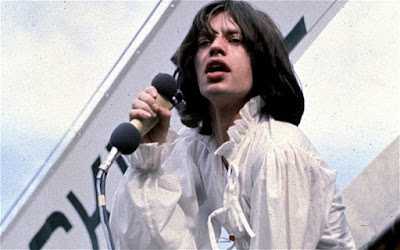
Mick Jagger performing with the Rolling Stones at Hyde Park, 5 July 1969.
Former Rolling Stones member Brian Jones was found dead at the bottom of his swimming pool at the age of 27. An autospy confirmed that his liver and heart had been enlarged by past drug and alcohol abuse, but there were rumors in years to come that Jones had been murdered by construction worker Frank Thorogood, who was the last person to see him alive. However, some have chosen to dismiss the theory, saying Jones died by misadventure.

A few days after Jones' death, the Rolling Stones, with David Bowie, performed their first full concert since 1967 at Hyde Park in London to a crowd of a quarter of a million. The show was dedicated to Jones' memory, and marked the debut of David Bowie as a Rolling Stone, to which his performance of "Space Oddity" was met with applause. Some believed it was written as a tribute to Jones, but Bowie denied those claims, having written the song before Brian Jones' death.

Shortly after Jones' funeral, Mick Jagger flew down to Australia to film his part for the film Ned Kelly, his first starring role in a feature-length movie, with Up Against It alongside Ian McKellan as his second. It was during the filming that Jagger composed "Brown Sugar". Despite his absence, the Stones continued the sessions for Space Oddity, focusing mainly on Bowie's songs.

21 November 1969

The Rolling Stones - Space Oddity
Released: 21 November 1969
Recorded: 16-17 November 1968, 23 February - 2 November 1969
Producer: Jimmy Miller, Tony Visconti

Track listing[6]
Side A
Space Oddity
Gimme Shelter
Honky Tonk Women
Letters to Hermione
Memory of a Free Festival
Let It Bleed

Side B
Wild Eyed Boy from Freecloud
Sister Morphine
You Can't Always Get What You Want
Cygnet Committee

Space Oddity marked a true departure for the Rolling Stones following the release of Lazarus of England the year previous. Whilst there was still a heavy emphasis on hard rock and blues, there were also some progressive and psychedelic influences, no doubt due to Bowie's presence.

In July, four months before the album's release, "You Can't Always Get What You Want" and "Honky Tonk Women" were released as a double A-side; whilst the former was almost five minutes long on the album, it was seven-and-a-half minutes in length for the single release, rivaling the Beatles' "Hey Jude" from Beatles '68.[7]

David Bowie during the filming for the "Space Oddity" music video, 1969.
The title track was released as a single in December with "Live with Me" as its B-side, topping the charts in the United Kingdom, and reaching #4 in the United States.[8] "Let It Bleed" was the third single from the album with "Wild Eyed Boy from Freecloud" as the B-side, and although "Gimme Shelter" wasn't released for a single, it still remained one of the Rolling Stones' most popular songs.

Space Oddity reached #1 in the United Kingdom, temporarily dethroning the Beatles' Get Back for three non-consecutive weeks. It topped at #3 in America, but critical reception was near universally positive, being called their greatest album of the 1960s, and a perfect album to close the decade.

MICK JAGGER: "Mind you, we still had that issue with the Who trying to beat us at our game, but now we had David Bowie as our secret weapon to put them in their place. They put out Tommy, and we put out Space Oddity as a response to them. I think they should've given up right there and then, but they came out with Live at Leeds in May. It seemed as if they didn't want to give up without a fight, and I don't know if that was brave or foolish of them to do so. Or both." (1997)

Footnotes
  1. There were rumors about the Beatles appearing at Woodstock, but due to the Beatles hating each other at the time, this did not happen. James Taylor also did not perform at Woodstock despite the invitation, nor did Bob Dylan.
  2. Adapted from the January 30 rooftop performance with additions. "Come Together", "Old Brown Shoe", "Don't Pass Me By", and "Helter Skelter" were later performed by their respective singers during their solo live performances.
  3. Tracks are sourced from Past MastersLet It Be... NakedAbbey RoadThe White Album, and Anthology 3. The closing dialogue from the Anthology 3 version of "She Came in Through the Bathroom Window" is cut.
  4. All tracks are sourced from Led Zeppelin II excluding "Your Time is Gonna Come" and "Babe I'm Gonna Leave You", both sourced from Led Zeppelin I.
  5. In OTL, Mick Taylor began recording with the Rolling Stones on May 31, 1969 starting with "Live with Me" on the Let It Bleed album. Circumstances would've likely changed with Taylor due to butterflies.
  6. All of David Bowie's tracks come from his 1969 self-titled album (sometimes referred to as Space Oddity), with "Memory of a Free Festival" edited down to 3:59, per the single release. "Gimme Shelter" and "Let It Bleed" both come from Let It Bleed, "Honky Tonk Women" and the single edit of "You Can't Always Get What You Want" are from GRRR!, and "Sister Morphine" is from Sticky Fingers.
  7. In OTL, it was the other way around with "You Can't Always Get What You Want" being edited for single release.
  8. "Space Oddity" topped the charts in 1975, six years after its initial release.
Author's Comments

There's quite a lot to take in, isn't there? The Beatles are now in conflict with each other, mostly due to Paul being pushy, the Yardbirds have lost their founding members, and the Rolling Stones have brought in David Bowie. The latter half of the 1960s have really changed a lot from how they were in OTL; how it will effect the 1970s onwards remains to be seen.

At this point, you'll notice that I haven't put much focus on how Apple Corporation has been faring. Not to worry; the next chapter will serve as a summary as to how it's been going from August 1968 to December 1969. In addition, we'll see the full details as to who became part of the roster.