Monday, May 15, 2023

The Second Coming - Nirvana's Late-1990s Albums

In the early 1990s, Nirvana was one of the biggest bands in the world thanks to their most well-known hit, "Smells Like Teen Spirit", bringing the grunge genre to the forefront in the music world. Amongst their contemporaries like Pearl Jam, Soundgarden, Alice in Chains and Stone Temple Pilots, Nirvana have had the shortest active life, lasting only seven years and putting out three albums in that timeframe, due to Kurt Cobain's suicide in 1994. Yet, their influence has been felt, with Cobain being called "the John Lennon of the swinging Northwest" according to Time, and many fans have been left wondering what might've been had Cobain not died so soon.

I actually have plans for Nirvana for Strawberry Peppers: The Second Coming, even though they don't come in until the end of the 1980s; Kurt never gets addicted to heroin, and instead takes on marijuana. Nirvana (and by extension, grunge) catches the interest of the one and only John Lennon, impressed with what he's hearing, who has the group signed up onto Apple Records in 1991, following the failed sessions for Sheep; just as well, since Sub Pop Records were having financial problems at the time. (As an aside, Kurt never runs into Courtney Love, for she ends up fading to irrelevance.) Lennon helps to produce Nevermind, and Nirvana become superstars, and in 1994, they headline Lollapalooza, their first performance with Pat Smear as their fourth member.

So, what comes next for Nirvana? Well, consider the following:

From the Muddy Banks of the Wishkah (April 14, 1995)
1. You Know You're Right - 3:38 (Nirvana 2002)
2. She Only Lies - 2:45 [studio mockup by TheBeginningOfMusic]
3. Big Me - 2:12 (Foo Fighters 1995)
4. Alone + Easy Target - 4:06 (Foo Fighters 1995)
5. What More Can I Say? - 3:14 [studio mockup by TheBeginningOfMusic]
6. Poison's Gone - 2:09 [studio mockup by TheBeginningOfMusic]
7. Do Re Mi - 4:18 [studio mockup by TheBeginningOfMusic]
8. Marigold - 2:33 (Heart-Shaped Box single)
9. The Yodel Song - 2:35 [studio mockup by TheBeginningOfMusic]
10. Desire - 2:29 [studio mockup by TheBeginningOfMusic]
11. Clean Up Before She Comes - 3:05 [studio mockup by TheBeginningOfMusic]
12. Exhausted - 5:45 (Foo Fighters 1995)
13. Opinion - 1:33 [studio mockup by TheBeginningOfMusic]
Total length: 40:22

With the Lights Out and the solo Montage of Heck showcase that Nirvana had as many three albums' worth of material, if not more so. But because of Kurt's death, we may never know what he would have written for Nirvana's fourth album, although "You Know You're Right" - eventually released in 2002 on a compilation album - gives us a glimpse of what might have been. A possibility here is that Dave Grohl could have some of his own songs being recorded as Nirvana songs, like "Marigold", released as a B-side. This could've helped to take some of the songwriting weight off of Kurt's shoulders, and maybe they'd become the Lennon-McCartney of grunge.

For this album and the next two, I've utilized fan remixes of some of Kurt's tracks; otherwise, they would've clashed heavily with the more polished production of Dave's. Thank goodness for YouTube being a source for the remixes. The title comes from the live album that was released in 1996, two years after Kurt's death.

The Color and the Shape (May 20, 1997)
1. Burn My Britches - 2:44 [studio mockup by TheBeginningOfMusic]
2. Monkey Wrench - 3:51 (The Color and the Shape)
3. Talk to Me - 3:02 [studio mockup by Riot Earth]
4. Sappy - 3:26 (With the Lights Out)
5. Friend of a Friend - 3:13 (In Your Honor)
6. Ivy League - 2:20 [studio mockup by If Kurt Cobain Lived]
7. My Hero - 4:20 (The Color and the Shape)
8. Come on Death - 3:30 [studio mockup by TheBeginningOfMusic]
9. Moist Vagina - 3:33 (In Utero - 20th Anniversary Deluxe Edition)
10. Dogs - 3:34 (Sweet 75)
11. Everlong - 4:10 (The Color and the Shape)
12. Weirdo - 4:16 [studio mockup by Silaserrad]
Total length: 41:59

With Dave Grohl having more prominence in songwriting and recording (with "Friend of a Friend" going all the way back to 1990), it becomes clear to Nirvana that they'll need a second drummer to supplement Dave whenever he sings live. Enter buddy Taylor Hawkins, and Nirvana now becomes a five-piece band, and it would stay that way for over twenty years. Dave and Taylor aren't constrained to Nirvana, however, for the former has his own side project, the Foo Fighters, also including Nate Mendel on bass guitar, and they're eventually joined by Chris Shiflett on guitar.

Dave explains in an interview upon the album's release, "I love playing with Kurt, Krist and Pat, but the Foo Fighters was done so that I could express myself more. We've heard stories from John [Lennon] about how George [Harrison] would get frustrated when the Beatles wouldn't play one of his songs, so this was something Kurt and I had agreed upon from the start. We've not fallen out or anything; we're still really good friends."

Honestly, The Color and the Shape is such a good album title that there was no way I couldn't use it for Nirvana's fifth album. This is where the band really shows how much they'd evolved over the past few albums, to the point where Krist Novoselic even writes a song ("Dogs") for it! (Let's imagine that it was either given to Kurt to sing or Krist sings it himself.) This would definitely be Nirvana at their most collaborative, and maybe it's just me, but I can almost picture it being ranked even higher than Nevermind.

(As an aside, I'd imagine that while Nirvana continues to evolve their sound and grow in popularity, Oasis loses favor with listeners following Be Here Now, and the band breaks up before their fourth album is even released.)

Montage of Heck (November 2, 1999)
1. Stacked Actors - 4:16 (There is Nothing Left to Lose)
2. Old Age - 4:20 (With the Lights Out)
3. Learn to Fly - 3:55 (There is Nothing Left to Lose)
4. Burn the Rain - 3:44 [studio mockup by Harmonova]
5. Generator - 3:48 (There is Nothing Left to Lose)
6. Montage of Heck - 6:35 [studio mockup by jone; Breathe the Lie]
7. Token Eastern Song - 3:21 (With the Lights Out)
8. Next Year - 4:36 (There is Nothing Left to Lose)
9. Horrified - 6:47 [unknown song #2]
10. Rehash - 2:35 (Montage of Heck)
11. M.I.A. - 4:03 (There is Nothing Left to Lose)
Total length: 48:00

As the millennium drew to a close, and with Dave Grohl having released the first Foo Fighters album earlier that year, Nirvana got back in the studio together to record their sixth album, declining an invitation to Woodstock '99 due to scheduling conflicts. (In retrospect, this turned out to be a wise move on their part.) Montage of Heck once again showcased Grohl's songwriting ability, to the point where he opens and closes the album. Still, Kurt Cobain's songwriting was nothing to sneeze at either, and Nirvana had ended the decade, century and millennium on a high note. Where could they go next as the 2000s dawned? Only time will tell...

The last Nirvana album I can realistically make as I was running low on Kurt Cobain material to utilize. I'm amazed I was even able to find material for three albums' worth, and I feel that if I tried going any further, I'd just be scraping the bottom of the barrel. Of course, if Kurt had lived, some of the songs he'd write from 1994 onward would probably be more innovative than what we got leftover. He's an enigma in the world of music history, and we'll probably never know what else he could've done...

What happens from 2000 onward?
Nirvana would likely to continue as a five-piece band, perhaps on a trajectory akin to the Foo Fighters in OTL, but with Kurt and Krist along for the ride. They do take on side projects, though, like Kurt and Dave helping George Harrison record for Portrait of a Leg End, released on the ex-Beatle's 59th birthday. In 2001, Nirvana is interviewed for a documentary about themselves and the impact they left behind in the 90s, with Jools Holland directing, titled With the Lights Out. A box set is released in conjunction with the documentary, which sells in high numbers. Nirvana would inevitably go through a creative slump in the decade, but over time, their albums from that period gradually become critical favorites. One of their biggest post-90s albums is 2011's Actually, serving as a sequel to Nevermind twenty years later, down to Spencer Elden reprising his role for the cover, this time swimming away from the dollar bill.

Monday, April 10, 2023

The Second Coming - Tom Petty and Mudcrutch Discography (1986-1996)

In the original Strawberry Peppers, the story of Tom Petty and Mudcrutch was relatively minor compared to a lot of other storylines. The only major changes from OTL were that Tom Petty didn't have to deal with meddlesome executives, the band's first album was released earlier (a different one from OTL), and Southern Accents was finished without the Dave Stewart contributions. For The Second Coming, the only pre-1985 retcon I've made was by having him sign up with Apple Records. Outside of that, the storyline is unchanged. If you want to see the 1975-1984 albums, I'll leave you with the following links:
Inevitably, the big question would be, "what happens after Southern Accents?" This was something that I had been resting on for a while, but now I can finally show you all what comes next for Tom Petty, all the way up to 1996!

Don't Come Around Here No More (February 28, 1985)
Side A (9:30)
1. Make It Better (Forget About Me) - 4:23
2. Don't Come Around Here No More - 5:07

Side B (5:12)
3. It Ain't Nothin' to Me - 5:12

The Dave Stewart tracks on Southern Accents felt really out of place with the intended concept of life in the south, so the big question now is, what to do with them? Originally, I was going to utilize these songs along with some outtakes from 1986 and make an album out of them, but in the end, I decided to make the Petty/Stewart tracks a standalone extended play. Maybe it's not the most ideal choice, but it is what it is, and you've got to work with what's available.

Ways to Be Wicked (June 22, 1987)
Side A (21:16)
1. Ways to Be Wicked - 3:27 (Playback)
2. Runaway Trains - 5:13
3. The Damage You've Done - 3:16 (Playback)
4. It'll All Work Out - 3:11
5. Make That Connection - 5:04 (Playback)
6. Moon Pie - 1:05 (Playback)

Side B (22:02)
7. Think About Me - 3:45
8. Can't Get Her Out - 3:11 (Playback)
9. A Self-Made Man - 3:02
10. You Come Through - 5:15 (Playback)
11. How Many More Days - 3:18
12. Let Me Up (I've Had Enough) - 3:31

I'd given away two tracks - "Jammin' Me" and "All Mixed Up" - for the 1987 Traveling Wilburys project, which left plenty of room for replacement tracks. Another track that was cut, "My Life/Your World", contained some rewritten lyrics from the then-unreleased "Walkin' from the Fire". Assuming that the latter had been released back in 1984 as intended, it's likely that the former would not have happened. I also removed "Ain't Love Strange", though it would most likely come out as a B-side, and even included the country version of "The Damage You've Done" to give the album some variety.

With all of these changes being made, is this a much better album than Let Me Up (I've Had Enough)? That's up to you to decide, but I do like giving these rare songs some more attention.

Full Moon Fever (April 24, 1989)
Side A (19:33)
1. Free Fallin' - 4:14
2. Travelin' - 3:15 (Playback)
3. Love is a Long Road - 4:06
4. A Face in the Crowd - 3:58
5. King of the Hill - 4:00 (An American Treasure)

Side B (20:31)
6. I'll Feel a Whole Lot Better - 2:47
7. Yer So Bad - 3:05
8. Depending on You - 2:47
9. Waiting for Tonight - 3:30 (Playback)
10. Alright for Now - 2:00
11. A Mind with a Heart of Its Own - 3:29
12. Down the Line - 2:53 (Playback)

Once again, three tracks - "I Won't Back Down", "Runnin' Down a Dream" and "Zombie Zoo" - were donated to the 1989 and 1991 Traveling Wilburys albums, and "The Apartment Song" had already been included on Southern Accents. Fortunately, there were just enough songs leftover to fill the gaps, and we even have guest appearances made by Roger McGuinn ("King of the Hill") and the members of The Bangles ("Waiting for Tonight"), in lieu of George Harrison and Roy Orbison.

Into the Great Wide Open (July 2, 1991)
Side A (21:32)
1. Learning to Fly - 4:02
2. Kings Highway - 3:08
3. Into the Great Wide Open - 3:43
4. Two Gunslingers - 3:09
5. The Dark of the Sun - 3:23
6. All or Nothin' - 4:07

Side B (22:34)
7. All the Wrong Reasons - 3:46
8. Too Good to Be True - 3:59
9. Out in the Cold - 3:40
10. You and I Will Meet Again - 3:42
11. Makin' Some Noise - 3:27
12. Built to Last - 4:00

Besides changing up the album cover, adapted from a T-shirt design in promotion of the tour, nothing has really changed about Into the Great Wide Open. I guess there weren't that many outtakes (if at all) from that time period.

Ghosts on the Highway (November 16, 1993)
1. Mary Jane's Last Dance - 4:33 (Greatest Hits)
2. You Saw Me Comin' - 4:38 (Finding Wildflowers)
3. Honey Bee - 5:21 (Finding Wildflowers)
4. Something Could Happen - 4:35 (All the Rest)
5. Thirteen Days - 3:36 (Angel Dream)
6. Lonesome Dave - 3:40 (An American Treasure)
7. Something in the Air - 3:21 (Greatest Hits)
8. House in the Woods - 5:06 (Finding Wildflowers)
9. Crawling Back to You - 5:06 (Finding Wildflowers)
10. Cabin Down Below - 2:45 (Finding Wildflowers)
11. Wake Up Time - 5:31 (Finding Wildflowers)
12. Come on Down to My House - 3:05 (Playback)
Total length: 51:17

Just recently, I learned that soniclovenoize's double album reconstruction of Wildflowers had been removed for reasons I'm not sure of; most likely it relates to copyright restrictions regarding Tom Petty's music. The link you see above was archived by Wayback Machine. In that same post, he also included what a 1993 Heartbrakers album would've been like, which contains some overlap with the double album Wildflowers. I've left the track listing to Ghosts on the Highway untouched (although I did edit the cover art to change the band name), right down to the sources where each track originates from so you can recreate it for yourself.

As a final addition, I've also included "Peace in L.A." and "Christmas All Over Again" as bonus tracks, both sourced from Playback.

Wildflowers (November 1, 1994)
1. You Don't Know How It Feels - 4:49
2. You Wreck Me - 3:22
3. To Find a Friend - 3:23
4. California - 2:38 (All the Rest)
5. Don't Fade on Me - 3:32
6. Wildflowers - 3:11
7. Leave Virginia Alone - 4:16 (All the Rest)
8. Only a Broken Heart - 4:30
9. Hard on Me - 3:48
10. Hung Up and Overdue - 6:03 (All the Rest)
11. A Higher Place - 3:56
12. Time to Move On - 3:15
13. Somewhere Under Heaven - 4:37 (All the Rest)
14. Climb That Hill - 2:33 (All the Rest)
15. It's Good to be King - 5:10
16. Harry Green - 3:54 (All the Rest)
17. Confusion Wheel - 4:20 (All the Rest)
18. Hope You Never - 3:03 (All the Rest)
19. Girl on LSD - 3:45 (Finding Wildflowers)
Total length: 74:05

Once again, playing homage to Albums That Never Were, I took SLN's track listing from his double album reconstruction, removed the tracks that had already been featured on Ghosts on the Highway, and made it a single disc. Three tracks ("Honey Bee", "Thirteen Days" and "Cabin Down Below") were originally on disc one, and five ("House in the Woods", "Crawling Back to You", "Something Could Happen", "Lonesome Dave" and "Wake Up Time") on disc two. To fill in some of the gaps, I included "Harry Green" and "Somewhere Under Heaven", extending the runtime to 74 minutes, just within the limits of CDs.

Angel Dream (August 6, 1996)
1. Angel Dream (No. 2) - 2:27
2. Grew Up Fast - 5:09
3. Change the Locks - 4:56
4. Zero from Outer Space - 3:08
5. Baby, Let's Play House - 2:33 (Playback)
6. Drivin' Down to Georgia - 4:58 (Finding Wildflowers)
7. One of Life's Little Mysteries - 3:10
8. Walls (No. 3) - 3:01
9. Wooden Heart - 2:09 (Playback)
10. 105 Degrees - 3:11
11. You Get Me High - 2:48 (Playback)
12. Supernatural Radio - 6:03
13. God's Gift to Man - 4:18 (Playback)
Total length: 47:51

Using the track listing from the 2021 reconstruction of She's the One as a basis, once again, I removed songs that were already utilized for both Ghosts on the Highway ("Thirteen Days") and Wildflowers ("Climb That Hill"), and found replacements off of Playback. I even replaced a few songs outright ("Asshole", "French Disconnection") in favor of more outtakes which I felt improved the quality of the album a bit. I'm really pleased with how the 1993-1996 albums turned out without double-dipping, even though a few songs have gone unused.

What happens after 1996?
Now this is where things get interesting since there aren't too many outtakes from between the Echo sessions (1998-1999) and Tom Petty's death in 2017 that have been officially released. Of the available material, "I Don't Belong", "Gainesville" and "Sweet William" all trace to the Echo period, "For Real" is an outtake from The Last DJ, "Special Place" is an iTunes bonus track for Mudcrutch's first album from 2008, as is "Little Girl Blues" for Mojo, and "Bus to Tampa Bay" and "Playing Dumb" were part of the Hypnotic Eye era.

In addition to the above, there's also the Blue Stingrays' cover of "Goldfinger" (a side project by Mike Campbell), Tom Petty's covers of "Blue Moon of Kentucky" and "You're Gonna Change (Or I'm Gonna Leave)", Mike Campbell and the Dirty Knobs' "Feelin' High" from 2010, as well as Benmont Tench's You Should Be So Lucky album from 2014. The only track in which I can't find a link for is the Mudcrutch outtake "How Much Do You Need", which I imagine would've replaced "Trailer" on their second album from 2016. If anyone can find a link that hasn't been taken down yet, that would be great.

I feel like as the band got older, Tom would be more willing to let Mike and Benmont step up to the microphone every now and again. After all, Tom Leadon did sing for a couple of tracks on Mudcrutch's 2008 album, as did Benmont. The same thing even happened with Mudcrutch 2. As far as I'm concerned, it's all Tom Petty to me, regardless as to who contributed what.

Possibly save for the additions of the above songs I listed, I wouldn't see the 1999-2016 albums changing all that much - Highway Companion from 2006 least of all, since there don't seem to be any outtakes from that era. However, if I were to give the two Mudcrutch albums new names, they would respectively be House of Stone (2008) and Dreams of Flying (2016). All the same, one has to wonder what could have been if Tom Petty hadn't left the world so suddenly...

Monday, March 6, 2023

The Second Coming - Crosby, Stills and Nash Discography (1986-2016)

I wasn't originally going to make this post, but after learning about David Crosby's recent death, as well as seeing a few tributes to him from fellow alternate history music fans, I thought I'd do one myself that ponders the question, "What if Crosby, Stills and Nash continued making music past 1982?" I've already done a post that shows what their discography would've been like from 1967 up to 1980, so consider this post part two. Once again, 1982's Daylight Again is unchanged from OTL.

This post is largely inspired from Albums That Should Exist, in which Paul imagines a world that Crosby, Stills and Nash (and sometimes Young) put out more albums than they really did. Note that the timings may be inaccurate to the versions he used for his albums; I'm listing where the songs originated from because CSN(Y) tended to re-record many songs years after they were first performed. It's a habit that's practically stuck with them for years. Why that is, I'll never understand.

Allies (March 27, 1986)
Side A (21:13)
1. 50/50 - 4:22 (Right by You)
2. Try to Find Me - 4:09 (Reflections)
3. Melody - 4:07 (Oh Yes I Can)
4. Vote - 2:31 (1984 live performance)
5. Raise a Voice - 2:31 (Allies)
6. Love is the Reason - 3:33 (Reflections)

Side B (21:15)
7. War Games - 2:18 (Allies)
8. Flying Man - 3:25 (Oh Yes I Can)
9. Sad Eyes - 3:22 (Innocent Eyes)
10. He Played Real Good for Free - 3:48 (Allies)
11. Right by You - 5:04 (Right by You)
12. Lonely Man - 3:18 (Reflections)

The release gap between 1982 and 1988 for a new album was an unusually long for the supergroup at the time (sure, there's 1970-1977, but they did plan to release Human Highway three times over before unceremoniously scrapping the project), but it mostly comes down to the fact that David Crosby had been arrested for drug possession. Not only that, he, Stephen Stills and Graham Nash looked pretty washed up during that time; Crosby had gone bald (save for his iconic mustache), Stills had gotten fat, and while Nash looked fine, he had that ridiculous mullet which didn't fit him at all.

There were, however, according to Nash, plans to release an album in either 1985 or 1986, most likely off the heels of Live Aid, but because of Crosby's arrest, that didn't happen, and this part of time in CSN's long, complicated history has been mostly ignored. It probably didn't help that Stills and Nash put out solo albums that hardly anyone cared about.

We may never know what a mid-1980s CSN album may have sounded like, but I managed to cobble together an album consisting of their 1983-1986 material along with some outtakes that, hopefully, comes across as acceptable. Nash is quite prominent on the album, having written and sung five songs, whereas Crosby struggled to come up with good material for another few years. However, this is not an album that I could see ranking very highly amongst CSN's work, despite the inclusion of the song "War Games" which was planned for the 1983 film of the same name.

"Vote" was performed live twice by CSN in 1984, most likely as a reaction to the upcoming presidential election. I believe that this is the same song that Graham Nash initially wrote as far back as the early 1970s before eventually releasing it as a single in 2020. If anyone can provide more information to confirm or confound this, that would be great.

Oh Yes We Can (January 23, 1989)
Side A (21:29)
1. He's an American - 4:18 (1987 live performance)
2. Got It Made - 4:36 (American Dream)
3. Don't Say Goodbye - 3:23 (American Dream)
4. Tracks in the Dust - 4:48 (Oh Yes I Can)
5. Feed the People - 4:24 (Man Alive!)

Side B (23:05)
6. Clear Blue Skies - 3:05 (American Dream)
7. Compass - 5:19 (American Dream)
8. House of Broken Dreams - 3:18 (Live It Up)
9. Night Song - 4:17 (American Dream)
10. Oh Yes I Can - 5:08 (Oh Yes I Can)
11. America (My Country 'Tis of Thee) - 1:58 (Oh Yes I Can)

Ah, American Dream. The album that was hyped up to be CSN's big return to relevance, and with help from their estranged bandmate Neil Young, no less! And the result... was a complete disappointment. To paraphrase Todd in the Shadows, they were trying to be everything except CSNY, and the songs had anything but a group feel to them. Stills, Nash and Young each had four songs while Crosby only had two, which is strange because next year, he put out Oh Yes I Can (of which the album's title is derived from) which contained songs that went back as far as 1978. It's very likely, as was usual for the group, that they all held back their best songs.

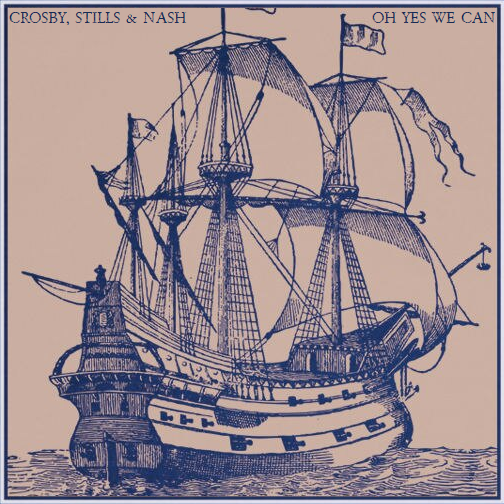
Per this scenario, Neil Young never joins CSN, instead sticking with Crazy Horse. I mean, it's crazy enough having to deal with three egos, but four egos is an accident waiting to happen, as it often did. This leaves more wiggle room for the others to deal with, especially Crosby, who takes the lead on the album. In general, I tried to maintain the original album order as best as I could, therefore avoiding having two consecutive vocal spots by the same singer. The album cover design is adapted from a T-shirt that features a wooden ship.

"He's an American" is an unreleased song by David Crosby that he performed live in 1987, most likely fresh off his time in prison. I don't know why that wasn't considered for inclusion on either American Dream or Oh Yes I Can, even though it might have fit thematically. Then again, it may have suffered due to bad 80s production.

Yours and Mine (June 14, 1991)
1. Isn't It So - 3:14 (Stills Alone)
2. Hero - 4:39 (Thousand Roads)
3. I Don't Get It - 3:35 (Man Alive!)
4. Chippin' Away - 4:07 (single release)
5. Haven't We Lost Enough - 3:06 (Live It Up)
6. Yours and Mine - 4:21 (Live It Up)
7. Got to Keep Open - 4:40 (Live It Up)
8. On the Other Side of Town - 3:35 (Crosby & Nash 04)
9. Lady of the Harbor - 3:19 (Oh Yes I Can)
10. Hearts Gate - 2:59 (Man Alive!)
11. Arrows - 3:51 (Live It Up)
12. After the Dolphins - 5:05 (Live It Up)
Total length: 46:31

If American Dream was a massive disappointment for CSN, then the follow-up album, Live It Up, was even worse. The first sign that the album was bad was the cover art with hot dogs on the moon. (Seriously, whoever thought that that art was a good idea was most likely on drugs.) Not helping was questionable production choices, some really bad songs making the cut as well as superior songs that were either relegated to B-sides or not released as all. Live It Up is widely considered to be CSN's worst album for these reasons.

At least half of the original album is intact, although a sixth song, "House of Broken Dreams", had been pushed forwards to Oh Yes We Can, likely having origins going back to 1986. For this album, I adapted the DVD cover for the 1990 compilation film Long Time Comin'. I don't really think you can compare Yours and Mine to the original Live It Up; you may as well compare an apple to an orange.

After the Storm (August 16, 1994)
1. Thousand Roads - 4:31 (Thousand Roads)
2. Amazonia - 2:28 (Stills Alone)
3. Camera - 4:18
4. Unequal Love - 4:44
5. It Won't Go Away - 4:49 (1992 live performance)
6. Till It Shines - 4:19
7. These Empty Days - 2:30
8. After the Storm - 3:34
9. Panama - 4:15
10. Yvette in English - 5:53 (Thousand Roads)
11. In My Life - 2:20
Total length: 43:41

After the Storm is generally viewed as an improvement to both American Dream and especially Live It Up, but it didn't sell well upon release, most likely due to bad marketing. I suspect that poor decisions behind the scenes recording the previous albums was also a factor and people didn't want to take a chance on the album. Either way, it felt like a case of too little, too late for CSN. A shame, really, especially since more than half of the songs were pretty good.

Once again, the weaker material was cut in favor of some stronger solo tracks. This is probably the album that has its content changed the least compared to the albums that came before it. Plus, having the album close out with a cover of the Beatles' "In My Life" seemed fitting as they had been together for over 25 years at that point.

Half Your Angels (October 26, 1999)
1. Faith in Me - 4:21
2. Half Your Angels - 3:59 (1998 internet single)
3. Stand and Be Counted - 4:52
4. Wounded World - 3:12 (Man Alive!)
5. Heartland - 4:28
6. Morrison - 4:45 (CPR)
7. Seen Enough - 5:14
8. Dream for Him - 5:03
9. No Tears Left - 5:06
10. Someday Soon - 3:43
11. Climber - 5:20 (Voyage)
12. Acadienne - 4:02 (Man Alive!)
Total length: 54:05

Looking Forward was CSNY's final studio album, and for the next sixteen years right up until their final breakup in 2015 (and then David Crosby's death in 2023), they released no more albums, instead going on tour and performing songs that, you guessed it, were either filtered away onto solo albums or never released at all. They've made these same mistakes for years, and all that they've done is leave many fans frustrated, wanting to listen to every final nugget of their recording history. It makes you wonder why they haven't even considered putting out archival releases of songs that they've never put out on an album before.

Thankfully, most of these songs have been performed live by CSNY during 1999-2002, which makes it easier to work around the production issues. It also helps that the songs on their own are pretty good for the most part, yet they still can't hold up to the classics of the 1960s and 1970s. Like I did with American Dream/Oh Yes We Can, I removed the Neil Young songs and replaced them with more songs by Crosby, Stills and Nash, among them being their 1998 internet single "Half Your Angels", which gave the album its new title. "Sanibel" was also cut as it was not written by any of the members, and it features Young on vocals. The cover is adapted from a CSN tapestry blanket (I don't know what year it was made) and put into a frame with a plaque reading the album title on the bottom.

Drivin' Thunder (August 12, 2005)
1. Lay Me Down - 3:37 (Crosby & Nash 04)
2. Milky Way Tonight - 3:25 (Crosby & Nash 04)
3. Round the Bend - 5:12 (Man Alive!)
4. Blizzard of Lies - 4:08 (Songs for Survivors)
5. Just Like Gravity - 3:49 (Just Like Gravity)
6. Don't Dig Here - 6:10 (Crosby & Nash 04)
7. Different Man - 2:10 (Man Alive!)
8. They Want It All - 5:35 (Crosby & Nash 04)
9. The Chelsea Hotel - 3:55 (Songs for Survivors)
10. Drivin' Thunder - 4:30 (Man Alive!) 
11. Jesus of Rio - 4:12 (Crosby & Nash 04)
12. How Does It Shine? - 5:21 (Crosby & Nash 04)
Total length: 52:04

Crosby and Nash put out a self-titled album as a duo in 2004 (for which the album cover above was adapted from), their first since 1976, and two years later, they put out a shortened version that highlighted the best of the double album. Around that same time, Stephen Stills released Man Alive!, which consisted of outtakes that went back many years, as listed above with previous albums. Thankfully, his Carry On box set listed when some songs were recorded, which makes the task of picking out material from him much easier.

The resulting album, Drivin' Thunder, is stronger than the sum of its parts, with most material coming from 2004 and 2005, with a few songs held back from earlier in the decade to add some variety. Unfortunately, we're not going to see much of Stephen Stills from this point on since he hasn't written much new material by himself since then, his most recent collaborations in the past decade being with the Rides and former girlfriend Judy Collins. Similarly, Graham Nash hasn't released an album since 2016's This Path Tonight, though he is putting out a new album this year titled Now. David Crosby has put out five albums between 2014 and 2021, making him the most prolific out of the trio in recent years until his death.

CSN 2014 (January 17, 2014)
1. What's Broken - 3:48 (Croz)
2. Can't Get Enough - 6:09 (Can't Get Enough)
3. Exit Zero - 4:32 (2013 live)
4. Radio - 3:33 (CSN 2012)
5. Burning for the Buddha - 4:29 (2013 live performance)
6. Low Barefoot Tolerance - 3:53 (Wretches & Jabberers Soundtrack)
7. In Your Name - 3:53 (CSN 2012)
8. Set That Baggage Down - 4:01 (Croz)
9. Almost Gone (The Ballad of Bradley Manning) - 3:53 (CSN 2012)
10. Time I Have - 3:49 (Croz)
11. Only Teardrops Fall - 4:53 (Can't Get Enough)
12. I'm Here for You - 4:03 (2014 live performance)
Total length: 50:56

Crosby, Stills and Nash were unusually quiet throughout the late 2000s and the early 2010s, and I believe they were planning to record an album of covers as a stop-gap release, but, as you can probably guess, due to behind the scenes drama, it was canned. (Let's imagine that, for this scenario, it was actually released.) It seemed obvious at the time that they were creatively stagnant, and it wouldn't be until later in the decade that they would finally get their songwriting groove back. This album and the next are solid proof of that, though if you want to, you can view it as a double album spread out over two individual releases.

"Burning for the Buddha" and "I'm Here for You" are a pair of Graham Nash-penned songs that have been performed live by CSN between 2013 and 2015. The former was also performed live by Nash solo in 2013; the latter was first performed in 2014. I believe both of those songs were co-written with Shane Fontayne, who co-wrote all of the songs for This Path Tonight.

Back Home (April 15, 2016)
1. Roadhouse - 5:06 (Can't Get Enough)
2. Myself at Last - 5:18 (This Path Tonight)
3. The Clearing - 4:00 (Croz)
4. Watch Out for the Wind - 3:06 (This Path Tonight)
5. Don't Want Lies - 4:41 (Can't Get Enough)
6. Golden Days - 3:38 (This Path Tonight)
7. Somebody Home - 4:30 (Snarky Puppy's Family Dinner - Volume 2; edit)
8. Olympia - 3:42 (2015 live performance)
9. Virtual World - 4:01 (Pierced Arrow)
10. What Makes It So - 4:00 (Lighthouse)
11. Back Home - 4:48 (This Path Tonight)
12. Look Each Other in the Eyes - 3:39 (2016 internet single)
Total length: 50:29

Despite the renaissance Crosby, Stills and Nash were undergoing in the mid-2010s, there was no album to release from them as a group, and by the end of 2015, the group was finished for good. Then in 2023, David Crosby died, which further affirmed that any chance of a reunion between the members had died with him. A half-century's worth of ego, drugs, constant bickering and questionable musical choices had ended with no resolution, no retrospective and no shaking of hands. This supergroup that had all the potential to fulfill their fans' wishes had ended on bad terms with one another.

And yet, they didn't have to. They could've released one more album by 2015, or possibly even two as there was enough good material by them as a group. Chances are it could've been their best album since 1970, but the sad fact is, we may never know if it would've lived up to that hype. After all, a few albums by the group were hyped up and performed underwhelmingly. On a more positive note, I find it rather fitting that the final CSN album concludes with a Stephen Stills-penned song; they started with a song written by Stills - "For What It's Worth" (or "Suite: Judy Blue Eyes", depending on whether you see 1967 or 1969 as when they started as a group) - and they end their career with a Stills song. Coincidentally, both of them are politically-themed.

"Olympia" is another Graham Nash song that was also performed live by CSN between 2014 and 2015. Again, it's very likely it was co-written with Shane Fontayne.

What about the leftover songs?
When it came to picking out songs, inevitably, there were going to be some tough cuts made. Out of the remaining songs Paul had picked out for his own CSN/Y albums, there were nine that I ended up cutting (Neil's tracks notwithstanding). The first of them was "Chuck's Lament (A Child's Dream)", that was released on the Amazing Grace and Chuck soundtrack in 1987, and later as the B-side to "Live It Up" in 1990. I presume it would have still been released as a B-side to one of the singles for Oh Yes We Can, since it dates to the late 1980s.

One of my main reasons for cutting certain songs was due to the balance of material between the three members; I tried to give each a minimum of three songs and a maximum of five, but in some cases, that was not always possible. "Somehow She Knew", "Rusty and Blue" and "Time is the Final Currency" were all performed live during the 1990s prior to their actual release on CPR (Crosby, Pevar and Raymond) in 1998, with the former even being performed by CSN in 1992. Similarly, "Dirty Little Secret" and "Lost Another One", both from Graham Nash's Songs for Survivors from 2002, were performed by CSN live in 2003. I simply assumed that solo projects outside of CSN were still a thing by 2005.

In addition, I cut songs that they covered as I wanted to focus on the songs that they either wrote or co-wrote. Stephen Stills' version of Booker T. Jones' "Ole Man Trouble" was released on Man Alive! in 2005, and his live cover of Mudcrutch's "The Wrong Thing to Do" ended up on Live at Shepherd's Bush in 2009. The last remaining song, Crosby and Nash's live performance of Joni Mitchell's "A Case of You" in 1992, has not been released on any album as far as I'm aware; CSN have even performed it a few times in 2003, and Nash even performed it solo as recently as 2022. Perhaps all three songs could end up on Songs We Wish We'd Written instead?

Monday, February 13, 2023

The Second Coming - Fleetwood Mac's 1990s Albums

On November 30, 2022, the world of music lost yet another iconic musician, for Christine McVie, keyboardist for Fleetwood Mac, died from a short illness at the age of 79. To say that 2022 was a bastard of a year for music would be an understatement, and given that we recently just lost Jeff Beck, David Crosby and Lisa Marie Presley this year, it wouldn't surprise me if 2023 were to follow suit.

Which brings me onto the reason this blog post is being written up. Christine McVie, then married to bassist John McVie, was present during the recording for Fleetwood Mac's fourth album Kiln House, becoming a full member of the band as their keyboardist by the end of 1970. She'd been present on every album since then except for 2003's Say You Will, having left in 1998 before coming back full-time in 2014, even though she contributed to a couple of tracks ("Steal Your Heart Away" and "Bleed to Love Her"). And this does not include her 2017 album with Lindsey Buckingham, which is practically a Fleetwood Mac album in all but name, most likely due to Stevie Nicks' absence.

Meanwhile, Lindsey Buckingham, who had joined the band in 1975 along with on-off girlfriend Stevie Nicks, left in 1987 due to disagreements with the band, marking the end of an era. He'd since come back to the group for a reunion tour in 1997, only to be kicked out in 2018 again due to personal disagreements.

So what if things had turned out differently for Fleetwood Mac by the end of the 1980s? Instead of Lindsey Buckingham getting pissy with the other members, what if they'd worked things out in the group and came back stronger than ever, remaining a hit-making force well into the 1990s? To answer those questions, we must refer to the sessions that produced the all-time classic Rumours which nearly tore apart the group due to relationship drama. The sudden success of their 1975 album, along with drugs and alcohol, most likely didn't help either. Then, according to Stevie Nicks, there was a seven month tour in which fans weren't receptive to the material off of Rumours.

For this scenario, let's imagine that after the tour, the group decides to take a hiatus to sort out their personal relationships, and instead of getting Tusk in 1979, we get two albums - one by Christine and Stevie under McVie Nicks, and another by Lindsey - and an extended play to signal to the fans that they weren't breaking up, just pursuing solo projects. In turn, this may lead to an album in 1985, and feeling reinvigorated, Lindsey agrees to keep the band going into the new decade.

Behind the Mask (1990)
Side A (24:14)
1. Skies the Limit - 3:45
2. No Questions Asked - 4:40 (Greatest Hits)
3. Turn It On - 3:50 (Out of the Cradle)
4. As Long as You Follow - 4:10 (Greatest Hits)
5. Soul Drifter - 3:27 (Out of the Cradle)
6. Affairs of the Heart - 4:22

Side B (23:49)
7. Street of Dreams - 4:28 (Out of the Cradle)
8. Behind the Mask - 4:18
9. Freedom - 4:12
10. Doing What I Can - 4:05 (Out of the Cradle)
11. Save Me - 4:15
12. The Second Time - 2:31

Behind the Mask is often cited as a low point for Fleetwood Mac; some would argue that Rick Vito and Billy Burnette were the best thing to happen to the band, but they didn't really leave much of an impact. I mean, out of the 1975-onward material that was represented on 25 Years - The Chain in 1992, "In the Back of My Mind" and "Love is Dangerous" feature vocals that weren't by Lindsey, Christine or Stevie, although the latter did sing on "Dangerous". Not only that, "Save Me" is the main representation of Behind the Mask on 50 Years - Don't Stop from 2018, along with "Skies the Limit" and "Love is Dangerous" That's how little impact Vito and Burnette left on the group, and it says a lot that the 1968-1974 material gets more recognition.

For this reconstruction, seven songs, mainly those featuring Vito and Burnette, were sent to the chop - "Love is Dangerous", "In the Back of My Mind", "Do You Know", "When the Sun Goes Down", "Stand on the Rock", "Hard Feelings" and "When It Comes to Love". Already, we've got half an album left over to work with. Fleetwood Mac's 1988 Greatest Hits album contained two new songs recorded without Lindsey - Stevie's "No Questions Asked" and Christine's "As Long as You Follow", the latter of which became a single. "Behind the Mask" was a keeper since Lindsey appears on acoustic guitar.

And now we come to the issue with Lindsey Buckingham's material. He didn't release a solo album until 1992, called Out of the Cradle. However, he did begin recording in 1988, which makes it fair game for inclusion. For additional bonus, some songs were co-written with Richard Dashut, who produced for Fleetwood Mac during 1977-1987, and given that Christine (with then-husband Eddy Quintela) and Stevie (with Mike Campbell of the Heartbreakers) were also working with outside writers for their songs, it adds to the authenticity of this reconstruction.

In general, I maintained the order of the track listing, with "Save Me" now being part of Side B, and "Turn It On" being part of Side A, so that each singer/songwriter has two spots per side.

Time (1995)
1. Paper Doll - 3:56 (25 Years - The Chain)
2. Don't Look Down - 2:47 (Out of the Cradle)
3. Love Shines - 4:48 (25 Years - The Chain)
4. Destiny - 5:00 (Street Angel)
5. I Do - 4:28 (Time)
6. Countdown - 3:21 (Out of the Cradle)
7. Heart of Stone - 4:39 (25 Years - The Chain)
8. You Do or You Don't - 3:37 (Out of the Cradle)
9. Blue Denim - 4:22 (Street Angel)
10. Sooner or Later - 5:41 (Time)
11. Surrender the Rain - 3:36 (Out of the Cradle)
12. Rose Garden - 4:28 (Street Angel)
13. Nights in Estoril - 4:47 (Time)
14. Make Me a Mask - 4:02 (25 Years - The Chain)
15. These Strange Times - 7:07 (Time)
Total length: 66:39

If Behind the Mask was a disappointment, then Time is one of many definitions of a trainwreckord (apologies to Todd Nathanson; it wouldn't surprise me if he did a video on this album one day). It's such a mess of an album that the only representation it gets on 50 Years - Don't Stop is in the form of its only single "I Do". It doesn't help that Stevie Nicks was on the outs with Fleetwood Mac during that time, mainly due to a dispute with Mick Fleetwood over the inclusion of "Silver Springs" on her 1991 solo album Timespace. That's how bad Time was.

Fortunately, it's not all bad news. 25 Years - The Chain included four new songs - Stevie's "Paper Doll", Christine's "Love Shines" and "Heart of Stone", and Lindsey's "Make Me a Mask" - which are all fair game for inclusion. Unfortunately, this means that there are seven tracks written by Christine McVie, so two of them - "Hollywood (Some Other Kind of Town)" and "All Over Again" - had to be cut to make room for more Stevie and Lindsey contributions. As a result, there are only four tracks from Time being featured, one of which, "These Strange Times", is spoken wood by drummer Mick Fleetwood. So if you wanted another song by a member who wasn't Christine, Stevie or Lindsey, there you go.

Because there's enough good material leftover from Out of the Cradle, we can pull four more songs from that album, including the minor hit "Countdown", increasing his prominence on the album.

Which just leaves Stevie Nicks. Her 1994 album, Street Angel, came out during a particularly bad time in her personal life, and there were no major hits off of the album. It didn't help that she was in drug rehab for Klonopin while the album was being mixed, and several tracks had been written years earlier for prior projects - "Rose Garden" even goes back to the early 1970s! As a result, Stevie gets only four tracks compared to Lindsey and Christine having five each. The tracks I picked off of Street Angel have alternate mixes found on Enchanted from 1998, so you can use those if you prefer them instead.

The Dance (1998)
1. Bleed to Love Her - 4:06 (Say You Will)
2. Hollywood (Some Other Kind of Town) - 5:45 (Time)
3. Thrown Down - 4:02 (Say You Will)
4. My Little Demon - 3:33 (The Dance)
5. Temporary One - 4:00 (The Dance)
6. Sweet Girl - 3:19 (The Dance)
7. Come - 5:59 (Say You Will)
8. Smile at You - 4:33 (Say You Will)
9. All Over Again - 3:36 (Time)
10. Say Goodbye - 3:26 (Say You Will)
11. Twisted - 4:13 (Twister: Music from the Motion Picture Soundtrack)
Total length: 46:32

The last of the three 90s Fleetwood Mac albums; Say You Will, released 2003, actually had origins going back to 1995-1997. Presumably, there was to be a reunion album by the 1975-1987 lineup, but because of Christine McVie's departure in 1998 due to her fear of flying, that never happened, leaving the album unfinished until 2003. While better received than Behind the Mask and Time, Say You Will suffered mostly by Christine's absence despite appearing on two tracks.

Luckily for us, we have a glimpse of that possible late-90s album on The Dance, a live album released by Fleetwood Mac in 1997. Unluckily for us, however, we have no way of knowing what else would have made the album. The Dance contained four new songs - Lindsey's "Bleed to Love Her" and "My Little Demon", Christine's "Temporary One", and Stevie's "Sweet Girl". Out of those songs, only "Bleed to Love Her" ended up on Say You Will six years later, and it even features on Christine on backing vocals. We will use those tracks as our basis for the 1998 reconstruction.

In order to increase Christine's prominence on The Dance, we're bringing back the two tracks from Time that were dropped - "Hollywood (Some Other Kind of Town)" and "All Over Again". That way, it feels more like a Fleetwood Mac album and less like a Buckingham Nicks album.

Speaking of which, what else is there to choose from Say You Will? Stevie's "Smile at You" dates back to the Tusk sessions in 1979, which makes it fair game for inclusion. Besides, it wasn't the first time she'd re-recorded an older song for later projects. And according to Stevie herself in the Destiny Rules documentary, "Thrown Down" was written during Fleetwood Mac's last tour (1997) at the time, which suggests that it dates back to that period. Stevie's final track for the album, "Twisted", was included on the soundtrack to Twister in 1996, and it even features Lindsey Buckingham on guitar and Mick Fleetwood on drums, making it an honorary Fleetwood Mac track.

And that leaves with Lindsey, who so far has only two tracks to his name. In order to pick two more songs by him, I had to guess just by notes. "Come", according to Lindsey, was about his former girlfriend Anne Heche, who would later leave him for Ellen DeGeneres. The two women became partners in 1997, so that led me to believe that it was written around that time. The final song, "Say Goodbye", was written in 1987 after a fight between himself and Stevie that resulted in him leaving Fleetwood Mac. I'm not sure if the song would've existed had the fight not taken place, it's a powerful one regardless.

So, are all of these albums better than what we were actually given? In many ways, I'd say so, given that there's far more involvement from Christine, Lindsey and Stevie. However, I think the bigger question is, do they stack up when compared to the 1975-1987 albums? It's hard to say, given that Rumours is regarded as one of the biggest albums of all time. Inevitably, with the rise of bands like Nirvana, Alice in Chains and Pearl Jam in the early 1990s, Fleetwood Mac would most likely be viewed as "dinosaurs" by this point. They were pretty much losing relevance by then even in OTL, as Behind the Mask barely made the Top 20 in America, with Time further speeding it up. Alas, it's always egos within bands that either cause them to break up or an important member leaves for other pastures.

Speaking of bands with egos, my next post will be dedicated to another artist we lost recently!

Monday, January 16, 2023

Meat Loaf's "Bat Out of Hell III" - A Complete Jim Steinman Reconstruction

To mark the first anniversary of the death of one Marvin Lee Aday - a.k.a. Meat Loaf - I've put together an album that answers the question of how a purely Jim Steinman composed Bat Out of Hell III would've sounded like. This was inspired from two reconstructions of this attempt; one was by a Vimeo user known as The Archivist who remixed some songs to see what it would sound like, and the other was by the team behind the Cobain Continues Redone timeline who have also based a wiki around it. My approach combines ideas from both attempts, and hopefully it gives the Bat Out of Hell trilogy a proper close.

Bat Out of Hell III: Braver Than We Are (2006)
Disc 1 (57:55)
1. Paradise Lost - 1:31 (fan remix)
2. Seize the Night - 9:46 (The Monster is Loose)
3. Bad for Good - 7:33 (The Monster is Loose)
4. Who Needs the Young? - 5:27 (Braver Than We Are)
5. More - 6:07 (Braver Than We Are)
6. Making Love Out of Nothing at All - 5:25 (fan cover)
7. In the Land of the Pig, The Butcher is King - 5:38 (The Monster is Loose)
8. What Part of My Body Hurts the Most? - 5:19 (fan cover)
9. Only When I Feel/If It Ain’t Broke, Break It - 6:46 (Braver Than We Are/The Monster is Loose)
10. Train of Love - 4:23 (Braver Than We Are)

Disc 2 (59:37)
11. Godz - 3:34 (Braver Than We Are)
12. Skull of Your Country - 3:35 (Braver Than We Are)
13. The Future Ain’t What It Used to Be - 7:54 (The Monster is Loose)
14. Souvenirs - 8:17 (Braver Than We Are)
15. Loving You is a Dirty Job (But Somebody’s Gotta Do It) - 6:09 (Braver Than We Are)
16. Speaking in Tongues - 4:24 (Braver Than We Are)
17. Is Nothing Sacred Anymore? - 5:49 (The Very Best of Meat Loaf; edit)
18. It’s All Coming Back to Me Now - 6:05 (The Monster is Loose)
19. Going All the Way is Just the Start - 11:28 (Braver Than We Are)
20. Cry to Heaven - 2:22 (The Monster is Loose)

The majority of the songs are sourced from the official Bat Out of Hell III: The Monster is Loose, as well as 2016's Braver Than We Are. Of course, there's the inevitable issue with Meat Loaf's voice, having strained his voice for so many years, largely due to the fact that he'd never learned to properly sing. Fortunately for us, everything on the latter album was written before 2006, with three songs having their origins tracing all the way back to 1969 when Jim Steinman worked on The Dream Engine. Those being "Who Needs the Young?", "In the Land of the Pig, The Butcher is King" (which was later reworked for the unproduced Batman: The Musical) and "Skull of Your Country" (previously titled "Come in the Night"). Goodness knows why it took Meat Loaf 47 years to finally record them.

Moving forward a little bit, "Going All the Way is Just the Start" - originally titled "Braver Than We Are" - was first worked on in 1972 for Little Friend from Front Street and is one of two tracks co-written with Don Black. "Train of Love" was also demoed back in 1972, but I'm not sure what it was originally intended for. "Godz" and "Souvenirs" were both written for More Than You Deserve - originally The Vietnam Project - in 1973.

"Seize the Night" (originally called "The Storm") and "Bad for Good" both originated from Jim Steinman's 1981 album Bad for Good. Interestingly, four other songs from that album were recorded by Meat Loaf for Bat Out of Hell II: Back into Hell, and one other song each ended up on 1984's Bad Attitude and 1995's Welcome to the Neighborhood. On the other end of things, a song never recorded by Meat Loaf, "Making Love Out of Nothing at All", was intended for him, but due to political reasons in the music industry, it was given to Air Supply in 1983. The fan cover I provided a link to shows what it might have sounded like.

"Loving You is a Dirty Job (But Somebody's Gotta Do It)" was first recorded by Bonnie Tyler for Secret Dreams and Forbidden Fire in 1986, originally a duet with Todd Rundgren, who also worked with Meat Loaf. Bonnie also recorded "Total Eclipse of the Heart", another song Jim Steinman wanted Meat Loaf to record, but again, did not happen. "The Future Ain't What It Used to Be" and "It's All Coming Back to Me Now" both originated from Original Sin by Pandora's Box in 1989, and is another album containing tracks eventually recorded for Bat Out of Hell II.

"More" was co-written with Andrew Eldritch and recorded by The Sisters of Mercy for 1990's Vision Thing. "Is Nothing Sacred Anymore?" was originally intended to appear on Meat Loaf's Welcome to the Neighborhood and is another co-write with Don Black, but it came out as a non-album single in 1999, having been released on The Very Best of Meat Loaf the year prior. It might be a bit of a cop-out to include a song that had been recorded years prior, but hey, we're working with what's available. "Cry to Heaven" is another track that was intended for Batman: The Musical; I don't know the exact date it was written, but it's believed to be at some point between 1998 and 2002.

The final few songs on this reconstruction are possibly the most recent (presuming a release date of around 2004-2006). Meat Loaf performed "Only When I Feel" and "If It Ain't Broke, Break It" as part of a medley during his "Hair of a Dog" tour in 2005, suggesting that they would've been included. "What Part of My Body Hurts the Most" and "Speaking in Tongues" were both performed by The Dream Engine in 2006, although they could've been written earlier than that; the former is another convincing fan cover. "Paradise Lost" was first revealed in 2007, but I don't know when it was first written.

Overall, running at 117 minutes - nearly two hours! - is Bat Out of Hell III: Braver Than We Are really what Meat Loaf could've recorded had he not kept quarrelling with Jim Steinman? (I mean, they kind of were like a married couple; Meat Loaf even said "I love Jim Steinman, but I wouldn't French kiss him!") Well, it's uncertain as to what the original track listing might have been, but we do know that the seven Jim Steinman penned tracks would've made the cut. Including every song out of the original Braver Than We Are as well as a non-album track and some fan remixes may be a bit excessive, but to that, I say when it comes to Meat Loaf, you don't just go big; you go Jim Steinman. Besides, Bat Out of Hell II was almost half an hour longer than the original Bat Out of Hell, so it's only right that Bat Out of Hell III be bigger than that by at least forty minutes. Listening to all three albums back to back would take nearly four hours. That's a lot of Meat Loaf to consume in one sitting!

Monday, December 12, 2022

Yoko Ono's "Walking on Thin Ice" and "Milk and Honey Fantasy" - 1981 and 1983 Solo Albums

When it comes to John Lennon's two final solo albums, both with Yoko Ono - 1980's Double Fantasy and 1984's Milk and Honey - people often tend to combine John's tracks from both of them to make a purely John Lennon solo album. Many, myself included, have played this game before, each having their own twist on it. But what about the tracks by Yoko? More often than not, the Yoko songs are discarded, the main reason being that they don't mix well with the John songs despite the intention behind it.

Originally, both Double Fantasy and Milk and Honey were intended by the couple to represent a conversation between a husband and wife, which is why the songs alternate between singers. With only the John songs, the listener is better able to relate to him as a househusband. But is there a way to salvage the Yoko tracks and make an album out of them?

Actually, there is. Two albums, in fact. Yoko's 1997 album A Story was actually recorded in 1974 during John's lost weekend, and many of the tracks included were later re-used for future albums. I've used that as a reference in order to make these albums feel more complete, so that meant tracks from both Season of Glass and It's Alright (I See Rainbows) were utilized. This is based upon the assumption that John and Yoko both did solo projects instead of duet albums and John was never killed. The latter point is mostly to explain why tracks from both of Yoko's solo albums are included, as I doubt the majority of Season of Glass would've existed if John lived.

Walking on Thin Ice (1981)
Side A (21:00)
1. Walking on Thin Ice - 6:00 (non-album single)
2. Give Me Something - 1:35 (Double Fantasy)
3. I'm Moving On - 2:13 (Double Fantasy Working Version)
4. Dogtown - 3:22 (Season of Glass)
5. It Happened - 5:08 (B-side)
6. Kiss Kiss Kiss - 2:42 (Double Fantasy)

Side B (20:15)
7. Yes, I'm Your Angel - 3:08 (Double Fantasy)
8. She Gets Down on Her Knees - 4:13 (Season of Glass)
9. Beautiful Boys - 2:55 (Double Fantasy)
10. Will You Touch Me - 2:37 (Season of Glass)
11. Every Man Has a Woman Who Loves Him - 4:02 (Double Fantasy)
12. Hard Times are Over - 3:20 (Double Fantasy)

The main inspiration for this was Uncle Dan's Double Milk and Honey Fantasy boxset from 2018, in which for one of the discs, he combined all of Yoko's tracks (barring "Let Me Count the Ways") from both albums into one, with the inclusion of "Walking on Thin Ice", which provided the album title. I wanted to go for a similar approach, albeit my version will focus solely on tracks from Double Fantasy, as well as a few from Season of Glass and the "Walking on Thin Ice" single. Overall, enough material for a complete album running at 41 minutes.

Walking on Thin Ice begins with the title track, running for the whole six minutes; this will be the album's lead single, albeit an edited version is utilized instead. Following this is "Give Me Something" and "I'm Moving On", the latter of which is the version with Cheap Trick as the backing group. Next is the first of the Season of Glass tracks, "Dogtown", which was originally recorded in 1974 before being reused in 1981. Also worked on in 1974 is "It Happened", the B-side of "Walking on Thin Ice", now being promoted to an album track; both sides of the single dominate Side A, which concludes with "Kiss Kiss Kiss", much like Uncle Dan's version did.

Side B utilizes similar cues to Uncle Dan, beginning with "Yes, I'm Your Angel". Following is "She Gets Down on Her Knees", another 1974 track, and then "Beautiful Boys" and "Will You Touch Me", the latter of which makes three tracks originally included on Season of Glass. The album concludes similarly to the original Double Fantasy with a one-two punch of "Every Man Has a Woman Who Loves Him" and "Hard Times are Over", the latter of which also originated in A Story.

So how does Walking on Thin Ice compare to Double Fantasy, much less any theoretical John solo album from 1980? Compared to Double Fantasy, it's obviously more cohesive as we can hear Yoko taking a more pop route with her music. But alas, it will inevitably pale compared to her husband's work, which many Beatle fans will likely prefer. Depending on lyrical content, more tracks from Season of Glass could be included, but as it stands, Walking on Thin Ice is a pretty solid album overall.

And now, the 1983 solo Yoko album!

Milk and Honey Fantasy (1983)
Side A (17:14)
1. My Man - 3:56 (It's Alright)
2. Don't Be Scared - 4:35 (extended version)
3. Sleepless Night - 3:53 (extended version)
4. O' Sanity - 1:05
5. Open Your Soul to Me - 3:45 (Onobox)

Side B (17:02)
6. Your Hands - 3:04
7. Forgive Me, My Love - 3:11 (Onobox)
8. Loneliness - 3:47 (It's Alright)
9. You're the One - 4:34 (extended version)
10. Tomorrow May Never Come - 2:26 (It's Alright)

Right out of the gate, the problem with compiling Yoko's tracks from Milk and Honey is that they're quite short, running at a combined length of a little less than 16 minutes. Even more so if we cut "Let Me Count the Ways" - a track that leads into John's "Grow Old with Me" - running at about 13 and a half minutes. Fortunately, there do exist longer versions of most of the songs on Onobox from 1992, extending the combined length to a little over 17 minutes, albeit I imagine that getting a hold of it is pretty hard. That's more or less a whole side figured out, so now it came down to at least doubling the length and getting creative.

Milk and Honey Fantasy begins with "My Man" from It's Alright, which was originally written in 1980 while John was still alive, yet Yoko didn't record this until after he'd been murdered. Once again taking cues from Uncle Dan, we follow that with the extended versions of "Don't Be Scared" and "Sleepless Night", and then "O' Sanity", the shortest Yoko track from the sessions at just slightly over one minute. The first side concludes with "Open Your Soul to Me", an outtake considered for Double Fantasy, but was later recorded during the sessions for Season of Glass.

The second side begins with "Your Hands", followed by "Forgive Me, My Love", another outtake considered for Double Fantasy, but again, re-recorded for It's Alright; it was even considered for a musical John and Yoko were planning before he was killed. Next is "Loneliness", yet another track originally started in 1974, followed by the extended version of "You're the One" and concluding with "Tomorrow May Never Come", the latter of which was also first recorded in 1974. Originally, I wanted to include "There's No Goodbye", a demo that eventually ended up on Take Me to the Land of Hell in 2013, but I opted against it instead.

Admittedly, Milk and Honey Fantasy is quite short, running at just 34 minutes, mainly because I was unsure as to which songs were about John after his death. But hopefully it turns out okay, especially with the extended versions of some songs helping the length a bit. That being said, a couple of more tracks wouldn't hurt. Both albums combined will fit onto a single CD.

Monday, November 14, 2022

Neil Young's "Hawks and Doves" - A 1980-1981 Compilation

With Neil Young putting out a new album this month, titled World Record and with his most frequent backing group Crazy Horse, I figured that I'd post something to mark this occasion, knowing that this is his 45th studio album since putting out his eponymous debut in 1969. Seriously, 45 albums across a period of over 50 years! But of course, he's also recorded at least six more albums' worth of songs that haven't been released in any form until his Archives series, beginning in 2009 with Vol. 1: 1963-1972 and Vol. 2: 1972-1976 eventually coming out in 2020, with Vol. 3 1976-198? due out in 2023 - hopefully!

Like I mentioned in a previous post, The Reconstructor did a revision of Neil Young's 1970s discography, although since the release of Archives Vol. 2, it's since been reworked. I did an Excel sheet compiling the revised Neil Yong discography, and so far, everything up until Hitchhiker follows what The Reconstructor has in mind; the only 70s albums that aren't final (yet) are American Stars n' Bars (which I've reworked as an odds and ends album of outtakes from 1971-1976), Oceanside, Countryside (the original title for Comes a Time) and a reworked Rust Never Sleeps. Of course, the sheet is far from a finished product, and things up until 1987 (at least, from what I've read online thus far) are subject to change. But today, I figured I'd go into a little more detail regarding Neil's first two albums of the 1980s.

Hawks and Doves and Re-ac-tor both marked the beginning of a commercial downturn for Neil Young, at least until 1989's Freedom. Although most of Rust Never Sleeps had been recorded in 1978, it was actually released the following year, as by that point, he'd had a son born with cerebral palsy, and that took up a lot of his time just caring for him. Yet he'd managed to take the time to record some new material during the first two years of the new decade, and by 1982, he was touring once again, and getting into petty squabbles with David Geffen.

With Hawks and Doves, the first side consisted of unreleased material from 1974 to 1977, while the second side was all new material recorded in early July 1980, and yet the album was still not even half an hour long! Heck, the second side was just short of thirteen minutes! Meanwhile, Re-ac-tor was close to 39 minutes in length, but that was because two tracks - "T-Bone" and "Shots" - were pretty lengthy, the former running at nine minutes, and the latter almost eight. Without those two tracks, Re-ac-tor comes up at nearly 22 minutes. Put them together, and the combined length is just short of 35 minutes, with two wildly uneven sides. Clearly, Neil was padding out his albums due to what was going on in his personal life, but if he was that focused on raising his son Ben, why couldn't he have waited it out before recording an album, let alone releasing one?

Luckily, there is a way around this. There were some songs during that timeframe that Neil didn't release at the time (or at all), and so I utilized those to help bring the album up to a reasonable length.

Hawks and Doves (1981)
Side A (22:29)
1. Opera Star - 3:31
2. Surfer Joe and Moe the Sleaze - 4:15
3. Get Back on It - 2:14
4. Southern Pacific - 4:07
5. T-Bone - 3:47 [edit]
6. Rapid Transit - 4:35

Side B (22:16)
7. Coastline - 2:24
8. Stayin' Power - 2:17
9. Winter Winds (Turbine) - 3:15 (unreleased 1980 live recording)
10. Motor City - 3:11 (unreleased 1980 live recording)
11. Union Man - 2:08
12. Comin' Apart at Every Nail - 2:33
13. Are There Any More Real Cowboys? - 3:01 (original Old Ways 1 version)
14. Hawks and Doves - 3:27

One would assume that right out of the gate, this album wouldn't work because the country sound of Hawks and Doves and the proto-grunge vibes of Re-ac-tor clash with each other, and they'd be right. However, the way I've arranged the album was so that the heavier tracks would take up the first side, and the second side would be largely country. All tracks from Side A come from Re-ac-tor with "Motor City" (we'll get to that) and "Shots" (pushed forward to Rust Never Sleeps, first played live in 1978) removed, and "T-Bone" cut down to less than four minutes. I've provided a link to my edit of the track, but if you're curious, here's how I edited it down:

About half a minute of the opening guitar intro is cut in two different places (0:15-0:27 and 0:39-0:55), meaning that Neil's vocal comes in at the 33-second mark. The next edit comes in at 1:59 up to 3:20, removing the entire third verse (which is basically the same as the first) and merging the second verse's four "got mashed potato" lines with the fourth verse's two "ain't got no T-bone" lines, thereby making them a whole new verse. The next cut is from 4:10 to 5:51, which not only cuts the sixth verse (again, a repeat of the first), but it also allows the fifth verse with its two "got mashed potato" lines to transition into the seventh, right at the first "ain't got no T-bone" line. The third "ain't got no T-bone" comes from a guitar solo, shortened at 5:59 to 6:26. The final edit combines the eighth and ninth verses, with a cut between 7:10 and 8:36. Overall, well over five minutes have been cut entirely, and each of the four new verses sound unique to one another as opposed to repeating paired counts of "got mashed potato" and "ain't got no T-bone" between them.

The track arrangement of Side B is based upon that of a lone concert that Neil Young did in 1980, as detailed in a post by Albums That Should Exist, with the inclusion of "Are There Any More Real Cowboys?", which is said to have originated during the Re-ac-tor sessions, using the original recorded version for the first version of Old Ways from 1983. We don't have the 1980 recording, so that will do for now. Two other tracks, "Winter Winds (Turbine)" and "Motor City", come from the 1980 concert; in the case of the latter, I used that version instead of the official version to give the album some variety. The remaining five tracks all come from Hawks and Doves.

There are two other tracks from the Re-ac-tor sessions that have yet to be released - "Get Up Now" and "To Me, To Me". We still don't know how they sound, and I'm not sure how they will sound compared to the rest of the album, or even if they will fit. But as it stands, Hawks and Doves sounds pretty good, now running close to 45 minutes, with the first side being more "hawkish" and the second side more "dove" sounding. If Neil Young had put out an album like that in 1981, and hadn't signed up with Geffen Records, perhaps things could've turned out differently for him in the 1980s; they were practically a wilderness decade for many artists who came of age in the 1960s to early 1970s. But what do you people think?