Monday, March 2, 2020

Chapter 48: The Boys are Back in Town (January - May 1976)

30 January 1976
It was every music fan's dream come true; the Beatles were finally reuniting after not making music as a complete unit for almost six years. As good as the output from the Ladders and Paul McCartney & Smile was - for the most part - they just couldn't compare to what the Beatles as a whole were putting out between 1963 and 1970. Pre-orders were stacked up for the as-of-yet untitled reunion album, interviews were being held with the members individually, and Peter Brown's plan to have Warner Brothers be their distributor had fallen into place, perhaps better than he could have predicted. This was going to be the greatest thing since "Bohemian Rhapsody"!

The Beatles - Rock 'n' Roll
Released: 30 January 1976
Recorded: 18 November - 1 December 1975
Producer: The Beatles and Dennis Wilson

Track listing[1]
Side A
Be-Bop-A-Lula [John]
Twenty Flight Rock [Paul]
You're Sixteen [Ringo]
You Can't Catch Me [John]
Brown Eyed Handsome Man [Paul]
Slippin' and Slidin' [John]
Bye Bye, Love [George]

Side B
Stand By Me [John]
Lucille [Paul]
Ya Ya [John]
She Said Yeah [Paul]
Only You [Ringo]
To Know Her is to Love Her [John]
Just Because [Paul]

Side C
Bring It on Home to Me [Paul]
Sweet Little Sixteen [John]
Movie Magg [Paul]
Hey! Baby [Ringo]
Peggy Sue [John]
Crackin' Up [Paul]
Do You Wanna Dance? [John]

Side D
Ain't That a Shame [Paul]
True Love [George]
Angel Baby [John]
No No Song [Ringo]
All Shook Up [Paul]
Bony Moronie [John]
Don't Get Around Much Anymore [Paul]

On the day it was released, Rock 'n' Roll had been met with complete bewilderment among fans and critics. Like... really? This was the great reunion album they'd been anticipating for nearly six years; a collection of covers? Although the album had reached #1 in both the United States and the United Kingdom based on pre-orders alone, many fans felt that they had been cheated and protested the album's release; some of the more extreme fans even sent death threats to Apple personnel.

JOHN LENNON: "This is insane; we gave the fans a Beatles reunion album, but now they're saying that we sold out and are even attacking some of our camp even though they had nothing to do with the album's production. And if you're one of those people sending death threats to some of our close friends or boycotting the release of the album and saying that we 'sold out'... fuck you. Honest to God, fuck you." (1976, two weeks after the release of Rock 'n' Roll)

George Harrison, John Lennon and Paul McCartney during their days as part of the Quarrymen, 1957. The Quarrymen would eventually evolve into the Beatles in 1960.
Once the initial reaction had worn off, many praised the performances of the songs, thinking that the Beatles had done justice to them, recognizing that they were songs from their youth. The most notable song was Eddie Cochran's "Twenty Flight Rock", the very first song Paul McCartney had sung and performed in front of John Lennon at their first meeting. It was almost as if history had come full circle. Among the other notable performances were George Harrison revising some lyrics to "Bye Bye, Love" following his split with Pattie Boyd, a proper version of "Lucille", previously recorded by John and Paul in a 1974 jam, and Julian Lennon's guest appearance on drums in "Ya Ya".

Despite the controversy surrounding the initial release, the Beatles would reflect fondly on Rock 'n' Roll in later years, with George Harrison finding a deeper meaning to the album than, as some critics put it, just a step backwards.

GEORGE HARRISON: "That album contains our musical roots, back when we were teenagers listening to Elvis or Chuck, when we were just starting. This was long before the mania of the 1960s - tours, fame, egos, what have you. We had to get back to 1956 or 1962, whatever, and recapture what we had back in the day. No way we could've gotten back together in 1975; too much ego between us. We recorded fairly quickly like we did with the first few albums in the '60s without any ego or conflict between the four of us. It was almost like a reboot of sorts." (1996)

The album's sole single was released on 15 March, "You're Sixteen" (with Ringo on vocals) backed with "Stand By Me" (with John on vocals), and marked the Beatles' final ever EMI release. The single reached #1 in both the United States and the United Kingdom (marking their 28th #1 single overall) and received mixed reviews from critics, with many wondering why the superior and more serious "Stand By Me" wasn't the A-side instead.

23 February 1976
The cover to Jimmy McCulloch's "Medicine Jar"/"Wino Junko" single, released February 1976.
Shortly after recording for Rock 'n' Roll with the Beatles, McCartney, along with Denny Laine, Colin Allen and Geoff Emerick, stayed in the studio to record for Jimmy McCulloch's debut single on Apple Records. "Medicine Jar" and "Wino Junko" were both co-written by McCulloch and Allen and contained an anti-drug message.

GEOFF EMERICK: "We recorded Jimmy's single fairly quickly, and I was left to do the final mixing whilst Paul and the others prepared for the release of 'Medicine Jar'. The release for the single was most unfortunate, though." (2008)

"Medicine Jar" had managed to reach #35 in the United States, but it failed to leave an impact at all in the United Kingdom. It is believed to this day that the single had been overshadowed by the release of the Beatles' Rock 'n' Roll despite McCartney's involvement in the single. Still, Jimmy McCulloch stayed on with the label and released a few more singles before departing the label in 1977. After his ironic death from heart failure due to morphine and alcohol poisoning on 27 September 1979, "Medicine Jar" re-entered the charts at #4 in the United Kingdom and #11 in the United States. Since then, it has been regarded as a forgotten gem in Apple Records' discography, and has even appeared on several "best of " compilations.

February - March 1976
Ringo Starr, 1976.
PAUL McCARTNEY: "After we put out Rock 'n' Roll to fulfill our EMI contract, we thought that'd be it, but people wanted more from us rather than just a covers album. They wanted the Beatles, y'know! Although we'd promised to George that we'd put out just one reunion album, we were feeling pressure from Peter [Brown] and the people of Warner Brothers for a Beatles album of originals." (1983)

Behind the scenes, the Beatles and their management were preparing for a few television and radio appearances in both the United States and the United Kingdom. Several printed interviews were published, both individually and as a group, with the general feeling that they might put out one more album as a group before the end of 1976. Their first television appearance after the release of Rock 'n' Roll was on Cilla, a talk show hosted by their old NEMS stablemate Cilla Black, to whom Paul McCartney had penned the first opening theme song "Step Inside Love" back in 1967. The Beatles' guest spot premiered on 14 February as the first episode of the eighth and final season of Black's talk show. "Step Inside Love" was even brought back as the theme song for the purpose of this episode.[2]

The Beatles' next appearance on British television was The Old Grey Whistle Test on 2 March, in which they performed their version of "You're Sixteen" from Rock 'n' Roll. They were also aided by Pete Ham (who was in England for official Apple business) on the piano and the kazoo vocal solo. The performance was well-received and even helped to ensure it reached #1 in the United Kingdom.[3]

24 March marked the Beatles' first appearance on Top of the Pops in ten years, when they transmitted a live performance of "Paperback Writer". For this performance, they played their version of Ben E. King's "Stand by Me", as well as a rendition of "I Lost My Little Girl", the first ever song Paul McCartney wrote following his mother Mary's death in 1956, dedicated to his father Jim, who died earlier this month on 13 March; it was John Lennon who had informed Paul of the sad news. Jim McCartney's funeral took place on 22 March, but Paul did not attend; according to his brother Mike McGear, "It was no coincidence that Paul was busy with the Beatles at the time. Paul would never face that sort of thing."

Linda and Paul McCartney, 1976.
Although the period was busy for the Beatles, John still had the chance to spend time with his girlfriend Madeline Kahn, having recently finished work on Michael Winner's Won Ton Ton, the Dog Who Saved Hollywood, and it was during this period that she and Linda McCartney had become very close friends.

LINDA McCARTNEY: "Maddy and I both found common ground with having Jewish ancestry, growing up in eastern America, and being in love with two members of the biggest band in the world, but our careers were vastly different. She's an actor, I'm a photographer. She's a comedian, and I'm a writer. She had this amazing ability to make people laugh, and yet she was very shy in person." (1992)

MADELINE KAHN: "From that time onward, Linda and I became very close sister figures. By the time we'd gone to America for the Beatles to make their appearance on Saturday Night Live, she was the first I told about feeling sick in the stomach. I was feeling very dizzy and nauseous, and she could tell that was a sign that there was much more to it." (2003)

April 24, 1976
Raquel Welch on Saturday Night, April 24, 1976.
Tonight's episode of Saturday Night was hosted by Raquel Welch, known for her roles in Fantastic Voyage, One Million Years B.C., as well as an appearance in The Magic Christian as the Priestess of the Whip. But everyone knew that this sex symbol of the 1960s wasn't the main reason this latest episode was worth tuning into tonight. Already, people were anticipating that the Beatles' presence as musical guest stars would drag in millions of viewers across America, possibly only being matched by the upcoming presidential election between incumbent president George McGovern (Democrat) and former Governor of California Ronald Reagan (Republican) for being the most watched American television program in 1976.

Following the Awards Sketch featuring cast member Chevy Chase hurrying through a well-written sketch to do a fall for the cold open, the episode began with a monologue by Raquel Welch featuring her and Joe Cocker (portrayed by John Belushi) singing "Superstar". Following three more sketches (Purina Rat Chow, The Decabet, and a Muppets sketch with Welch) was the Beatles' first ever musical performance, that being "She Loves You" per request by producer Lorne Michaels. The crowd cheered wildly before the song started and again when it had finished.[4][5]

PAUL McCARTNEY: "Twelve years before, when we did The Ed Sullivan Show, girls screamed and cheered non-stop when we performed our short setlist. But when we played on Saturday Night Live, the crowd was respectful and did not applaud until we'd finished playing a song. They'd grown up a lot following the days of Beatlemania, y'know, and now they wanted to hear us play our music. It was amazing to see how much times had changed between 1964 and 1976." (1977)

RINGO STARR: "It felt so unreal, playing on American television once again after what felt like forever. It was such a blast appearing on Saturday Night Live, and even George was enthusiastic. Seven months after the Beatles appeared and performed together, he appeared on the show again, but with Paul Simon." (1996)

Later in the episode, the Beatles made their second appearance by performing a later song, "Get Back", which was extremely fitting given that they had "gotten back" together again. After the song was finished, Lorne Michaels appeared on camera to interview the Beatles.

The following is an excerpted transcript of the Lorne Michaels interview with the Beatles from the eighteenth episode of the first season of Saturday Night Live, originally premiered April 24, 1976.

LORNE MICHAELS: *shaking hands with the Beatles* Hello. Good evening, Beatles.

JOHN LENNON: Good evening, Lorne Michaels.

PAUL McCARTNEY: Evening.

RINGO STARR: Hello, Lorne.

LORNE: Words cannot describe right now how pleased we are to have you, the Beatles here on Saturday Night.

GEORGE HARRISON: The feeling here is mutual, Lorne.

LORNE: If you guys don't mind, I'd like to take this opportunity to ask you a few questions.

JOHN: *to audience* What do we think, viewers? *the crowd responds very positively*

PAUL: We'll take that as a yes, Lorne.

LORNE: Alright, so first question; it's pretty interesting to see that Paul and John weren't talking about a year or maybe two years ago and suddenly started to talk to each other again, like nothing happened. I want to ask, how did you get along again, not just Paul and John, but Paul and the Ladders in general?

JOHN: It began back in late March of '74 when I was filming Young Frankenstein with Mel Brooks when I got an unexpected visit from Paul. We began talking about our personal lives like nothing had happened, and then we got into the studio with Ringo and recorded some jams together.

GEORGE: I was in L.A. overseeing the start of Highway 61 Records with Jack Oliver and didn't know about Paul's visit. I was still quite mad with him not bothering to listen to any of my songs, which boiled over at the end of the Get Back sessions.

PAUL: With hindsight, I should've taken notice of what George was capable of. I mean, "Something" is probably one of the best songs you've ever written, George. Not even I could write a long song as wonderful as that, y'know.

GEORGE: *smiling* Thank you, Paul. That means a lot to me. *a few "awws" from the audience can be heard*

RINGO: Paul really wanted to mend fences with George, disappointed that they never crossed paths during that fateful visit in Los Angeles. John and I did have contact with him throughout '74 and '75, but...

JOHN: *interrupting* But it was when I walked in on Paul during a listening session to "Bohemian Rhapsody" and I told him about the lawsuit from Morris Levy over one line in "Come Together" being pinched from Chuck Berry. *pause; shrugging* Seriously, all of this over a line! Other artists have taken influence from other artists and no one lost their marbles over it.

GEORGE: Except maybe when Bright Tunes got mad when I stole the melody of "He's So Fine". *laughs, as does Lorne, the other Beatles and the audience*

LORNE: But then there was the sessions for your latest album, Rock 'n' Roll. How was it you managed to keep yourselves from killing each other?

GEORGE: I was pretty hesitant about doing another album with Paul, but I was assured that it would be a one-time thing. Of course, it was during the sessions with Dennis Wilson - who produced Rock 'n' Roll with us - that I started to get into it, having had more fun than I ever had recording a Beatles album in years.

PAUL: Things between us haven't quite resolved themselves, but I feel that we're old enough to freely express ourselves without getting on the others' nerves. It probably helped that we had Dennis as our producer, through John's suggestion. When you have a guest in the studio, you have to be on your best behavior, y'know.

RINGO: That, and there was a possibility that one of us could suddenly drop dead without ever resolving issues with the others. It's a scary thought, isn't it?

JOHN: Yeah, life's too short to hold grudges for many years.

LORNE: Indeed. John, Paul, do you care to comment about one Pete Best?

JOHN: *chuckles* Never heard of him.

PAUL: Y'mean our original drummer before Ringo came onto the scene? With all seriousness, I hadn't heard much of him for the last fourteen years. In fact, I don't know much about what he's been up to since we'd sacked Pete.

JOHN: The poor bugger.

PAUL: But I'd like to meet up with him again some day, y'know, have a bit of closure, apologize for what happened and all that.

GEORGE: Who knows what might've happened if we'd stuck with Pete?

RINGO: I'd probably be stuck in a dead-end job in Liverpool. *smiles as audience laughs at his self-deprecating one-liner*

LORNE: *chuckles* There's a question that's been on everyone's mind since the announcement of your reunion; are you going on tour?

PAUL: Nah, I doubt that'll be happening any time soon. At least, not right now. *some audience members groan with disappointment*

JOHN: We haven't toured together since... I think, 1967, when we had our university tour back in England. Even before then, George hated touring the most, and when we experimented with our music, the technology outgrew what was possible on stage.

PAUL: But now look at what the Yardbirds, the Who, the Rolling Stones and the like are doing, y'know. Maybe we'll go on tour at some point in the future and play our late-60s material. If George is up to it.

GEORGE: *smirking* Just as long as we bring in Eric to play "While My Guitar Gently Weeps".

RINGO: If they're up to it, I'm all for it too.

LORNE: So, in that case, can we be expected to hear any new Beatles material any time soon?

JOHN: I got a few leftovers from when the Ladders did their last album [Goodnight Vienna].

GEORGE: I'm working on a few new songs myself.

PAUL: Yeah, same here. One of them will probably be a big hit for the Beatles.

RINGO: I'm just happy to be with my mates once again.

LORNE: Other than work on a new album, what are the plans for the four of you moving forward?

PAUL: That's the funny thing, isn't it? You never know what will happen next.

JOHN: Yeah, I guess that whatever we're working on and how it turns out will decide what we do next.

RINGO: It's like we said a decade ago - tomorrow never knows.

The excerpted interview ends here.

Lorne Michaels, circa mid-1970s.
JOHN LENNON: "When we went into the commercial, I asked for Lorne Michaels if we could bring in Maddy onto the set of Saturday Night. After we did our third song, I wanted to give her a surprise on national television." (1991)

LORNE MICHAELS: "Normally, we would've stuck to what was already scripted and refused their request. But this was the Beatles we were talking about here, high profile artists, for goodness sake, so we made an exception and John called Madeline into the studio for a surprise. It was a big one to be sure; not just to her, but to millions of viewers across America thirty years ago." (2006)

MADELINE KAHN: "Linda and I were watching Saturday Night at John's apartment when I received a surprise phone call from him, asking me to come to the studio. It was late, and I was almost about to refuse, but Linda encouraged me to go anyway. I'm actually happy I listened to her, looking back. It was a moment I would never forget the rest of my life." (2003)

The third and final Beatles song to be performed on Saturday Night was "In My Life", a song they had never performed live before (although some claimed that John did so following the Beatles' Candlestick Park concert ten years ago). The performance became even more touching when John Lennon introduced Madeline Kahn onto the stage, and then got down on one knee to deliver a short speech to her. All activity across the United States came to a stop to see what was going to happen next; once again, like the Beatles' first performance on The Ed Sullivan Show, even criminal activity was at zero percent.

"Maddy," he began, looking up to her, "ever since we first met when we did Blazing Saddles, you've made a real difference in my life. My life was on a downward path at the start of the decade, but upon meeting you for the first time, I began to change my behavior not just for your own sake, but my own sake and the sake of my bandmates." George and Ringo silently appreciated what John was saying; they didn't know why John had called Madeline into the studio, but Paul did. He'd known John long enough to understand what he was planning.

"So... Madeline Gail Kahn... will you marry me?" Many viewers sitting at home around the country stared intently at their television screens, wondering what would happen next. There was a long silence before Madeline gave her answer.

"Yes," she said, smiling. "I will." There was rapturous applause from not only the crowd, but the people behind the scenes of Saturday Night, and Paul, George and Ringo as well. Paul silently winked at John, as if saying, "Congratulations, mate."

"Oh, and John," said Madeline, once the applause had died down, "I've got happy news for you as well. I spoke with Linda about it the other day, and... well, John, I-I'm pregnant with your child."

The one-two punch of John Lennon's proposal of marriage to Madeline Kahn and the latter announcing her pregnancy to the former became a classic Saturday Night moment. Many people all over the United States applauded the happy news for the couple as they embraced and kissed on national television. No one could hear what John had actually said, but judging by his expression, they could tell that he was glad. Even though Linda wasn't there to witness the event in person, Madeline could sense that Linda was proud as well.

There were no words needed to describe this moment; the Beatles may have appeared on the show, but even their performances would pale in comparison to John's proposal of marriage and Madeline's pregnancy announcement back to back.

Following this moment was Raquel Welch performing "Ain't Necessarily So" and another Muppets sketch before the episode concluded with the good nights. During that segment, Welch gave her congratulations to John and Madeline for their engagement as well as the news of them having their first child together (and John's second overall). It was a happy night for many involved.

May 8, 1976
"Ladies and gentlemen - Madeline Kahn!"

Madeline Kahn giving her monologue on Saturday Night, May 8, 1976.
Madeline laughed softly upon receiving much applause from the Saturday Night audience. "Oh, my my, my, my! Hello! And thank you," she began, "and to get right to the point, what are we going to do? Um, it's Mother's Day very soon - uh, in a half-hour or so, um, it'll be Mother's Day. And what, and what, and what can we do? I mean, you know, um, it- It- There just doesn't seem to be any way to repay, you know, what a person's mother gives. I mean, you know, my mother gave me birth - I don't know uh, about... about yours. And then, you know, and I-I gave her a scarf. And um... and sometimes she gives me strength, and I give her nothing. Um, and it-it's just- It's very upsetting. And I didn't do anything this time, because I've been so busy, so..."

She paused for effect, giving a smile.

"Um, just two weeks ago, when the Beatles performed on American soil for the first time in a decade," Madeline continued, "you know, 'she loves you, yeah, yeah, yeah,' I told John Lennon, who is my fiance, and the rest of the country that I was pregnant with his child." There was applause at that statement; Madeline smiled and motioned towards her abdomen before continuing again.

"The doctor said that in seven months, I-I'm going to become a mother for the first time, and now I know that I'll soon be feeling how my mother must have felt when she gave birth to me." She giggled slightly upon saying that. "And so, um, to celebrate Mother's Day and the fact I'll be a mother soon, I'd like to give this wonderful opportunity, and perhaps I could speak for all of you..." she paused again with a smile, "ah, in-in-in-in-in singing a little... a little something... to mother. And, here it is..."

She took a breath before she began to sing:

"M is for the many things she gave me.
O is for the other things she gave me.
T is for the thousand things she gave me.
H is for the hundred things she gave me.
E is for everything she gave me.
R is for the rest of the things she gave me.
P is for the presents that she gave me.
Put them all together, they spell 'Motherp,'
The one who means the world to me."

Madeline gave a shrug and smiled as the audience applauded her little poem.

"We'll be right back!" she said, and then NBC went into the commercial.[6]

Footnotes
  1. All of John's tracks are sourced from Rock 'n' Roll. Paul's tracks are sourced from Choba B CCCP (also known as "The Russian Album") and Run Devil Run. Ringo's tracks are sourced from Ringo, Goodnight Vienna and Ringo's Rotogravure. George's tracks are sourced from Dark Horse and Thirty-Three & 1/3.
  2. In OTL, the special guests were Jim Dale, Lennie Peters and Dianne Lee.
  3. John Lennon appeared in an episode on The Old Grey Whistle Test in 1975 where he played "Stand by Me".
  4. In OTL, Lorne Michaels, the then-producer of Saturday Night Live, offered the Beatles $3,000 just to play three songs for a brief reunion. By sheer coincidence, John Lennon and Paul McCartney were watching NBC in the former's Dakota apartment in New York and considered going down there to claim the money, but decided not to because they were too tired. The following day marked the last time Lennon and McCartney ever saw each other face to face, but they still talked to each other on the phone until the former's death in 1980. The near-miss reunion later influenced the 2000 television drama Two of Us, directed by Michael Lindsay-Hogg and starring Jared Harris and Aidan Quinn as Lennon and McCartney, respectively.
  5. In OTL, the musical guests for the April 24, 1976 Saturday Night show were Phoebe Snow (performing "All Over" and "Two-Fisted Love") and John Sebastian (performing "Welcome Back"). As mentioned above, Lorne Michaels offered the Beatles $3,000 to appear on the show.
  6. Madeline Kahn's monologue is directly lifted from the one she delivered on her first Saturday Night Live appearance, albeit edited to reflect her current position ITTL (in this timeline). I even added in her stutters for a bit of added realism.
Author's Comments

Now how's that for a bombshell? The Beatles have put out their first album in six years (but not without its share of controversy), they've appeared on Saturday Night (they didn't put Live in the title back then), and to top it all off, John Lennon and Madeline Kahn are engaged and about to become parents together! That is quite a lot to take in if you know what I mean.

I didn't think much about this when I was planning this chapter, but there were quite a lot of coincidences (mostly happy ones) when it came to the Saturday Night portion. Raquel Welch appeared in The Magic Christian, which starred Ringo Starr, and both of them featured in cavemen-centric movies. Similarly, the episode in which Madeline Kahn hosted the show directly followed the one where Lorne Michaels offered the Beatles $3,000 (he later added $200 to sweeten the pot) to appear on the show, albeit two weeks apart and only George appeared later in the show to "claim" his money. And in this universe, Madeline will be marrying one of the Beatles! I don't know if she ever had anything to say about them in OTL, but still, it was a nice will connection they had, albeit very indirectly.

Originally, I was going to include what I think Yes' 1976 album would've looked like, based upon the solo recordings of the members from 1975-1976, but I removed it as I think the Beatles story here can stand up on its own. Don't panic; you'll see the 1976 Yes album for an Extra Scene, but first, we got two more chapters to get through. Chapter 49 will be posted next week, but chapter 50 may take longer, but I promise the wait will be worth it for the finale of Phase Two!

Monday, February 24, 2020

Chapter 47: Shining Star (January - March 1976)

16 January 1976

Hunky Dory - Raw Power
Released: 16 January 1976
Recorded: September - November 1975
Producer: Hunky Dory and Ollie Halsall

Track listing[1]
Side A
Raw Power
Charley's Girl
Guru Banana
She Took a Long Cold Look
Song for Che
Word on a Wing

Side B
Gigolo Aunt
Doojiman
Ooohhh Baby
Who Can I Be Now?
Two Goes Into Four
5 Black Notes and 1 White Note

Side C
Crazy Feeling
Alife
Hey Peter
It's Gonna Be Me
Effervescing Elephant
Farewell Again (Another Dawn)

Hunky Dory's first album under Highway 61 Records was an unusual specimen upon release. It was a double album, but instead of having four sides of music, only the first three sides contained music whilst the fourth side had no music at all. Instead, it had an engraving of... something.

LOU REED: "I still had a bone to pick with RCA when they dumped our asses following Metal Machine Music and The Opel EP. Opel was basically one side of a record spread across two, and so I suggested that we do a three-sided record whilst the fourth side had an image engraved onto it. I didn't know what it would be at the time, but I still thought hard about it whilst we were recording Raw Power." (1995)

DAVID BOWIE: "Lou's credibility was damn near destroyed when Metal Machine Music came out, but he wasn't afraid. Never has been afraid of pissing off people. He wanted to double down on the next Hunky Dory project and send a message. That was where Andy Warhol came in." (2018)

Andy Warhol, 1975.
As the recording sessions for Raw Power wrapped up, Reed had called his old friend Andy Warhol, who was also the band's unofficial photographer, and told him as to what he wanted engraved on the fourth side of the record - a big, bold, vulgar middle finger which would serve as a message to RCA Records. What made this even more ridiculous was that all three of Reed's songs were dedicated to his girlfriend at the time, a transgender woman known as Rachel Humphreys (born Richard).

KEVIN AYERS: "That was hands down the maddest thing anyone in the music industry, let alone Lou Reed, could've ever possibly conceived. Maybe except for 'Revolution 9'. We had issues with RCA Records, but Lou was the most outspoken of us. He almost wanted to personally march into their offices and show them the record just to see the looks on the executives' faces when they turned to side D. It's this big, bold 'fuck you' symbol. *laughs*" (2007)

Syd Barrett and Iggy Pop also found the humor of the engraving on side D, but Robert Wyatt expressed concern about this potentially hurting sales for the next album, but Reed was adamant about his message, later admitting to having pulled some strings in order to get the album released on 16 January. Despite the vulgar fourth side, Raw Power (#20 US, #7 UK) was very well received, with some critics calling the engraving on the fourth side "genius" and "unlike anything that's ever come before and might come later."

For CD re-releases, Raw Power was made into a single disc album with Warhol's illustration of the middle finger on the disc itself. The Opel EP was also re-released as part of Raw Power, forming a complete double album.

23 January 1976

The Rolling Stones - Red and Black Blues
Released: 23 January 1976
Recorded: September - November 1975
Producer: The Glimmer Triplets

Track listing[2]
Side A
Station to Station
Hot Stuff
Cherry Oh Baby
Golden Years

Side B
Memory Motel
TVC 15
Stay
Crazy Mama

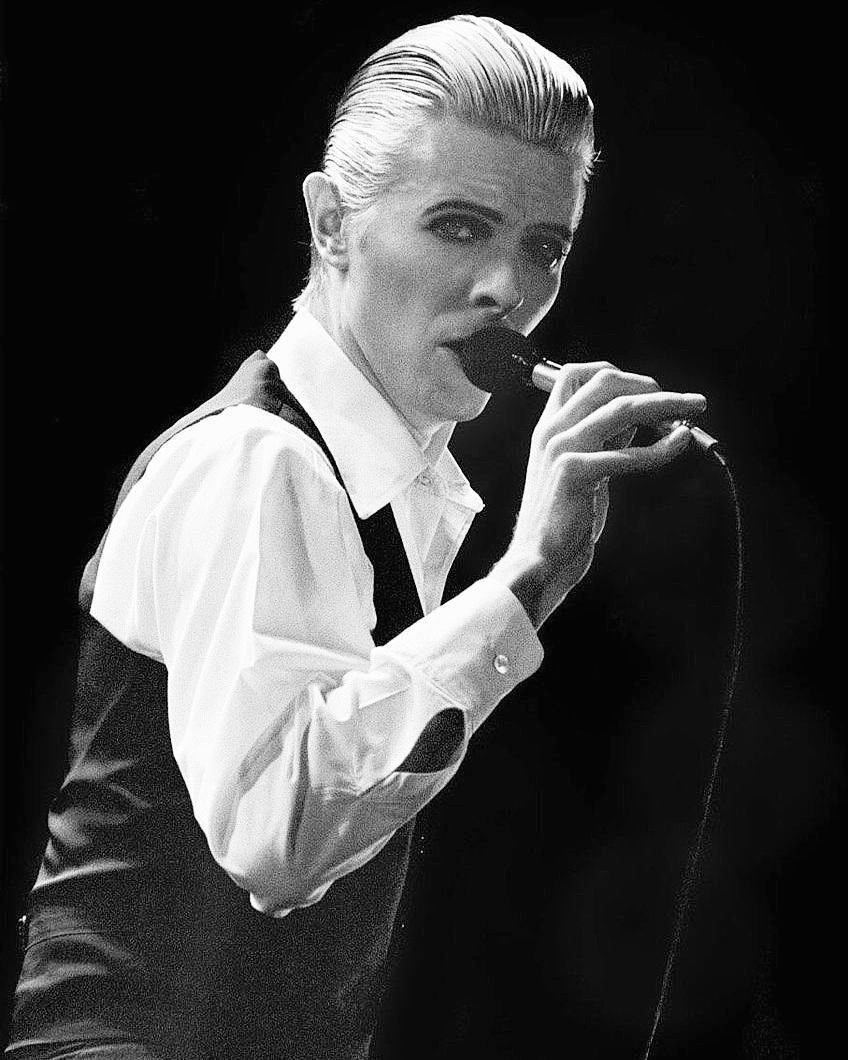
The Rolling Stones' 15th British album (and 17th American album) was recorded at the same time as Hunky Dory's Raw Power album, and it also marked the introduction of Bowie's new - and controversial - character, the Thin White Duke, an extension of Bowie's character Thomas Jerome Newton from The Man Who Fell to Earth, which was due out in March. By this point, Bowie was in the midst of a drug addiction, and it was even more obvious in an interview with Russell Harty for the latter's London Weekend Television talk show in anticipation for the release of Red and Black Blues.

MICK JAGGER: "Man, that interview David did with Russell was a mess. Dave looked like a fucking mess, his sanity was twisted over cocaine and he had lost a lot of weight." (1992)

KEITH RICHARDS: "The Thin White Duke? Seriously? I know there's a difference between the actor and the character they're playing, but it was hard to tell at the time if it really was David or the Duke. The Thin White Bowie, perhaps?" (2005)

Charlie Watts and Bill Wyman had no comment on the subject.

David Bowie performing live as the Thin White Duke, 1976.
Red and Black Blues reached #1 in the United States but stalled out at #2 in the United Kingdom. The first single released in January was a trimmed version of "Station to Station", backed with "Crazy Mama" (#33 US, #26 UK). The April single, "Hot Stuff" / "Golden Years" (#10 US, #8 UK), did much better, reaching the Top 10 on both sides of the Atlantic. Following the album's release was a tour lasting from February to May in Europe and North America, and on stage, Bowie portrayed the Thin White Duke with Jagger, Richards, Watts and Wyman portraying the Duke's White Counts.

The tour was successful, but the political controversy could not be ignored, especially after Bowie commented in Stockholm, Sweden, "Britain could benefit from a fascist leader," resulting in he and the rest of the Stones being detained by customs on the Russian/Polish border for possessing Nazi paraphernalia. Another incident took place in London when at Victoria station, a picture of Bowie waving to the crowd was taken and the resulting picture made it look as though he was greeting them with a Nazi salute. It was then later clarified that the photographer had caught Bowie in mid-wave.

The tour finally came to an end at the end of May; shortly afterward, Keith Richards and Anita Pallenberg ended up leaving Switzerland following the death of their infant son Tara Richards from respiratory failure. Charlie Watts, Bill Wyman, Mick and Bianca Jagger ended up returning to France, leaving Bowie to go alone to Switzerland, blaming his drug addictions and the Thin White Duke on his pro-fascist comments and behavior. Going even further back, he blamed his cocaine addiction on his time living in Los Angeles and later apologized for his statements.

During his time in Switzerland, Bowie found the time to pursue other interests outside his music career such as painting, producing a number of post-modernist pieces. It allowed Bowie the chance to refresh his mind following the Thin White Duke controversies, as it, along with Eric Clapton's drunken declaration of support for former Conservative Party minister Enoch Powell at a concert in Birmingham, eventually led to the formation of the political and cultural movement Rock Against Racism.

26 March 1976

The Yardbirds - Achilles' Last Stand
Released: 26 March 1976
Recorded: November - December 1975
Producer: Jimmy Page

Track listing[3]
Side A
Achilles' Last Stand
Candy Store Rock
Hots On for Nowhere
Royal Orleans

Side B
Nobody's Fault but Mine
For Your Life
Tea for One

After Robert Plant had suffered from a severe car accident, resulting in him being in a wheelchair for the time being, the Yardbirds were forced to cancel their American tour, due to start on August 23. The accident had inspired Plant to write up new lyrics for the band's twelfth album, and after making plans with Jimmy Page, they returned to the studio with John Bonham and John Paul Jones to begin work on their next album.

ROBERT PLANT: "At the time, we were tax exiles, and I had to recuperate from the car crash in France before heading to Malibu, California. When we did Achilles' Last Stand, I wanted to record in Munich, Germany given that they had state-of-the-art recording facilities." (1985)

JIMMY PAGE: "I took on a lot of responsibility during the recording sessions. I worked for hours on end when it came to recording and mixing, and it wasn't helped by the fact that we'd been booked into the studio just before the Rolling Stones were for the final sessions on Red and Black Blues. I had to negotiate with them just to borrow two days from their session time." (2007)

The rear cover to the Yardbirds' Achilles' Last Stand, released March 1976.
Most of Achilles' Last Stand was penned by Plant and Page, with "Royal Orleans" being written along with Jones and Bonham. The album marked a return to the band's hard rock sound that they became known for in the late 1960s to early 1970s, with no keyboards or acoustic guitars (barring "Candy Store Rock") in sight. During the sessions, Plant missed his family greatly and began to re-evaluate the priorities of his life, resulting in the Yardbirds going on hiatus for the rest of the year.

Like the five albums before it (barring Stairway to Heaven, which hit #2 in America), Achilles' Last Stand reached #1 in both the United States and the United Kingdom, but the sole single "Candy Store Rock" did not chart in either country. The album had received mixed reaction from fans and critics alike, with some critics suggesting that the Yardbirds' excesses have finally caught up with them. Since then, the album has gone on to be critical favorite.

Instead of a tour, the Yardbirds had completed the concert film The Song Remains the Same, featuring the shows recorded July 27-29 at Madison Square Garden, and released a soundtrack album to go along with the concert film. Both received mixed reviews from critics and the film pulled in $12 million at the box office. Sadly, it failed in the United Kingdom, where the band had not performed in the past two years due to their status as tax exiles. The concert film later gained newfound popularity as a document of the Yardbirds at their a newfound peak when it came out on DVD almost thirty years later.

It would be another year before the Yardbirds went on tour again, and another year after that before they returned to the studio to record their next album.

Footnotes
  1. Tracks are sourced from The Stooges' Raw Power, Lou Reed's Coney Island Baby, Kevin Ayers' Sweet Deceiver and The Confessions of Dr. Dream and Other Stories, Syd Barrett's The Madcap Laughs and Barrett, Robert Wyatt's Ruth is Stranger Than Richard and Rock Bottom, and David Bowie's Station to Station and Young Americans.
  2. Tracks are sourced from Station to Station and Black and Blue.
  3. All tracks from Presence are utilized and rearranged to have evenly-timed sides.
Author's Comments

At last, we've finally reached 1976, and there's quite a bit to talk about here. The backstory for Hunky Dory's Raw Power, once again, took influence from Auran's Gummaumma in which Lou Reed recorded a double album with only three sides' worth of music with the fourth featuring an engraving of a raised middle finger. Heh, I can only imagine how that would look for real.

Red and Black Blues has an interesting backstory to it; for an earlier draft, Freddie Mercury was part of the Rolling Stones instead of David Bowie, and the second side was as follows - "Somebody to Love", "Hey Negtria", "Good Old Fashioned Lover Boy", "Fool to Cry" and "Crazy Mama". I thought it followed surprisingly well, but as time went by, I felt that Freddie being part of the Stones didn't feel right, and so the backstory for both sides were heavily re-written so that Freddie had a solo career alongside Paul McCartney & Smile and David Bowie joined the Rolling Stones in 1969 instead of 1973/4. However, I still liked the title Red and Black Blues and so I reused that for the 1976 Bowie/Stones album and the cover of a roulette wheel with a bluish-purple tint worked really well.

Achilles' Last Stand was pretty easy to put together, mostly due to the small amount of material from that period, but trying to have evenly-timed sides wasn't easy to the length of the songs, but I still managed to keep the opening and closing tracks in their respective places. Oh, and for the first time, there's a back cover to one of the albums. The image I used could fill both the front and back and so I designed the back cover along with the front.

But now, we're getting close to the end of Phase Two, and all I can say is that there's going to be a very heavy emphasis on the Beatles for two of the upcoming chapters, with a third in the middle not relating to them.

Monday, February 17, 2020

Chapter 46: Over My Head (January 1974 - December 1975)

General Affairs for Apple Corps Ltd.
John Lennon and Peter Brown, 1975.
From a business perspective, 1974 had been rather uneventful, but by mid-1975, there were two lawsuits that Apple Corps had to deal with. The first was over the Ladders' "My Sweet Lord" plagiarizing the melody to the Chiffons' "He's So Fine", and the other was the Beatles' "Come Together" pinching a line from Chuck Berry's "You Can't Catch Me". Both were being handled by Apple vice-president Peter Brown, who had offered the estate of Ronnie Mack for Apple to purchase the rights to "He's So Fine", as well as having future pressings credit both George Harrison and Mack as writers to "My Sweet Lord". When Laurie Records, the Chiffons' label, got wind of this proposal, they offered to sell Apple the rights to the entire Chiffons catalog for the same amount of money (with the members' acknowledgement, of course), which soon resolved the matter; the Chiffons had even recorded a version of "My Sweet Lord" as a response to the controversy.

Convincing the owner of the publishing rights to Chuck Berry's catalog, Morris Levy, to drop his own lawsuit, however, was not an easy nut to crack. Frustrated that Levy was not going to easily let the matter drop, Brown brought this issue to the attention of John Lennon, who told Brown that, "I think it's high time that I got the band back together again," (1975) although at the time, his statement was very cryptic.

On the same day that John Lennon witnessed a playback to Freddie Mercury's "Bohemian Rhapsody", he explained to Paul McCartney about the "Come Together" vs. "You Can't Catch Me" lawsuit Morris Levy was placing upon Apple. "All this over one lyric," he fumed. "But since the end of 1970, when we... ahem, parted ways, people have been demanding that we put out at least one more album as a group."

"I think you're right," said Paul after a lengthy discussion. "Life's too short to hold a grudge like this. You can go see if George and Ringo are up to it."

When John approached the idea to the other former Beatles, Ringo had embraced the idea of a reunion album wholeheartedly, but George was far more reluctant, as out of the Beatles' relationships, his and Paul's was the most frosty. But then again, he had been through a plagiarism lawsuit himself and he would come off as a hypocrite if he didn't agree to it. "Just this one time," George insisted.

George Harrison meeting Bob Marley, 1975.
Meanwhile, Apple's relationship with EMI was falling apart. It began back in 1972 with Harrison had alleged that Capitol was not giving Apple's artists proper promotion in the United States, which led to the formation of Highway 61 Records, the American branch of Apple. All recordings released under Highway 61 were distributed internationally by Elektra Records, the decision which had caused EMI to balk; Apple's distribution deal with EMI would not end until the fall of 1975, and the former Beatles were artists under EMI until January 1976. Whilst EMI sought to renew their deals and keep the four most famous musicians in the world under their banner, Brown suspected during a meeting that EMI were underpaying royalties to Apple on records made either by the Ladders or Paul McCartney & Smile.

After he'd brought up the Levy lawsuit to Lennon, who then brought it up to the former Beatles, Brown focused on seeking other potential distributors for Apple. By the end of August, he had planned out the framework for a deal with Warner Brothers, who also owned Elektra Records. By that point, following Lennon and McCartney's meeting during the sessions for both Bohemian Rhapsody and A Night at the Rock Show, rumors of a Beatles reunion were beginning to circulate. Had they turned out to be true, then Brown would have a tremendous bargaining chip in his negotiations. If they were true, of course.

That September, the former Beatles put out a joint statement from Apple's press office that they would be returning to the studio in November to put out a reunion album for next year. This announcement was met with great excitement among millions of music fans around the world, and it even strengthened Brown's bargaining power. In a meeting on 3 October, the board members of Apple, including Lord Beeching, had approved of a new distribution plan with Warner Brothers which was extremely favorable for Apple, putting the empire on a unified distributor around the world. The best part of the deal was that Warner would act solely as distributor, so the Beatles could retain ownership over their recordings, marking the start of a new chapter in the histories of both the Beatles and Apple.

Paul McCartney in the recording studio with the other Beatles, 1975.
By the time EMI had attempted to rekindle negotiations with Apple, it was already too late, but they still made one last effort to get one more album out of the Beatles. They proposed to increase royalty on the Beatles' records that they owed, Apple would drop a potential lawsuit for underpayment and the Beatles would record one more album for EMI.

Already having to deal with the lawsuit from Morris Levy over "You Can't Catch Me", John Lennon was the first Beatle to be in favor of this proposal. Although the other three and Brown were initially skeptical about the proposal, they later reasoned that it would give the Beatles the opportunity to kill two birds with one stone; record the covers album which would provide them with increased back catalog royalties from EMI, and put an end to the lawsuit that was breathing down their necks. That opportunity was taken, and that November, with Dennis Wilson in the producer's chair, the Beatles began recording their first album together since 1970's Everest. It would not be released to the public until January 30, 1976; by then, the Beatles' deal with EMI would come to an end.

Whilst all the lawsuit matters were happening behind the scenes, Brian Epstein, Lord Beeching and Peter Brown put their focus upon expanding the Apple empire. After hearing about the purchase to the Chiffon's catalog, Paul McCartney made a proposal about expanding Apple's revenue by obtaining the rights to the catalogs of the likes of Buddy Holly and Carl Perkins, which was met very favorably. By the end of the decade, Apple would become one of the biggest independent music publishers in the world.

A screenshot from Monty Python and the Holy Grail, released under Apple Films 3 April 1975. From left to right; Eric Idle as Sir Robin, John Cleese as Sir Lancelot, Graham Chapman as King Arthur, Terry Jones and Sir Bedevere, and Michael Palin as Sir Galahad. Terry Gilliam also performs in the film as Patsy, Arthur's servant.
As exciting as business was for Apple in 1975, it was also an interesting year for its film division. Now being managed by Denis O'Brien, Apple Films saw the release of Little Malcolm, which was met with positive reception among critics. With Mel Brooks having already achieved commercial success with Blazing Saddles and Young Frankenstein, O'Brien had extended his contract to producing five films under Apple instead of three; by now, Brooks was working on his third film under Apple, Silent Movie, due for a release in the summer of 1976.

The other major film released under Apple was Monty Python and the Holy Grail, directed by Terrys Gilliam and Jones. Initially, critical reception was mixed, but over time, it became regarded as one of the greatest comedy films of all time. It even pulled in five million dollars in American money against a minimalist budget of 400 thousand. Around the time of the film's release, John Cleese was working on a sitcom based at a hotel run by its short-fused, easily frustrated owner Basil Fawlty and his bossy wife Sybil, portrayed by Prunella Scales. The cast would also include Cleese's then-wife Connie Booth (Polly) and German-British actor Andrew Sachs (Manuel).

Fawlty Towers was the first television program to be released under Apple Television, also handled by Dennis O'Brien, and premiered on BBC 2. The concept for the sitcom was influenced from a visit the Monty Python members had made to Gleneagles Hotel in Torquay, Devon, run by Donald Sinclair. When the members left the hotel due to Sinclair's behavior, a fascinated Cleese stayed behind in order to study him, and based the character of Basil Fawlty off of him. Fawlty Towers would later go on to be regarded as one of the most popular British sitcoms of all time; John Lennon himself would even call himself a fan of the show.

Meanwhile, Michael Lindsay-Hogg had met up with Alexander and Ilya Salkind, who had made negotiations with DC Comics for a film adaptation based upon their famous character Superman. Impressed by what he was reading, and having done some research on the character and DC Comics, Lindsay-Hogg offered the Salkinds and their partner Pierre Spengler to have Apple co-produce the film. After an extensive meeting with with Superman creators Jerry Siegel and Joe Shuster, as well as several DC executives, the tentatively titled Superman: The Movie would be jointly produced by Apple Films and the Salkinds. Right now, matters fell into finding a director for the film as well as actors to portray the characters of Jor-El, Lex Luthor and Superman himself.

Apple Corps Executives, December 1975
Managing Director and Chairman of the Board: Brian Epstein
Vice Presidents: Peter Brown, Lord Beeching
Director Communications: Derek Taylor
General Counsels: Lee and John Eastman[1]

Apple Records
President: Ron Kass[2]
Vice President: Jack Oliver[3]
Director of A&R: Roy Thomas Baker, later Mal Evans (temporary)
Director of Promotion and Marketing: Tony Bramwell[4]
Director of Design: Josh Kosh[5]
Studio Manager, Apple Studios: Geoff Emerick

Apple Films and Apple Television
President: Denis O'Brien
Other Notable Figures: Michael Lindsay-Hogg, Mel Brooks, John Cleese, Terry Jones

Apple Management
Director: Neil Aspinall
Associate Director: Mal Evans

Apple Publishing
Director: Alistair Taylor

Highway 61 Records
President: Jack Oliver
Vice President: Chris O'Dell[6]
Directors of A&R: Pete Ham, Dennis Wilson

The Artists of Apple Records

Old Signings
The band members of Fleetwood Mac, 1975.
When Badfinger broke up prior to the release of Head First, each of the members went on a different path. Pete Ham went on to become a producer and one of the joint directors of A&R for Highway 61 Records, Mike Gibbins became the new drummer for Crosby, Stills, Nash & Young, and Tom Evans left Apple altogether to become part of the group Utopia, fronted by Todd Rundgren. But what about Joey Molland? Following Badfinger's dissolution, he stayed at home wondering what he'd do until he got a phone call from Jeff Lynne, asking if he'd like to join the Electric Light Orchestra as a touring member, to which Molland agreed, especially upon the departure of Roy Wood.

Badfinger's split seemed to mark the end of an era for Apple Records when Jackie Lomax also departed the label at the start of 1975, having not recorded new material since 1972. James Taylor had put out Walking Man in 1974, but it was a critical and commercial disappointment. Fortunately, he made a comeback with Gorilla the following year, backed by a cover version of "How Sweet It Is (To Be Loved by You)". Billy Preston's fortunes were opposite to that of Taylor, having made a #1 hit on both sides of the Atlantic with "Nothing from Nothing" from The Kids & Me, but his follow-up, It's My Pleasure, had no hit singles.

After Heroes Are Hard to Find was a minor hit in America, Fleetwood Mac would experience a re-resurgence in commercial success when the band brought in Lindsey Buckingham and Stevie Nicks  following the departure of Bob Welch. Their second self-titled album, released 1975, reached #1 in America, backed by the single "Over My Head", written and sung by Christine McVie, ending the dry spell on the American charts. "Rhiannon" and "Say You Love Me" would be released as singles the following year.

Eric Clapton performing live, 1974.
Eric Clapton also had a resurgence as a commercial force with 461 Ocean Boulevard, its lead single being a cover of Bob Marley's "I Shot the Sheriff", becoming his only #1 hit in America. There's One in Every Crowd, however, was not as successful. Michael Jackson's contract with Motown Records would soon reach an end with Forever, Michael and its lead single "Just a Little Bit of You". Within the next few years, he would be a full-time artist for Apple Records. Unlike Nazareth, however, who had left Apple Records following the release of Hair of the Dog, their most successful album to date.

Splinter's debut album, The Place I Love, achieved success in their home country the United Kingdom, but alongside the lead single "Costafine Town", it was largely ignored by American listeners. It was the same result with Harder to Live and its lead single "Lonely Man". Vangelis' only major release of 1974-75 was Heaven and Hell.

Elton John's musical streak in America continued with Caribou, Captain Fantastic and the Brown Dirt Cowboy and Rock of the Westies. The "Candle in the Wind"/"Bennie and the Jets" double A-side from Goodbye Yellow Brick Road in 1973 also hit #1 in 1974, as had "Don't Let the Sun Go Down on Me" and "Lucy in the Sky with Diamonds" in the same year, and "Philadelphia Freedom" and "Island Girl" in 1975. "The Bitch is Back" and "Someone Saved My Life Tonight" were also Top 5 hits in America.

With Apple Records' roster shrinking, it looked as though it had reached the point of stagnation, with A&R Roy Thomas Baker partially to blame, mostly focusing on Nazareth, Paul McCartney & Smile and Freddie Mercury. Perhaps it was for the best that he resigned his post and focused on those he produced for; Mal Evans took on temporary A&R management until a permanent replacement for Baker was found.

New Signings
The only new signing of the 1974-75 period was Jimmy McCulloch, a touring member for Paul McCartney & Smile. His debut single was currently being worked on for a 1976 release.

The Artists of Highway 61 Records

Old Signings
Bob Dylan, 1975.
The period of 1974-75 was an interesting one for Highway 61 Records; Bob Dylan had put out Planet Waves (a collaboration with The Band) and Blood on the Tracks, the latter of which has since been regarded as one of his greatest albums. Stackridge had also achieved success with The Man in the Bowler Hat, produced by former Beatles producer George Martin, but less so with Extravaganza. Aerosmith, meanwhile, had newfound success with Get Your Wings and Toys in the Attic, producing hits such as "Same Old Song and Dance", "Sweet Emotion" and "Walk This Way". Lynyrd Skynyrd also found success with their single "Sweet Home Alabama" from Second Helping, a response to Neil Young's "Southern Man" and "Alabama".

The other artists under Highway 61 Records included Ravi Shankar, Kiki Dee, Tom Scott, the L.A. Express, Cliff Richard, and Dave Edmunds and Peter Tork taking on producing duties. Although they were fine artists, they were not hit makers nor were they capable of creating commercial music.

New Signings
Alice Cooper in from his 1975 concert Alice Cooper: Welcome to My Nightmare, released under Apple Films.
Apple's roster may have stagnated and shrunk down to those who were making commercial music, but its sister label had experienced great growth in 1974 and 1975; Elton John's drummer Nigel Olsson had put out an album of his own, and pop singer Neil Sedaka had also been picked up by the label. Elton's other contribution was helping to sign up Dutch prog rock band Solution who put out their first album under Highway 61, Cordon Bleu, in 1975.

Outside of Tom Petty & Mudcrutch, the remaining artists signed up for 1974 included Alice Cooper (real name Vincent Damon Furnier) following the dissolution of his band to begin his solo career, Tina Turner, Ronnie Wood, and Supertramp after they were dropped by their previous label, A&M Records. They had a career revival with their single "Dreamer" / "Bloody Well Right", produced with Ken Scott. Cooper's Welcome to My Nightmare and its singles were also successful.

The following year, other established artists including Dr. John, Genesis, Harry Nilsson, Rod Stewart and Blue Öyster Cult (after leaving Columbia Records) all found themselves on Highway 61 Records. All barring Nilsson were signed up by Dennis Wilson, who had since become an indispensable part of the label. When Pete Ham became A&R for Highway 61, he had signed up Canadian female-fronted band Heart and produced their debut album Dreamboat Annie. His other signings were Patti Smith and the Ramones, and he took interest in signing up the Talking Heads as well. Having seen the problems Apple had with an aging roster, Ham (with help from Wilson) decided to try and discover new, young artists for Highway 61.

Stephen Stills performing live, 1975.
One other signing to Highway 61 was Boxer, fronted by Mike Patto and Ollie Halsall, under David Bowie's suggestion. The remaining members of Hunky Dory also expressed interest in signing onto the label upon seeing its growth.

Like Neil Young, Stephen Stills had been interested in putting out solo albums on Highway 61 Records alongside their work as part of Crosby, Stills, Nash & Young. His fourth solo album, Turn Back the Pages, was produced with his good friend Peter Tork and included outtakes from early 1970s CSNY sessions that didn't make previous albums.

Apple Records discography, January 1974 - December 1975

Albums
  • Badfinger by Badfinger - 1 February 1974 (#10 UK, #54 US)
  • Rampant by Nazareth - 26 April 1974 (#13 UK, #94 US)
  • The Kids & Me by Billy Preston - 5 May 1975 (#1 UK and US)
  • Monkey Grip by Bill Wyman - 13 May 1974 (#39 UK, #99 US)
  • The Diamond Dogs of Rock 'n' Roll by The Rolling Stones - 24 May 1974 (#1 UK and US)
  • Walking Man by James Taylor - 7 June 1974 (#13 US)
  • Caribou by Elton John - 28 June 1974 (#1 UK and US)
  • 461 Ocean Boulevard by Eric Clapton - 12 July 1974 (#3 UK, #1 US)
  • The Falcons of El Dorado by Electric Light Orchestra - 6 September 1974 (#19 UK, #16 US)
  • Heroes Are Hard to Find by Fleetwood Mac - 13 September 1974 (#28 US)
  • The Place I Love by Splinter - 20 September 1974 (#16 UK)
  • Band on the Run by Paul McCartney & Smile - 4 October 1974 (#1 UK and US) [EMI]
  • Killer Queen by Freddie Mercury - 8 November 1974 (#3 UK) [extended play]
  • Dark Horse by The Ladders - 15 November 1974 (#13 UK, #4 US) [EMI]
  • Hawaiian Sunrise by Crosby, Stills, Nash & Young - 6 December 1974 (#2 UK, #6 US)
  • Head First by Badfinger - 10 January 1975 (#39 UK)
  • Sweet Thing by David Bowie - 17 January 1975 (#5 UK, #3 US)
  • Forever, Michael by Michael Jackson - 31 January 1975 (#92 US) [Motown]
  • Young Americans by The Rolling Stones - 7 March 1975 (#2 UK, #9 US)
  • There's One in Every Crowd by Eric Clapton - 21 March 1975 (#15 UK, #21 US)
  • Hair of the Dog by Nazareth - 30 April 1975 (#8 UK, #17 US)
  • Captain Fantastic and the Brown Dirt Cowboy by Elton John - 19 May 1975 (#1 UK and US)
  • Gorilla by James Taylor - 26 May 1975 (#47 UK, #6 US)
  • Human Highway by Crosby, Stills, Nash & Young - 20 June 1975 (#1 UK and US)
  • Harder to Live by Splinter - 4 July 1975 (#12 UK)
  • Fleetwood Mac by Fleetwood Mac - 11 July 1975 (#14 UK, #1 US)
  • It's My Pleasure by Billy Preston - 18 July 1975 (#23 UK, #10 US)
  • Goodnight Vienna by The Ladders - 25 July 1975 (#6 UK, #8 US) [EMI]
  • Rock of the Westies by Elton John - 24 October 1975 (#5 UK, #1 US)
  • A Night at the Rock Show by Paul McCartney & Smile - 31 October 1975 (#1 UK and US) [EMI]
  • Bohemian Rhapsody by Freddie Mercury - 21 November 1975 (#1 UK, #4 US)
  • Heaven and Hell by Vangelis - 12 December 1975 (#30 UK)
Notable Singles
  • "I Miss You" / "Shine On" by Badfinger - 4 February 1974 (#17 UK)
  • "Candle in the Wind" & "Bennie and the Jets" by Elton John - 4 February 1974 (#8 UK, #1 US)
  • "Rebel Rebel" / "Time Waits for No One" by The Rolling Stones - 18 February 1974 (#5 UK, #12 US)
  • "Shanghai'd in Shanghai" / "Love, Now You're Gone" by Nazareth - 25 March 1974 (#33 UK)
  • "Don't Let the Sun Go Down on Me" / "Sick City" by Elton John - 20 May 1974 (#9 UK, #1 US)
  • "Helen Wheels" / "Picasso's Last Words (Drink to Me)" by Paul McCartney & Smile - 14 June 1974 (#10 UK, #9 US) [EMI]
  • "It's Only Rock 'n' Roll" / "Diamond Dogs" by The Rolling Stones - 28 June 1974 (#10 UK, #16 US)
  • "I Shot the Sheriff" / "Give Me Strength" by Eric Clapton - 15 July 1974 (#9 UK, #1 US)
  • "Nothing from Nothing" / "My Soul is a Witness" by Billy Preston - 5 August 1975 (#1 UK and US)
  • "Rock and Roll Winter" / "Illusions in G Major" by Electric Light Orchestra - 12 August 1974 (#6 UK)
  • "The Bitch is Back" / "Cold Highway" by Elton John - 2 September 1974 (#10 UK, #2 US)
  • "Silver Train" / "1984" by The Rolling Stones - 9 September 1974 (#7 UK, #18 US)
  • "Costafine Town" / "Elly-May" by Splinter - 16 September 1974 (#17 UK)
  • "Whatever Gets You thru the Night" & "Snookeroo" by The Ladders w/ Elton John - 23 September 1974 (#23 UK, #1 US) [EMI]
  • "Band on the Run" / "Now I'm Here" by Paul McCartney & Smile - 7 October 1974 (#2 UK, #1 US) [EMI]
  • "Killer Queen" / "Stone Cold Crazy" by Freddie Mercury - 21 October 1974 (#1 UK, #10 US)
  • "Oh My My" / "Maya Love" by The Ladders - 8 November 1974 (#3 UK, #5 US) [EMI]
  • "Love Hurts" / "Hair of the Dog" by Nazareth - 8 November 1974 (#20 UK, #8 US)
  • "Lucy in the Sky with Diamonds" / "One Day (At a Time)" by Elton John - 18 November 1974 (#10 UK, #1 US)
  • "Can't Get It Out of My Head" / "Are You Ready to Rock" by Electric Light Orchestra - 18 November 1974 (#8 UK, #6 US)
  • "Willie and the Hand Jive" / "Mainline Florida" by Eric Clapton - 25 November 1974 (#26 US)
  • "Ding Dong, Ding Dong" / "Rock and Roll People" by The Ladders - 6 December 1974 (#35 UK, #30 US) [EMI]
  • "Lay Me Down" / "Queen of Darkness" by Badfinger - 6 January 1975 (#35 UK)
  • "Jet" / "Sally G" by Paul McCartney & Smile - 27 January 1975 (#7 UK and US) [EMI]
  • "Drink All Day (Got to Find Your Own Way Home)" / "China Light" - 7 February 1975 (#35 UK)
  • "Fool to Cry" / "Young Americans" by The Rolling Stones - 17 February 1975 (#6 UK, #10 US)
  • "Philadelphia Freedom" / "I Saw Her Standing There" by Elton John - 24 February 1975 (#7 UK, #1 US)
  • "Junior's Farm" / "Walking in the Park with Eloise" by Paul McCartney & Smile - 14 March 1975 (#4 UK, #1 US) [EMI]
  • "Hair of the Dog" / "My White Bicycle" by Nazareth - 28 March 1975 (#14 UK, #6 US)
  • "Carry Me" / "Myth of Sisyphus" by Crosby, Stills, Nash & Young - 5 May 1975 (#9 UK, #5 US)
  • "Swing Low, Sweet Chariot" / "Pretty Blue Eyes" by Eric Clapton - 12 May 1975 (#19 UK)
  • "Goodnight Vienna" / "The Answer's at the End" by The Ladders - 19 May 1975 (#23 UK, #10 US) [EMI]
  • "Just a Little Bit of You" / "We're Almost There" by Michael Jackson - 9 June 1975 (#46 UK, #23 US)
  • "Lonely Man" / "Green Line Bus" by Splinter - 16 June 1975 (#18 UK)
  • "How Sweet It Is (To Be Loved by You)" / "Sarah Maria" by James Taylor - 16 June 1975 (#28 UK, #5 US)
  • "Someone Saved My Life Tonight" / "House of Cards" by Elton John - 23 June 1975 (#17 UK, #4 US)
  • "Fame" / "Worried About You" by The Rolling Stones - 7 July 1975 (#17 UK, #1 US)
  • "As I Come of Age" / "Grave Concern" by Crosby, Stills, Nash & Young - 1 August 1975 (#20 UK, #12 US)
  • "You" / "Beef Jerky" by The Ladders - 15 August 1975 (#20 UK, #15 US) [EMI]
  • "Knockin' on Heaven's Door" / "Someone Like You" by Eric Clapton - 22 August 1975 (#38 UK)
  • "Rattlesnake Roll" / "Strange Magic" by Electric Light Orchestra - 25 August 1975 (#38 UK, #14 US)
  • "Over My Head" / "I'm So Afraid" by Fleetwood Mac - 8 September 1975 (#20 US)
  • "Island Girl" / "Sugar on the Floor" by Elton John - 29 September 1975 (#14 UK, #1 US)
  • "Human Highway" / "Homeward Through the Haze" by Crosby, Stills, Nash & Young - 20 October 1975 (#26 UK, #8 US)
  • "I'm in Love with My Car" / "Magneto and Titanium Man" by Paul McCartney & Smile - 27 October 1975 (#1 UK, #3 US) [EMI]
  • "Listen to What the Man Said" / "My Carnival" by Paul McCartney & Smile - 5 December 1975 (#5 UK, #1 US) [EMI]
  • "Bohemian Rhapsody" & "You're My Best Friend" by Freddie Mercury - 1 December 1975 (#1 UK, #7 US)
  • "Evil Woman" / "Indiana Rainbow" by Electric Light Orchestra - 8 December 1975 (#10 UK and US)
Highway 61 Records discography, January 1974 - December 1975

Albums
  • Planet Waves by Bob Dylan and The Band - 17 January 1974 (#7 UK, #1 US)
  • Tonight's the Night by Neil Young - 25 January 1974 (#35 UK, #11 US)
  • The Man in the Bowler Hat by Stackridge - 1 February 1974 (#23 UK)
  • Tom Scott and The L.A. Express by Tom Scott and The L.A. Express - 15 February 1974
  • Get Your Wings by Aerosmith - 15 March 1974 (#15 US)
  • Second Helping by Lynyrd Skynyrd - 15 April 1974 (#7 US)
  • Laughter in the Rain by Neil Sedaka - 29 April 1974 (#17 UK)
  • On the Beach by Neil Young - 19 July 1974 (#42 UK, #16 US)
  • I've Got the Music in Me by Kiki Dee - 26 July 1974
  • Tina Turns the Country On! by Tina Turner - 9 August 1974
  • Crime of the Century by Supertramp - 13 September 1974 (#4 UK, #38 US)
  • I've Got My Own Album to Do by Ronnie Wood - 13 September 1974 (#27 UK)
  • Shankar Family & Friends by Ravi Shankar - 20 September 1974
  • The 31st of February Street by Cliff Richard - 22 November 1974
  • Nigel Olsson by Nigel Olsson - 3 January 1975
  • Extravaganza by Stackridge - 10 January 1975
  • Blood on the Tracks by Bob Dylan - 17 January 1975 (#4 UK, #1 US)
  • Tom Cat by Tom Scott and The L.A. Express - 7 February 1975
  • Welcome to My Nightmare by Alice Cooper - 11 March 1975 (#15 UK, #2 US)
  • Turn Back the Pages by Stephen Stills - 17 March 1975 (#19 US)
  • Nuthin' Fancy by Lynyrd Skynyrd - 24 March 1975 (#43 UK, #9 US)
  • Toys in the Attic by Aerosmith - 8 April 1975 (#3 US)
  • Homegrown by Neil Young - 11 April 1975 (#7 UK, #9 US)
  • Subtle as a Flying Mallet by Dave Edmunds - 25 April 1975
  • The Basement Tapes by Bob Dylan - 26 June 1975 (#8 UK, #7 US)
  • Now Look by Ronnie Wood - 2 July 1975 (#118 US)
  • Acid Queen by Tina Turner - 1 August 1975 (#115 US)
  • Atlantic Crossing by Rod Stewart - 15 August 1975 (#1 UK, #9 US)
  • Tom Petty & Mudcrutch by Tom Petty & Mudcrutch - 15 August 1975 (#87 US)
  • Duit on Mon Dei by Harry Nilsson - 5 September 1975 (#141 US)
  • Crisis? What Crisis? by Supertramp - 14 September 1975 (#20 UK, #44 US)
  • Dreamboat Annie by Heart - 19 September 1975 (#36 UK, #7 US)
  • Overnight Success by Neil Sedaka - 25 October 1975
  • Horses by Patti Smith - 10 November 1975 (#157 UK, #47 US)
  • Cordon Bleu by Solution - 24 November 1975
  • New York Connection by Tom Scott - 8 December 1975 (#42 US)
Notable Singles
  • "On a Night Like This" / "Something There is About You" by Bob Dylan - 5 March 1974 (#44 US)
  • "Same Old Song and Dance" / "Pandora's Box" by Aerosmith - 19 March 1974 (#25 US)
  • "Sweet Home Alabama" / "Don't Ask Me No Questions" by Lynyrd Skynyrd - 24 June 1974 (#31 UK, #8 US)
  • "I've Got the Music in Me" / "Simple Melody" by Kiki Dee - 26 July 1974 (#19 UK, #12 US)
  • "Walk On" / "For the Turnstiles" by Neil Young - 5 August 1974 (#60 US)
  • "I Am Missing You" / "Lust" by Ravi Shankar - 13 September 1974
  • "(You Keep Me) Hangin' On" / "It's Only Me You Left Behind" by Cliff Richard - 16 September 1974 (#13 UK)
  • "Laughter in the Rain" / "Kiddio" by Neil Sedaka - 7 October 1974 (#15 UK, #1 US)
  • "Dreamer" / "Bloody Well Right" by Supertramp - 14 October 1974 (#13 UK, #35 US)
  • "S.O.S. (Too Bad)" / "Lord of the Thighs" by Aerosmith - 21 October 1974 (#31 US)
  • "Only One Woman" / "Get It Up for Love" by Nigel Olsson - 16 December 1974 (#91 US)
  • "Tangled Up in Blue" / "If You See Her, Say Hello" by Bob Dylan - 6 January 1975 (#31 US)
  • "Only Women Bleed" / "Cold Ethyl" by Alice Cooper - 7 April 1975 (#7 US)
  • "Baby, Get It On" / "Under My Thumb" by Ike & Tina Turner - 28 April 1975 (#53 UK, #80 US)
  • "Sweet Emotion" / "Uncle Salty" by Aerosmith - 5 May 1975 (#10 US)
  • "Saturday Night Special" / "Made in the Shade" by Lynyrd Skynyrd - 19 May 1975 (#27 US)
  • "Depot Street" / "Wild Eyes" by Tom Petty & Mudcrutch - 30 June 1975 (#55 US)
  • "(You Don't Know) How Glad I Am" / "Once a Fool" by Kiki Dee - 14 July 1975 (#33 UK, #74 US)
  • "Magic Man" / "How Deep It Goes" by Heart - 28 July 1975 (#9 US)
  • "Sailing" / "Stone Cold Sober" by Rod Stewart - 4 August 1975 (#1 UK, #58 US)
  • "Walk This Way" / "Round and Round" by Aerosmith - 28 August 1975 (#6 US)
  • "Don't Do Me Like That" / "Lost in Your Eyes" by Tom Petty & Mudcrutch - 8 September 1975 (#38 UK, #17 US)
  • "Bad Blood" / "The Immigrant" by Neil Sedaka - 22 September 1975 (#1 US)
  • "Welcome to My Nightmare" / "Department of Youth" by Alice Cooper - 6 October 1975 (#26 US)
  • "You See Me Crying" / "Toys in the Attic" by Aerosmith - 11 November 1975 (#18 US)
  • "This Old Heart of Mine" / "All in the Name of Rock 'n' Roll" by Rod Stewart - 18 November 1975 (#4 UK, #83 US)
  • "Hurricane" / "Hurricane (Part II)" by Bob Dylan - 25 November 1975 (#43 UK, #33 US)
  • "Dreamboat Annie" / "Here Song" by Heart - 1 December 1975 (#17 US)
Apple Artists, as of December 1975
  • The Beatles (since 1968; contracted to EMI)
    • George Harrison, John Lennon and Ringo Starr as The Ladders (since 1970)
    • Paul McCartney (since 1971; affiliated with Smile since 1972)
  • Eric Clapton (since 1968; member of Cream 1968-1971)
  • Crosby, Stills, Nash & Young (since 1968)
    • Stephen Stills & Manassas (1971-1973; solo album released on Highway 61 Records 1975)
    • Neil Young (1971; solo works released on Highway 61 Records since 1973)
    • David Crosby and Graham Nash as Crosby & Nash (since 1972)
  • Electric Light Orchestra (since 1970)
  • Fleetwood Mac (since 1968)
  • Michael Jackson (since 1971; contracted to Motown)
  • Elton John (since 1969)
  • Jimmy McCulloch (since 1975)
  • Freddie Mercury (since 1973)
  • Billy Preston (since 1969)
  • The Rolling Stones (since 1970)
    • David Bowie (since 1971)
    • Bill Wyman (1974)
  • Smile (since 1969; affiliated with Paul McCartney since 1972)
  • Splinter (since 1973)
  • James Taylor (since 1968)
  • Vangelis (since 1972; member of Aphrodite's Child 1967-1972)
Departed Apple Artists
  • Aphrodite's Child (1970-1972)
  • Badfinger (1968-1975)
  • Brute Force (1969)
  • Delaney & Bonnie (1969-1972)
  • Cream (1968-1971)
  • Chris Hodge (1972-1973)
  • Mary Hopkin (1968-1972)
  • Hot Chocolate (1969)
  • Radha Krishna Temple (1969)
  • Jackie Lomax (1968-1975)
  • Nazareth (1972-1975)
  • Yoko Ono (1969-1973)
  • Ronnie Spector (1971-1972)
  • The Sundown Playboys (1972)
  • White Trash (1969)
  • Doris Troy (1969-1971)
  • Lon and Derrek Van Eaton (1972-1973)
Highway 61 Artists, as of December 1975
  • Aerosmith (since 1973)
  • Blue Öyster Cult (since 1975)
  • Boxer (since 1975)
  • Alice Cooper (since 1974)
  • Kiki Dee (since 1973)
  • Dr. John (since 1975)
  • Bob Dylan (since 1973)
  • Dave Edmunds (since 1973)
  • Genesis (since 1975)
  • Heart (since 1975)
  • L.A. Express (since 1973)
  • Lynyrd Skynyrd (since 1973)
  • Harry Nilsson (since 1975)
  • Nigel Olsson (since 1974)
  • Tom Petty & Mudcrutch (since 1974)
  • Ramones (since 1975)
  • Cliff Richard (since 1973)
  • Neil Sedaka (since 1974)
  • Tom Scott (since 1973)
  • Ravi Shankar (since 1973)
  • Patti Smith (since 1975)
  • Solution (since 1974)
  • Stackridge (since 1973)
  • Rod Stewart (since 1975)
  • Stephen Stills (since 1975)
  • Supertramp (since 1974)
  • Peter Tork (since 1973)
  • Tina Turner (since 1974)
  • Dennis Wilson (since 1975)
  • Ronnie Wood (since 1974)
  • Neil Young (since 1973)

Various Artists - The Best of Apple Records Vol. 4: 1974-1975
Released: 22 May 2009
Recorded: 1973-1975
Producer: Various

Track listing
I Miss You [Badfinger]
Rebel Rebel [The Rolling Stones]
I Shot the Sheriff [Eric Clapton]
Nothing from Nothing [Billy Preston]
Costafine Town [Splinter]
Whatever Gets You thru the Night [The Ladders]
Band on the Run [Paul McCartney & Smile]
Can't Get It Out of My Head [Electric Light Orchestra]
Philadelphia Freedom [Elton John]
Hair of the Dog [Nazareth]
Carry Me [Crosby, Stills, Nash & Young]
Just a Little Bit of You [Michael Jackson]
How Sweet It Is (To Be Loved by You) [James Taylor]
Over My Head [Fleetwood Mac]
Bohemian Rhapsody [Freddie Mercury]

The fourth Best of Apple compilation was also seen as the last of what would be known as "the EMI years". In reflection upon the label's then-stagnating roster, the overall length of the album was just short of an hour with just fifteen songs. It reached #3 in the United States and #2 in the United Kingdom after it was released.

Footnotes
  1. Lee and John Eastman were Linda's father and brother, respectively. Both represented Paul McCartney whilst Allen Klein managed John Lennon, George Harrison and Ringo Starr. Eastman and son later managed McCartney during his solo career.
  2. Ron Kass was president of Apple Records from 1968-1969 before being forced out by Klein through false allegations of "financial impropriety". Prior to being president of Apple, Kass was president of Liberty Records during its time as an independent label.
  3. Jack Oliver was Kass' successor as head of Apple Records up to 1971. He too was forced out by Klein.
  4. Tony Bramwell was an NEMS employee, the original head of Apple Films and briefly the CEO of Apple Records. Following his departure from Apple, he worked on various James Bond films and even worked at Polydor promoting many artists such as the Bee Gees.
  5. John Kosh was a designer who was hired as creative director in either 1968 or 1969. He was responsible for the design of the cover to Abbey Road and several other albums by Apple artists. He also designed covers for Bob Dylan, ELO, Rod Stewart, Linda Ronstadt, among others.
  6. Chris O'Dell was an Apple employee who worked as an assistant to the Beatles, Derek and the Dominos, the Rolling Stones, Bob Dylan and Santana, among other artists. She was also the inspiration for the George Harrison B-side "Miss O'Dell", backed with "Give Me Love (Give Me Peace on Earth)".
Author's Comments

Wow, that chapter was way longer than I envisioned! In fact, the listings for the Apple and Highway 61 discographies and the rosters for both take up well over half the chapter itself! Mind you, a lot of this is all super-nerdy stuff. I may even have to make individual pages for discographies of albums and singles so they can each be in one place all at once. Perhaps for future Apple overviews like this, I'll just describe what artists had successes and/or failures during that period and then link you to the discography pages.

But finally, at long last, we come to the end of 1975 and we look forward to the start of 1976. It's amazing that since the blog began, a little over a year ago, we've covered an entire decade - from December 1965 all the way up to December 1975, and we're not even close to approaching Live Aid in 1985. Only a few more chapters to go before Phase Two comes to an end...